A stretch of Oxford Street has become fully pedestrianised and closed to traffic.
Half of the 1.2 mile world-famous high street is now vehicle free, diverting buses, taxis and bikes to nearby roads.
The change comes in time for the run-up to Christmas on one of the world's busiest shopping areas.
Oxford Street produces an annual spend of around £3.1 billion and receives roughly half a million visitors each day.
The project is expected to cost about £150m, which includes the cost of highway changes.
Here is everything you need to know about the plans to transform Oxford Street.

Where will be pedestrianised?
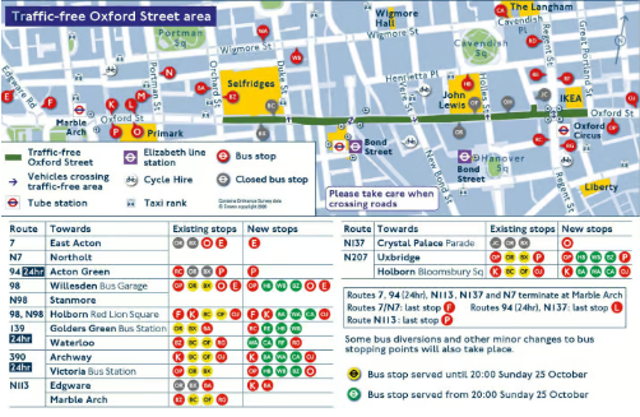
Almost a kilometer (0.6 mile) stretch between Orchard Street and Great Portland Street is closed to traffic as of 26 October.
The traffic ban stretches from the world famous Selfridges to Ikea, covering John Lewis and other high street favourites.
The area will be closed to traffic between 7am and midnight on every day of the week.
That means all deliveries will need to be made outside of these hours.
Why have cars and buses been banned?
While Oxford Street has been pedestrianised for short periods before, this is the first time it is becoming a pedestrian only space permanently.
Transport for London (TfL) says the changes will help create a safer and more spacious place in the heart of the capital.
London mayor Sadiq Khan has envisaged the street becoming a space to “host world-class events, from sport to culture and fashion, as well as exciting new retail and leisure experiences.”

“For centuries, Oxford Street has reinvented itself, adapting to changing times and helping shape British culture along the way,” he said.
“There has been talk of pedestrianising Oxford Street for decades. After so many false dawns, and now working with a government who share the scale of my ambition, I’m proud that we’re finally unlocking a new era for the street.”
What does it mean for public transport?
Several bus routes that normally go down Oxford Street have been diverted, while some routes have been given alternative bus stops.
Bus routes 98, 139, 390 , N98 and N207 will be diverted and use new bus stops on Wigmore Street, Henrietta Place and Cavendish Place.
Routes 7, N7, 94, N113 and N137 will terminate near Marble Arch.
There will also be some changes to bus routes 2, 13, 73, 74, 113, 159, 189, 274, N2, N8, N15, N25, N73, N74, N109, N136.
The new bus stops will be placed about 200m away from Oxford Street and taxi ranks will be just 100m away.
What does it mean for emergency services and the safety of pedestrians?
Emergency services will still have access to the street at all times using the cross streets.
Although taxis, buses and bikes are banned mobility scooters will still be allowed.
Barriers will be fixed in areas where traffic could cross Oxford Street and street lighting and CCTV may be changed to keep pedestrians safe.
Will there be new green spaces?
By the end of spring 2027, it is hoped there will be 50 new trees and more than 100 new seats installed.
The road surface will also be raised along two sections of the road to create public squares that could be used for events.