Morning opening: Serbia wakes up to new reality after Vučić
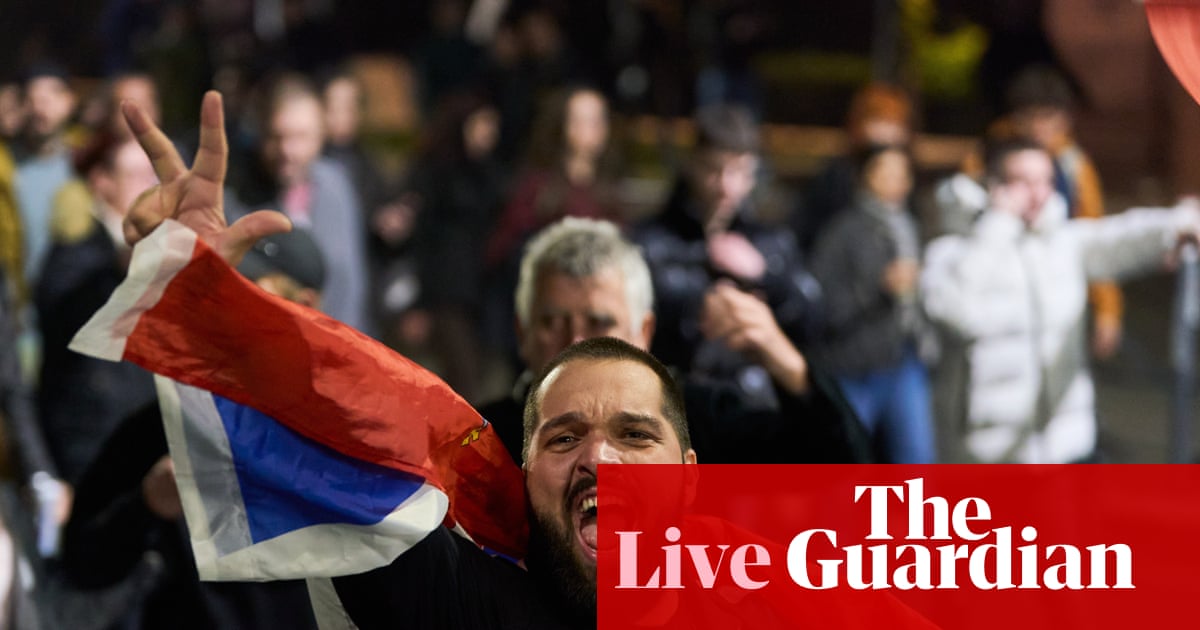
Serbia wakes up to a new reality this morning after a grassroots opposition movement led by students ousted the country’s former authoritarian president Aleksandar Vučić, raising hopes for a new opening in relations with the EU and other partners.
Opposition supporters celebrate at the parliament building after Aleksandar Vučić, represented by the silhouette, conceded defeat in the parliamentary election in Belgrade, Serbia. Photograph: Marko Đurica/Reuters
The latest CeSID projection suggested the students will have 140 seats in the new parliament, well clear of the 126 required for majority, with 103 for Vucic’s bloc. No other party crossed the 3% threshold, with national minority parties taking the remaining seven seats.
We are likely to get more reactions to the vote today, with international observers set to present their preliminary report on the vote in the early afternoon.
I will also pick up the latest on the first round of the presidential vote in Bulgaria, which saw a record-low turnout of just 22%. The second round will be held this Sunday.
Elsewhere, I will be looking for updates from France and Italy after another rocky weekend of protests. French PM Sébastien Lecornu is going to meet with the student unions in the afternoon for what could be pivotal talks on the future of the demonstrations.
And E5 defence ministers – that’s France, Germany, Italy, Poland, and the UK – are meeting in Paris for discussions on Ukraine. Oh, and Slovakia’s foreign minister Juraj Blanár is in Moscow for energy talks with Russia.
It’s Monday, 26 October 2026, it’s Jakub Krupa here, and this is Europe Live.
CRTA’s Raša Nedeljkov is currently presenting the organisation’s preliminary findings on last night’s elections, with a long list of reasons and issues that essentially make the Student List’s win against the incumbents even more impressive.
A drone view shows people queueing outside a polling station to vote during the parliamentary election in Belgrade, Serbia. Photograph: Marko Đurica/Reuters
He says that “systemic manipulation at the polling stations was largely prevented” by the record-high number of domestic observers – up to 15,000, three times more than in 2023 – and usual citizens getting involved in running polling stations.
He says international observers also played a role in the process, but they had a “different role,” without permanent structures in place to observe broader, systemic abuses.
Summing up yesterday’s vote, he says there were still clear issues with voter identification, the use of UV lamps (we explained what they use them for yesterday), and how polling stations were set up, and calls for an urgent reform of the system.
“Re-establishing the integrity of elections should be among the top priorities of the new legislative and executive authority and seen as the foundation for the recovery of democratic institutions in Serbia,” he said.
“Serbia should never again participate in elections that … were marked by the misuse of state and public resources,” he said, with “significant efforts to bring the flow of information under the total control of the government,” with attacks on media and social media as well as attempts to discredit election observers.
He says that he still believes the state capture by Vučić’s ruling party influenced the result of the election, given voter intimidation and state-media propaganda.
“You had one political leader [Vučić] who had public addresses in our media more than 500 times, on camera, live, on average 30 minutes. Give me a country in the world, except North Korea, that has this kind of [single-party] dominance in the media.”
Election monitors in Serbia set to present preliminary findings
Back to Serbia, we are expecting to hear from two groups of election monitors in the coming hours: first, very shortly, from Serbia’s Center for Research, Transparency and Accountability (CRTA), and then a bit later from a group of international observers, including from the OSCE, the ODIHR, and the European parliament.
Election officials prepare ballots before the count begins at a polling station in Belgrade. Photograph: Oliver Bunic/AFP/Getty Images
I will keep an eye on their findings and bring you the key lines.
Government to announce 'strong measures' to assuage social protests, Macron says
And we have just heard from France’s Emmanuel Macron who said PM Lecornu will announce “strong measures” to assuage protests in the country, while noting that next weekend could nevertheless bring the risk of more unrest.
“I have alsoasked the government to respond to the legitimate demands that lie at the root of this social movement,” he told reporters on a surprise visit to Marseille.
French president Emmanuel Macron and Marseille mayor Benoît Payan walk through the city hall, which was vandalised in recent protests, in Marseille, France. Photograph: Aurélien Morissard/EPA
More than five weeks after the start of school blockades, student representatives and then teachers’ unions will meet the prime minister, Sébastien Lecornu, this afternoon.
Lecornu is under growing pressure to answer demands to address teacher shortages, a lack of school nurses, overcrowded classes, and to ensure repairs to high schools that have collapsing ceilings, leaks, windows that don’t shut, holes in walls or rats and cockroaches, or where there aren’t enough chairs for students to sit on.
High school protestors are also asking for changes to the university applications platform, Parscoursup.
Students’ groups have said they would continue their protest movement if the government does not act.
The education minister, Édouard Geffray, is expected to announce what the government called “very concrete” measures at 5:30pm Paris time.
The former governor of the Bank of France, François Villeroy de Galhau, told French radio this morning that the government had to “be creative” to find solutions to school children’s “legitimate demands”, because France was facing a serious budget crisis. He said France has “no extra money in the till” and is “strangled by debt”.
Bulgarian presidential race goes to runoff on Sunday
Speaking of elections across Europe, more than 95% of ballots have now been counted in yesterday’s presidential vote in Bulgaria, prompting a runoff this Sunday.
The acting president and former vice-president, Iliana Iotova – a close ally of the prime minister, Rumen Radev – will take on the pro-European former reformist caretaker prime minister Andrey Gyurov in the second round.
Iotova topped the poll last night with 34.6% of the vote, with Gyurov trailing closely behind at 32%, with a record-low projected turnout of just 22%.
Bulgaria’s president Iliana Iotova casts her ballot in the presidential election in Sofia, Bulgaria. Photograph: Hristo Vladev/Anadolu/Getty Images
We will no doubt return to this topic closer to the end of the week.
Swedish centrist leader says latest government coalition talks failed
And since we mentioned Sweden’s reaction to the vote in Serbia, let’s bring you the latest on the increasingly complicated state of talks about forming the next government in the country.
It has been 43 days since last month’s election, and very little progress has been made.
Don’t make me count it all again guys. Photograph: Christine Olsson/EPA
Swedish Centre Party leader Elisabeth Thand Ringqvist said this morning that she was handing the process of forming a government back to parliament speaker Andreas Norlen, as widely expected, as she concluded that there was no majority for a centrist government.
Earlier, the Social Democrat leader Magdalena Andersson failed in her exploratory talks, too.
The speaker will now have to decide whether he hands the task of government formation to another leader, or forces a parliamentary vote on Thand Ringqvist’s candidacy.
Forcing a vote would burn the second of the four attempts permitted by the constitution in the government formation process – even though such a vote would almost certainly be doomed to fail.
A fourth failed attempt automatically triggers snap elections. Norlén is therefore likely to use all the leverage at his disposal to ramp up pressure on party leaders, hoping to break the deadlock without sending Swedes back to the polls.
Germany's Merz, Sweden's Kristersson join in congratulations for Serbian students
More European leaders have now logged in after the weekend and are sending their congratulations to Serbia’s Student List after their win over Vučić last night.
Ukraine’s president Volodymyr Zelenskyy said:
“There have been changes in Serbia – a victory of the Student List @studentblokade. And this is clearly a new chapter in the history of the country and its people. We wish Serbia success, real development, and warm relations with the European community.
We in Ukraine thank Serbia for respecting our people, our state, and our independence. And we always celebrate our shared achievements – everything that strengthens our societies and gives people more opportunities. We are ready to continue expanding our cooperation, and may all the good hopes of the people of Serbia come true!”
Germany’s chancellor Friedrich Merz said:
“The parliamentary elections in Serbia are clearly decided. We congratulate the Student List! With its demands for the rule of law, the fight against corruption, and fundamental freedoms, it has reached the people. We will actively support Serbia’s European path.”
Sweden’s caretaker prime minister Ulf Kristerssonsaid:
“Congratulations to the Student List on its decisive victory and to the people of Serbia that turned out in record numbers to choose their future. This is an opportunity to strengthen democracy, the rule of law, and the fight against corruption. Sweden continues to support reforms that underpin Serbia’s EU accession.”
Estonia’s foreign minister Margus Tsakhna said:
“The people of Serbia have made their voices heard. Congratulations to the Student List @studentblokade on its electoral victory.
Their calls for democracy, the rule of law and the fight against corruption reflect the importance of building trust in democratic institutions.
Estonia stands ready to share its experience in strengthening democratic institutions, ensuring media freedom and advancing e-governance. We are ready to work with Serbia towards a democratic, prosperous future in Europe.”
Reporters without Borders say 'press freedom predator' Vučić's defeat offers chance to 'restore media freedom'
Press freedom organisation Reporters without Borders welcomed the defeat of “press freedom predator” Aleksandar Vučić and said it offered “a historic opportunity to restore media freedom.”
Here is their first take on last night’s results:
“The defeat of press freedom predator Aleksandar Vucic by the opposition movement Student List in the Sunday parliamentary election offers a historic opportunity to restore media freedom. RSF hails the courageous work of all journalists who resisted Vucic’s oppression for more than a decade.”
Kremlin hopes new Serbian government understands value of cooperation with Moscow
We are also getting the first reaction to last night’s vote from Moscow.
The Kremlin said “it hopes Serbia’s new rulers understand that cooperation with Moscow is in their own country’s interests,” and that it would want to “continue to develop ties with Serbia, but it takes two to tango,” Reuters reported.
In recent years, Aleksandar Vučić was a rare European voice calling for “dialogue” with Russia and not shying away from visiting Moscow, even during the full-scale invasion of Ukraine.
This put him close to the EU’s awkward squad with Hungary’s now-ousted Viktor Orbán and Slovakia’s Robert Fico (up for re-election next year, where he is likely to struggle.)
Russian president Vladimir Putin and Serbian president Aleksandar Vučić enter the hall during their meeting in Kremlin, Moscow in May last year. Photograph: Alexander Zemlianichenko/AP POOL/EPA
The Student List’s policy on Russia is likely to look quite different in style – don’t expect their leader, whoever it may be, to attend Moscow’s Victory Parade, for instance – but will not necessarily see a major shift in substance, given Serbia’s close economic and energy ties with Moscow (including so many Russian émigrées finding their new home in Belgrade to escape sanctions).
Vučić used his concession speech last night to claim the incoming government would adopt sanctions against Moscow by spring, despite polling showing that a clear majority of over 60% of the public opposes such a move.
But putting his sour grapes rhetoric aside, that looks improbable. In fact, the Student List explicitly stated in its manifesto that it wants to retain “the traditional partnership” with Russia and will oppose any punitive measures against Moscow.
Hungary's Magyar 'feeling nostalgic' about pictures of celebrations in Serbia
Hungary’s prime minister Péter Magyar – who came into power after ousting Viktor Orbán earlier this year – is clearly emotionally invested in the events in Serbia.
After posting several times last night and drawing (somewhat imperfect, but understandable) parallels between the two victories, he is back at it this morning:
“Surely I wasn’t the only one feeling nostalgic when I saw those pictures coming out of Serbia last night? It’s symbolic that the “Budapest Express” reached Belgrade in politics before it did on the tracks.”
Morning opening: Serbia wakes up to new reality after Vučić
Serbia wakes up to a new reality this morning after a grassroots opposition movement led by students ousted the country’s former authoritarian president Aleksandar Vučić, raising hopes for a new opening in relations with the EU and other partners.
Opposition supporters celebrate at the parliament building after Aleksandar Vučić, represented by the silhouette, conceded defeat in the parliamentary election in Belgrade, Serbia. Photograph: Marko Đurica/Reuters
The latest CeSID projection suggested the students will have 140 seats in the new parliament, well clear of the 126 required for majority, with 103 for Vucic’s bloc. No other party crossed the 3% threshold, with national minority parties taking the remaining seven seats.
We are likely to get more reactions to the vote today, with international observers set to present their preliminary report on the vote in the early afternoon.
I will also pick up the latest on the first round of the presidential vote in Bulgaria, which saw a record-low turnout of just 22%. The second round will be held this Sunday.
Elsewhere, I will be looking for updates from France and Italy after another rocky weekend of protests. French PM Sébastien Lecornu is going to meet with the student unions in the afternoon for what could be pivotal talks on the future of the demonstrations.
And E5 defence ministers – that’s France, Germany, Italy, Poland, and the UK – are meeting in Paris for discussions on Ukraine. Oh, and Slovakia’s foreign minister Juraj Blanár is in Moscow for energy talks with Russia.
It’s Monday, 26 October 2026, it’s Jakub Krupa here, and this is Europe Live.