Burnham claims debate on revising Brexit could 'bring people together', and insists rejoining would be public's choice, not his
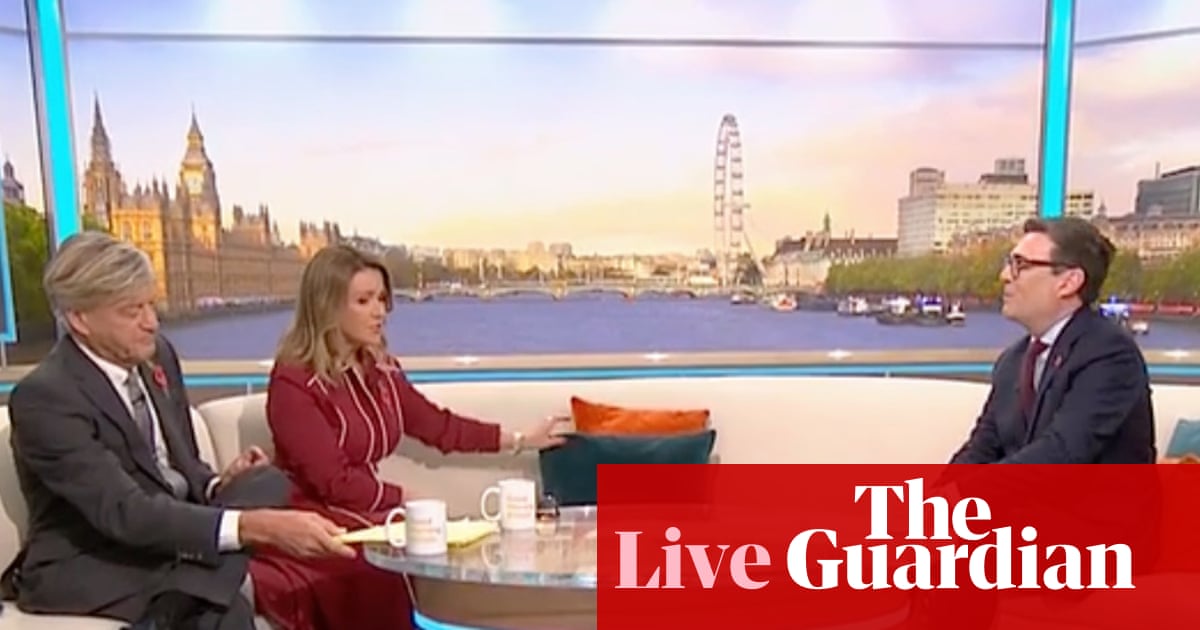
Good morning. Andy Burnham started budget week with an interview on ITV’s Good Morning Britain with Susanna Reid and Richard Madeley. There were plenty of decent lines in it, but some of his most intriguing comments were about Brexit. Yesterday opposition parties (and even in private some Labour MPs) were criticising the PM for saying in a Sunday Times interview that he would be willing to consider going into the next election proposing accepting EU free movement rules. This was treated as if it was a novel outrage – even though at Labour conference Burnham announced that rejoining the EU could end up as the best option to emerge from his proposed renegotiation of the Brexit settlement, which of course would automatically involve accepting free movement.
Neil Kinnock said recently he thought Burnham was determined to take Britain back in the EU, but in his interview this morning Burnham insisted that he was not dogmatic in that way. When Madeley asked him if he saw himself as someone “destined” to be the PM that would take Britain back in, Burnham replied:
Honestly, I don’t.
I see it as my job to be pragmatic about the whole situation. Can I make it work better? Can I add growth to the British economy?
And when Reid asked him bluntly to be honest and say if he wanted the UK to rejoin, Burnham replied:
I’ve said – I’m going to be honest – in my lifetime I would like to see that happen, but I am not going to move ahead of the public. I am not going to dictate in terms of my own opinions here. You have to make sure that the British public are the bosses here.
When it was put to him that he had broken a promise he made during the Makerfield byelection campaign not to reopen the Brexit referendum campaign, Burnham said that was not what he was doing.
He repeated the argument he made in his Labour conference speech – that it was worth revising the relationship with the EU because the current, post-Brexit settlement was not working.
But he also claimed that, rather than being divisive, this new debate could bring people together. Later in the interview, he returned to Brexit unprompted.
And [to] go back to Brexit, by just talking about it in a more practical way, by being honest about it … that can start to bring people together who voted in different ways.
The divides that we’ve lived through in the last decade really do need to end, and we need to pull people together …
I’m trying to give the country a direction and there is no way I can do that without coming back to the relationship with Europe and saying, ‘Look, here are some options as to how we got this right.’
Not for the first time, Burnham categorically ruled out trying to rejoin the EU before the election.
And, on the timing of the election, Burnham also insisted that it would be “no time soon”. He went on:
My mind is not on that [an early election]. I don’t know if that is coming over here, but it genuinely is not on that. There is no election coming anytime soon. People may as well just put that out of their mind.
I will post more from the interview soon.
Here is the agenda for the day.
Morning:Andy Burnham is on a visit in London ahead of attending a summit on rough sleeping in Downing Street.
11.30am: Downing Street holds a lobby briefing.
2pm: Nigel Farage, the Reform UK leader, and Robert Jenrick, his Treasury spokesperson, hold a press conference to present what they call their “economic rescue plan”.
2.30pm:Shabana Mahmood, the home secretary, takes questions in the Commons.
I’m afraid we are no longer able to have comments open below the line every day on this blog. If you want to contact me, please email politics.live@theguardian.com. You can use this email to flag up corrections, comments for publication, questions or complaints.
Reform UK claims it could 'kickstart economy' with more than 60 cost-free, 'job-creating policies'
Reform UK are holding a press conference later where Nigel Farage, the party leader, and Robert Jenrick, its Treasury spokesperson, will announce what they are describing as more than 60 “job-creating policies to kickstart the economy”. They are ideas that the party has floated before, mostly involving deregulation.
In a statement issued overnight, Jenrick said:
Everything reported so far suggests this will be a ‘mañana budget’, with John Healey dodging the tough decisions our country needs.
We can’t continue like this. The country can’t wait 10 years for Andy Burnham to work out a plan - we need action now.
Reform would bring forward more than 60 job-creating measures in our first budget to kickstart the economy. These common sense policies cost the taxpayer nothing - it’s a no brainer.
While many of the deregulatory measures on the list would be cost-free, others, like cutting employer national insurance, would impose a cost on the government.
But Reform UK is also claiming it could cut “£40bn of wasteful spending on the benefits bill, net zero subsidies and foreign [aid] to give the average household £1,300 in tax relief”.
Burnham says there's 'rock-solid business case' for trying to end rough sleeping because of its impact on public services
Speaking at his rough sleeping summit in Downing Street this morning, Andy Burnham expanded on the claim he made on Good Morning Britain about tackling rough sleeping being cheaper than ignoring the problem. (See 11.13am.)
He said:
We’ve also got to be conscious when we speak to the rest of the country, the taxpayers of this country, that actually to leave people sleeping rough has financial consequences. It doesn’t work for anybody and it doesn’t work for the public purse, because if you leave people in a position where they are in and out of A&E, and in and out of a hospital bed, that doesn’t make sense for anybody.
There is a rock-solid business case to do something to end homelessness, to put people on a path to recovery, so that they can contribute once again. And that should be the thinking that we take to this conversation.
If you find anybody in your area who says we can’t afford to do it, tell them from me directly that we can’t afford not to do it, and in fact not to do it is more wasteful of public resources.
But it’s worse than that. Far worse than that, it’s wasteful of people’s potential. It’s wasteful of people’s possibilities.
One person who says the government cannot afford the PM’s initiative is the shadow housing secretary, Katie Lam. She has issued this statement in response to the overnight announcement.
Burnham is throwing another £432m at a problem he failed to solve in Greater Manchester. Under Labour, rough sleeping has hit record highs – yet their answer is always more taxpayers’ money and more empty promises.
[John] Healey must use his budget this week to cut taxes for working people, get the ballooning benefits bill under control, and stop pushing up energy prices.
Andy Burnham speaking at rough sleeping summit in No 10 Photograph: BBC
Burnham refuses to deny report saying state pension rise won't lead to poorer pensioners paying tax
The Times is reporting this morning that the tax allowance for low-income pensioners will be raised in the budget so that they do not have to pay income tax on their state pension.
John Healey is expected to confirm on Wednesday that the full state pension will rise by £489 to £13,036 – equivalent to 3.9%.
However, the rise will push about one million people on low incomes who rely on the state pension above the £12,570 personal allowance threshold, meaning they would be dragged into paying income tax.
To retain the principle that the state pension is not taxable, Healey is expected to announce a rise in the tax-free allowance for low-income pensioners to £13,036. The move will cost taxpayers £200m a year by 2030.
Andy Burnham was asked if he could confirm the story was true in his interview on ITV’s Good Morning Britain. In response, he said that was the sort of question he could not answer, because it was an announcement for the budget on Wednesday. But he said nothing to suggest that the Times had got it wrong.
When Rachel Reeves was chancellor, she said pensions would not have to pay tax on their state pension if the value of the pension rose above the allowance. John Healey, the new chancellor, has previously said he will stick to this pledge, but without giving details of how poorer pensioners would be protected.
Burnham says rough sleeping 'fixable problem', as he doubles spending to address it
As Rowena Mason reports, Andy Burnham is to double spending on ending rough sleeping to almost £900m by the end of the current parliament, as he steps up efforts to get people off the streets by Christmas.
In his intervew on ITV’s Good Morning Britain, Burnham said rough sleeping was a “fixable problem”.
Saying that he was confident he could end rough sleeping, he said:
It’s a fixable problem. I don’t think we should have anyone in this country sleeping rough any night of the week. The damage to people’s health is catastrophic. People who’ve served in our forces. Can anyone accept that?
Burnham also claimed it would be “cheaper” spending money ending rough sleeping than having to deal with the costs of homeless people needing services like A&E.
Emma Haddad, CEO at St Mungo’s, a homelessness charity, said the funding announced today was “a vital step towards sustaining progress for years to come”.
She went on:
Rough sleeping is not inevitable. With the right funding, resources and long-term support, no one needs to sleep on a pavement. We are working closely with local authorities, regional authorities and partners to galvanise action and sustainable change.
Andy Burnham and John Healey, the chancellor, speaking to service users during a visit at St Martin-in-the-fields, a homeless charity in central London, this morning. Photograph: Ian Vogler/PA
Drive reindustrialisation from No 10 North or risk failure, MPs tell Burnham
Andy Burnham’s pledge to reindustrialise Britain is doomed to fail unless it is driven decisively from his new No 10 North outpost in Manchester, a group of more than 90 backbench Labour MPs is warning. Heather Stewart has the story.
Burnham says budget will confirm 'path' to higher defence spending
Andy Burnham has said the budget will set out a “path” to higher defence spending.
The government has signed up to a Nato commitment to raise defence spending to 3.5% of GDP by 2035. John Healey, the chancellor, has also in the past, when he was defence secretary, stressed the importance of the UK raising defence spending to 3% of GDP by 2030, but that is not a commitment he has firmly promised in his new job because he has not yet identified how that would be funded.
Asked in his ITV interview if Healey would set out the route to 3% by 2030 on Wednesday, Burnham at first just said he would set out “the path to meet our Nato commitments”. That appeared to be a reference just to the 3.5% target.
But when Burnham was asked if he was referring to both the 3% and the 3.5% targets, Burnham said he was. He said the budget would set out “a plan as to how we think is the right way to do that”.
Burnham also said his priority for this budget has been finding the £5bn a year needed to fund the defence investment plan announced by Keir Starmer before he resigned.
It was not clear from the interview whether Burnham’s reference to a “path” to higher defence spending meant a detailed fiscal plan, or just a statement of intent. Ministers have already expressed their wish to meet these targets; they just have not committed to the funding plans that would make them happen.
Giving evidence to the Commons defence committee earlier this month, Wes Streeting, the defence secretary, said he had always expected the detailed pathway to 3% to be set out in the spending review next year.
Burnham claims welfare cuts proposed by Tories and Reform UK will just lead to 'more failure and crisis and spending'
Andy Burnham has claimed that the welfare changes he is planning to get more young people into work could over time save a “significant amount of money”.
Ahead of the budget, the Conservatives and Reform UK are both calling for massive cuts in welfare spending, which they say could be used in part to fund more defence investment. At their conference the Tories identified welfare cuts worth £36bn a year, and today Reform UK is saying it would cut welfare spending by £40bn a year.
Burnham has repeatedly rejected what he calls “crude cuts”. But the government will soon publish recommendations from the Alan Milburn review into Neets (young people not in education, employment or training), and it is expected to recommend more spending on support getting young people into work, offset by some cuts to benefits. Milburn has said this would cost more in the short term, but would save money over time.
In his interview on ITV’s Good Morning Britain, Burnham said:
I think a big change is needed here where we move to a situation where the spending is not to sustain people on benefits, but we give people the right support when they need it as they are growing up, coming through their teenage years.
Asked how much this could save, he replied: “A significant amount of money, and that’s what the Milburn review is all about.”
Burnham also said the cuts proposed by the Tories and Reform UK would just lead to “more failure and crisis and spending”. He said:
The opposition parties are out there today saying just make crude cuts to the welfare budget.
I personally think that won’t work, and it isn’t right to do that anyway, because it just leads to more and more failure and crisis and spending that isn’t helpful for anybody.
Andy Burnham on ITV's Good Morning Britain. Photograph: ITV
Burnham says Shabana Mahmood 'right' to want to make settlement for migrant workers 'right to be earned'
Andy Burnham has said that Shabana Mahmood is right to want to make migrant workers wait longer until they can claim indefinite leave to remain (ILR) in the UK.
Under plans announced last year, migrant workers would normally have to wait 10 years for ILR, instead of five years as they do now, and care workers would normally have to wait 15 years. Some cabinet ministers have made it clear they believe 15 years is too long.
Asked about the split, Burnham broadly defended the home secretary in his Good Morning Britain interview. He said:
Why has this problem arisen? It’s arisen because if you look back to the early 2020s, people call it the Boriswave, a huge number of people came in seeking permanent settlement on longer-term visas …
And the home secretary is right, in my view, to bring forward changes that are based on the principle that settlement is a right to be earned, not just something that is granted automatically.
Burnham said the final plans would be published soon.
But, when asked if he was sticking to the 15-year element of the plan, Burnham just said that he stood by “the principle” of what Mahmood was proposing. He also said the government would take into account the results of its consultation on the plans.
In fact, Burnham himself is one of the ministers who have signalled they are unhappy about care workers being singled out for particularly harsh treatment. And Mahmood has already indicated that some aspects of the plan announced last year will be revised in response to objections.
Burnham was not asked for detail on what a compromise might look like.
Burnham insists there's 'no election coming soon', as 2 polls giving Labour 8-point lead revive early election speculation
In his Good Morning Britain interview, Andy Burnham was twice asked about an early election.
At the start, Susanna Reid asked him if he was softening people up for an early election. Burnham replied:
No, I’ve ruled that out.
Asked if that was absolutely the case, he said it was. He said he had made that clear before the Labour conference. He went on:
I just don’t think people want another backward-looking squabble. I think they want me to get on with the job.
And, when Reid raised the subject again at the end of the interview, Burnham said:
My mind is not on that [an early election]. I don’t know if that is coming over here, but it genuinely is not on that. There is no election coming anytime soon. People may as well just put that out of their mind.
Reid did not ask specifically about polling, but two polls came out over the weekend both giving Labour an eight-point lead.
🚨 Labour continues to lead in the polls, 8 points ahead of Reform in second place.
🌹LAB 30% (+1)
➡️REF 22% (-2)
🌳CON 20% (n/c)
🌍GRN 10% (+1)
🔶LD 9% (n/c)
Polling. Photograph: Opinium
These polls have attracted a lot of attention in part because they both give Labour a bigger lead than other recent polls. The Politico poll of polls, which averages the results of all polls, has Labour just four points ahead of Reform UK in second place. But that has not been updated to take into account the most recent Ipsos and Opinium numbers.
In one pre-conference interview, Burnham said that he would not hold the next election until 2029. But mostly he just rules out an “early” general election, while leaving it unclear what “early” means.
At Westminster no one is expecting an election before the end of the year. But the weekend polls have revived speculation about Burnham being tempted to call one in May next year, not least because having the rightwing vote split almost 50/50 between the Conservatives and Reform UK is an ideal backdrop for Labour.
Burnham claims debate on revising Brexit could 'bring people together', and insists rejoining would be public's choice, not his
Good morning. Andy Burnham started budget week with an interview on ITV’s Good Morning Britain with Susanna Reid and Richard Madeley. There were plenty of decent lines in it, but some of his most intriguing comments were about Brexit. Yesterday opposition parties (and even in private some Labour MPs) were criticising the PM for saying in a Sunday Times interview that he would be willing to consider going into the next election proposing accepting EU free movement rules. This was treated as if it was a novel outrage – even though at Labour conference Burnham announced that rejoining the EU could end up as the best option to emerge from his proposed renegotiation of the Brexit settlement, which of course would automatically involve accepting free movement.
Neil Kinnock said recently he thought Burnham was determined to take Britain back in the EU, but in his interview this morning Burnham insisted that he was not dogmatic in that way. When Madeley asked him if he saw himself as someone “destined” to be the PM that would take Britain back in, Burnham replied:
Honestly, I don’t.
I see it as my job to be pragmatic about the whole situation. Can I make it work better? Can I add growth to the British economy?
And when Reid asked him bluntly to be honest and say if he wanted the UK to rejoin, Burnham replied:
I’ve said – I’m going to be honest – in my lifetime I would like to see that happen, but I am not going to move ahead of the public. I am not going to dictate in terms of my own opinions here. You have to make sure that the British public are the bosses here.
When it was put to him that he had broken a promise he made during the Makerfield byelection campaign not to reopen the Brexit referendum campaign, Burnham said that was not what he was doing.
He repeated the argument he made in his Labour conference speech – that it was worth revising the relationship with the EU because the current, post-Brexit settlement was not working.
But he also claimed that, rather than being divisive, this new debate could bring people together. Later in the interview, he returned to Brexit unprompted.
And [to] go back to Brexit, by just talking about it in a more practical way, by being honest about it … that can start to bring people together who voted in different ways.
The divides that we’ve lived through in the last decade really do need to end, and we need to pull people together …
I’m trying to give the country a direction and there is no way I can do that without coming back to the relationship with Europe and saying, ‘Look, here are some options as to how we got this right.’
Not for the first time, Burnham categorically ruled out trying to rejoin the EU before the election.
And, on the timing of the election, Burnham also insisted that it would be “no time soon”. He went on:
My mind is not on that [an early election]. I don’t know if that is coming over here, but it genuinely is not on that. There is no election coming anytime soon. People may as well just put that out of their mind.
I will post more from the interview soon.
Here is the agenda for the day.
Morning:Andy Burnham is on a visit in London ahead of attending a summit on rough sleeping in Downing Street.
11.30am: Downing Street holds a lobby briefing.
2pm: Nigel Farage, the Reform UK leader, and Robert Jenrick, his Treasury spokesperson, hold a press conference to present what they call their “economic rescue plan”.
2.30pm:Shabana Mahmood, the home secretary, takes questions in the Commons.
I’m afraid we are no longer able to have comments open below the line every day on this blog. If you want to contact me, please email politics.live@theguardian.com. You can use this email to flag up corrections, comments for publication, questions or complaints.