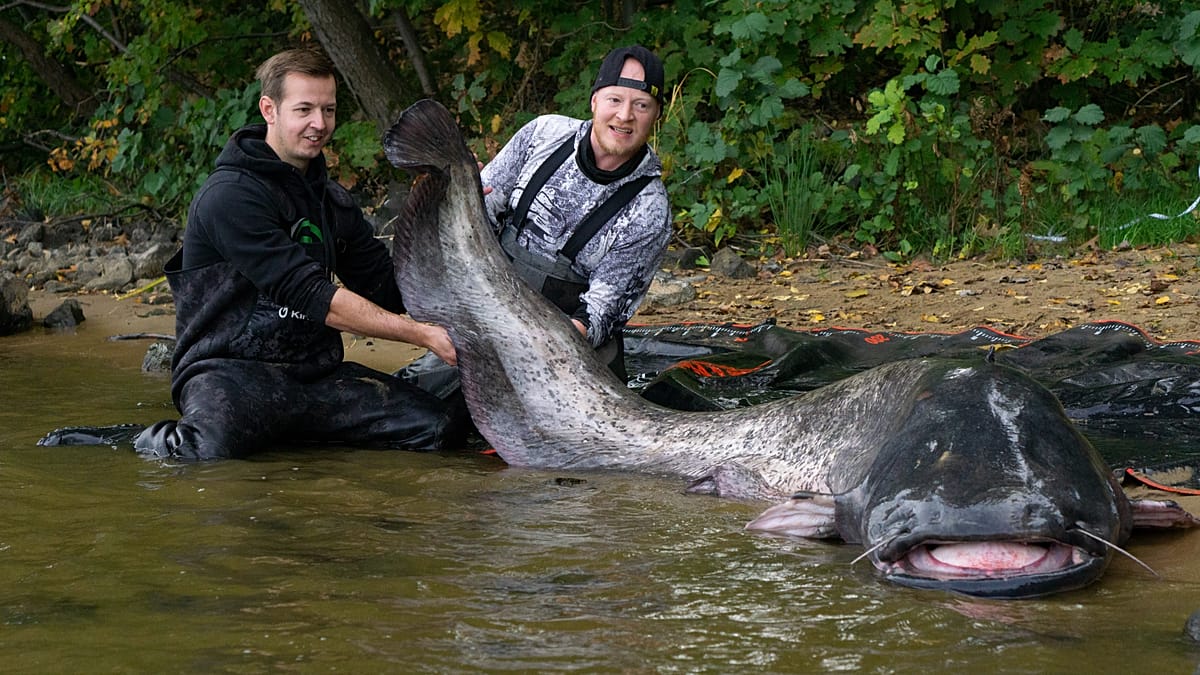
Oliver Schäfer from the Eifel and his fishing partner landed a 2.92-metre catfish at a tournament in Poland. The fish is already well known among anglers.
When Oliver Schäfer feels what is on the other end of his line, he quickly realises that this is no ordinary fish. The 34-year-old, from the western German state of North Rhine-Westphalia, is taking part in a predator fishing tournament inthe southern Polish city of Rybnik in Poland, together with his Dutch fishing partner Kevin Cremers.
On 10 and 11 October, 70 teams with around 150 anglers from all over Europe competed there, according to the German newspaper Bild. Schäfer and Cremers had travelled specifically for the event. As Schäfer told the newspaper, the pair were fishing with a special rod designed for large catfish and a soft plastic lure.
Schafer only grasped how enormous his adversary was when the fish broke the surface for the first time. The fight lasted more than 30 minutes. Cremers kept the boat on course against the wind, while Schäfer held.
Measured and released again
Back on shore, judges measured the catfish at 292 centimetres. It was then returned to the lake, as tournament rules require. Schäfer told Bild that the fish are brought ashore on a tarpaulin so that their protective mucus slime layer is not damaged.
However, the catch alone was not enough to win the tournament, which was decided on total points. According to the Berliner Zeitung and the results list of the anglers’ association PZW Katowice published by the Katowice branch of the Polish Angling Association (PZW), the duo finished second with 28,930 points.
There are, of course, other impressive specimens in the lake as well. On Instagram, Schäfer reports that he and Cremers targeted zander at sunrise. Their catches, including a fish measuring 81 centimetres, earned them "a good number of points" for the overall standings.
Is it the same fish caught last year?
The catfish has a backstory. According to media reports, participants believe it is the same fish that was caught during the tournament in October 2025. On that occasion, Polish anglers Krzysztof Pyra and Adrian Gontarz landed a catfish that also measured 292 centimetres. The Berliner Zeitung reports that the fish has not grown any longer since, but has become noticeably more bulkier.
International Game Fish Association (IGFA), the sport’s global governing body, keeps catfish records by weight, and there is no official list based on length. According to the German daily Welt Die Welt, Italian angler Alessandro Biancardi landed a catfish measuring 2.85 metres from the River Po in 2023.
The Polish city of Rybnik in the Silesian Voivodeship is therefore regarded, especially among anglers, as the place where the longest known catfish has been caught.
Schäfer’s dream of a three-metre catfish remains alive even after this angling success. He told BILD he was now "just a hand’s breadth" away.
Europe’s largest freshwater fish
According to Germany’s Federal Agency for Nature Conservation, the European catfish is the continent’s largest native freshwater fish. It can grow up to three metres long and weigh as much as 150 kilograms. Striking features include its scaleless body, broad head and six barbels that help it find its way in murky water.
It feeds mainly on fish; larger individuals occasionally prey on small waterbirds or mammals. For 2026, the anglers’ association, the Federal Agency for Nature Conservation and the Ichthyological Society have chosen the catfish as fish of the year.
Thriving in warmer waters
Originally, the catfish was native mainly to the Danube and Rhine river systems. Stocking programmes dating back to the 19th century and waterways such as the Main-Danube Canal have since opened up many more habitats to the species, according to the agency.
Climate change is also helping. As a warmth-loving species, catfish benefit from rising water temperatures. Biologist Jürgen Geist told the German news magazine Focus that populations are increasing markedly, both in range and in density. By contrast, cold-water species such as the brown trout are among the losers.
Warmth also plays a role in Rybnik. The reservoir serves as a cooling basin for a coal-fired power plant, and the heated water is discharged back into it. Because fish feed more actively at higher temperatures, catfish, carp and zander grow faster there, according to Schäfer.
Experts say the fish pose little danger to humans. They have only small rasping teeth, and outside the spawning season there is virtually no risk. However, in June 2025, a catfish measuring around two metres in length bit several swimmers in Brombachsee in Middle Franconia, causing minor injuries.