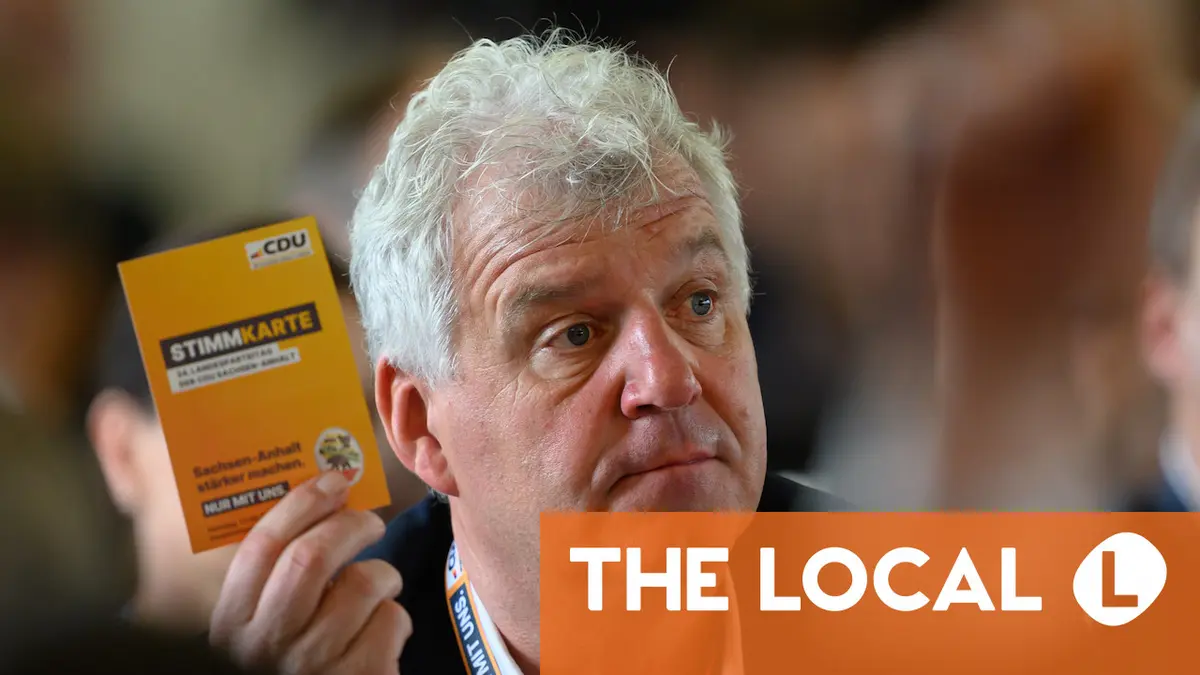
Friday's top story: One CDU politician refuses to walk out during election of far-right minister president
In December, Ulrich Siegmund, Alternative for Germany (AfD) lead candidate in Saxony-Anhalt is expected to stand for election for the position of minister president for the state.
Sven Schulze, leader of the Christian Democrats (CDU) in the eastern state had previously announced that his group of MPs would leave the plenary hall during the vote.
This was intended to show that no CDU members would vote for the far-right leader to head the state government. It came after an AfD member was elected to lead the state parliament with four more votes than were expected – and speculation that CDU members had secretly backed the far-right.
But a CDU MP named Guido Heuer, has said that he intends to go against the rest of his party group and stay in the plenary hall during the vote for Siegmund.
Asked how he intended to vote, he declined to comment: "I will not comment on it before or after a secret ballot."
The move has raised speculation that Heuer is crossing party lines to support the far-right.
Heuer was previously the chairman of the CDU parliamentary group in the state parliament until September, when he was replaced by Schulze who ran against him and won by just one vote.
To win in the first round of voting, Siegmund would need to gain some votes from beyond the AfD and BSW parties. If he succeeds, he would be the first far-right leader of a state government in Germany since the end of World War II.
READ ALSO: What we know so far about the Alternative for Germany email leakGermany arrests Ukrainian accused of spying for Russia
German police on Thursday arrested a Ukrainian man accused of spying for a Russian intelligence service with a focus on "militarily relevant information", federal prosecutors said.
The man, partially named as Vadym Y., allegedly collected "details regarding the production of armoured vehicles, ammunition and explosives, as well as information on personnel and military facilities at locations intended to secure NATO's eastern flank", they said.
He was arrested east of Berlin in the Oder-Spree district of Brandenburg state by the Federal Criminal Police Office, based on information from the domestic spy agency BfV, they said.
"At least as of July 2025, Vadym Y. was in contact with a Russian intelligence service via an intermediary," the prosecutors said in their statement.
They added that he gathered publicly available information but also "specifically targeted individuals within the European defence industry" to obtain other intelligence.
News weekly Der Spiegel reported, citing unnamed security sources, that the man is aged 53, lives in the eastern German city of Eisenhuettenstadt, and hails from Ukraine's eastern Luhansk region.
Chancellor Friedrich Merz, speaking in Montenegro on Thursday, praised the arrest as a "success" but added that Germany should expect more such cases as it had become "the target of intensive espionage activities" by Russian secret services.
Higher tax revenues expected but little prospect of relief
Germany is expected to collect more tax revenue than previously forecast, but Finance Minister Lars Klingbeil has warned that the improved outlook will not create additional room for spending in the 2027 federal budget.
Despite stronger economic growth and higher tax receipts, he argued that new financial commitments would still require clear funding sources.
READ ALSO: What does Germany's '€10 billion' income tax reform mean for you?
The latest tax estimate projects an additional €10.9 billion in revenue for Germany’s federal, state and local governments next year, with federal tax income expected to reach €398.6 billion in 2027.
The figures come amid a dispute within the governing coalition over further tax relief measures. The CDU/CSU is pressing for a reduction in electricity taxes for households and small businesses, while also advocating compensation for “cold progression”, whereby inflation pushes taxpayers into higher tax brackets. Together, these measures could cost billions of euros annually.
Opposition politicians and coalition partners continue to debate how such promises should be financed. Klingbeil has insisted that any additional relief must be matched by credible funding plans, warning against commitments that cannot ultimately be delivered.
Trucks can continue to drive on Sundays as low river levels persist
Germany will continue to suspend its Sunday and public holiday driving ban for trucks until December 20th as persistent low water levels on key waterways continue to hamper freight transport.

The decision was agreed by the country’s transport ministers and announced by Federal Transport Minister Steffen Bilger following a meeting in Bavaria.
READ ALSO: Low water on the Rhine cuts German economic growth
The measure was first introduced in August after prolonged drought conditions, particularly in southern Germany, caused river levels to fall sharply. The Rhine, Germany’s most important inland waterway, has been especially affected, restricting the movement of cargo ships and creating logistical challenges for businesses reliant on river transport.
Transport ministers said conditions have not improved sufficiently to restore normal rules. North Rhine-Westphalia’s Transport Minister Oliver Krischer noted that sustained low water levels continue to put pressure on the economy and disrupt supply chains.
While the underlying weather conditions cannot be controlled, he argued that targeted measures can help mitigate their impact.