Since 1993, Poland has allowed abortion only in cases of severe foetal abnormalities, risks to the mother's health or life, or pregnancies resulting from rape or incest.
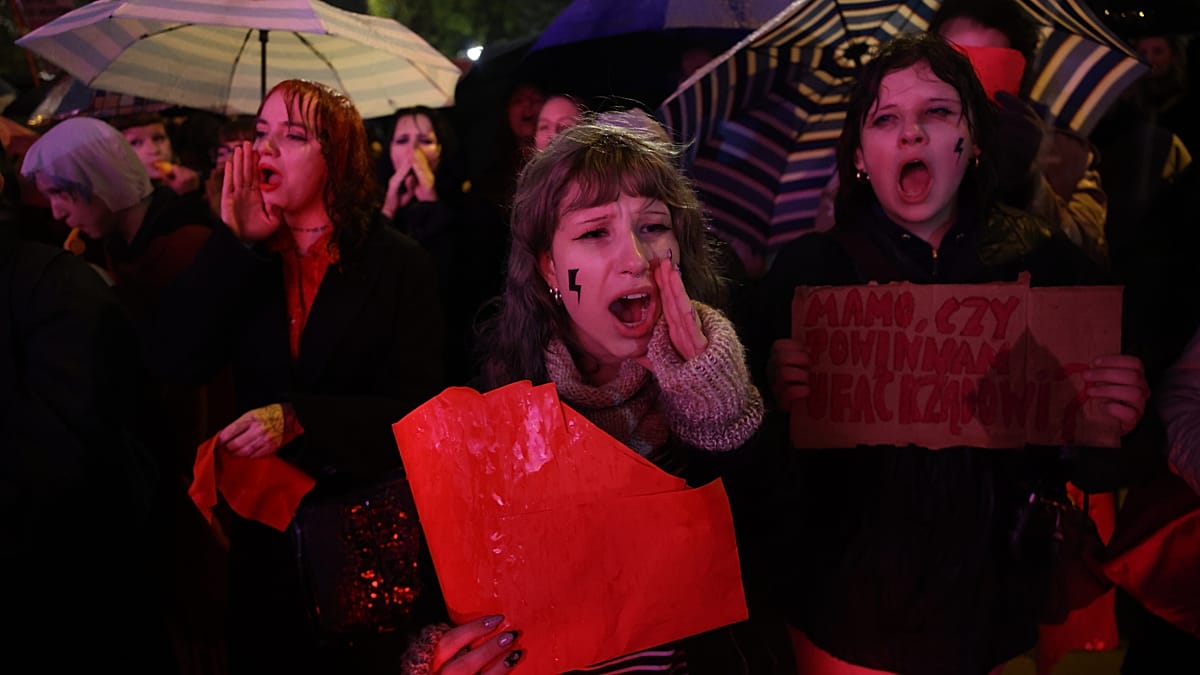
Thousands of people took to the streets of Warsaw and more than 20 other Polish cities on Thursday to demand abortion rights, marking the sixth anniversary of a near-total abortion ban introduced following a ruling by Poland's highest court.
The demonstrations were held under the slogan "Red card for abortion". Participants carried red cards and banners opposing the current abortion laws, with slogans including "Abortion ban kills women" and "Women's hell continues".
The protests came just days after parliament approved two bills aimed at easing abortion restrictions in the predominantly Catholic country. However, both measures are expected to face a veto from conservative President Karol Nawrocki.
People accuse Prime Minister Donald Tusk's liberal government of failing to deliver on its promise to reform the country's strict abortion laws.
Zofia Marcinek of the Warsaw-based reproductive rights group Abortion Dream Team described the legislation as a series of "token gestures" rather than a genuine attempt at reform, arguing that the government was aware the bills were unlikely to survive a presidential veto.
She accused the government of trying to win back women's support ahead of next year's parliamentary election by appearing to take action on abortion rights.
What the two abortion bills propose
Poland's parliament voted on Tuesday to ease the country's strict abortion laws, which are among the most restrictive in the European Union.
The first bill, proposed by Tusk's Civic Coalition (KO) and the Left, would partially decriminalise abortion and remove criminal penalties for assisting someone in obtaining one, an offence currently punishable by up to three years in prison.
The second bill, introduced by the more conservative coalition partners Poland 2050 and the Polish Peasants' Party (PSL), would overturn the effects of a 2020 Constitutional Tribunal ruling that banned abortion in cases of severe foetal abnormalities.
The first bill passed with 217 votes in favour, 213 against and three abstentions, while the second was approved by 233 votes to 203, with one abstention.
Where the protests took place
Alongside full decriminalisation, protesters are demanding access to legal abortion up to the 12th week of pregnancy, full access to the "morning-after" pill, and action by local authorities to disperse illegal protests held outside hospitals in Warsaw and Gdańsk and the AboTak clinic in Warsaw.
Demonstrations took place in 26 Polish cities as well as in London. Organisers announced another protest for Sunday.