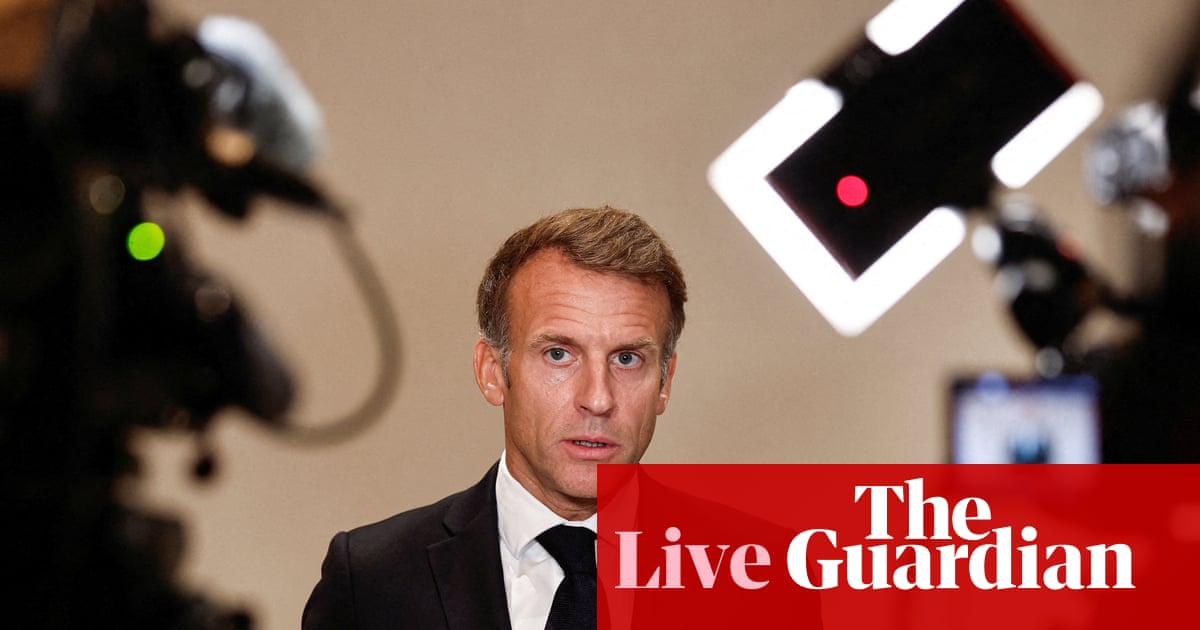
Macron blasted comments on the protests and riots in France from foreign leaders, accusing them of ‘campaigning at our expense.’ Photograph: Benoît Tessier/Reuters
Macron blasted comments on the protests and riots in France from foreign leaders, accusing them of ‘campaigning at our expense.’ Photograph: Benoît Tessier/Reuters
Macron blasts 'unacceptable' and 'stupid' commentary on French protests from other leaders
Meanwhile, French president Emmanuel Macron blasted “unacceptable” and “stupid” comments on the protests and riots in France from foreign leaders, accusing them of “campaigning at our expense.”
French President Emmanuel Macron speaks to members of the media in Qatar. Photograph: Benoît Tessier/Reuters
Speaking to reporters from Doha, visibly annoyed Macron said he was frustrated by “visible manipulation of information” about the events in France, “that were unacceptable and stupid from many quarters, including from foreign leaders.”
“For instance, we saw images generated by artificial intelligence depicting scenes that never actually occurred in France. Some people even claimed that we had been overrun by hordes of migrants and Islamists – which is completely false.”
(US president Donald Trump explicitly suggested that, repeatedly, and several EU leaders sort of said similar things, linking the protests with migration, including Hungary’s Péter Magyar and Poland’s Donald Tusk.)
Macron said he was particularly annoyed by political leaders “whether in our own region or on the other side of the Atlantic, gullibly repeating claims generated by AI or echoing narratives that certain circles with to propagate … it is clear that they are campaigning at our expense.”
He said these comments “reveal who loves France and who does not.”
Macron said he would hold a meeting with ministers and intelligence officials on his return on Thursday to get a “detailed account” of what happened and preparations for this weekend’s protests.
Trump hails 'unprecedented' release of US citizen by Russia
Meanwhile, back to Witkoff’s meeting with Putin in St Petersburg, the US president, Donald Trump, has just welcomed the release of Stephen Hubbard, a US citizen held by Moscow on allegations of fighting as a mercenary for Ukraine (11:24).
“Stephen Hubbard, taken four years ago by Russia during the Biden Administration, was just released from prison, at the request of President Donald J. Trump, made directly to President Vladimir Putin in a telephone conversation last week.
Stephen is on his way back home and will soon be with his family. The United States, out of respect for President Trump, was not required to give anything in return - an unprecedented situation for Russia. There was no “swap” necessary for this release.
This major return should have taken place long ago through the Biden Administration, which got nowhere in its negotiations with the Kremlin. Stephen is on his way back home. “Welcome home Stephen, it’s great to have you back,” stated President Trump.”
Why are French police so violent? Their job is to protect the state, not the people
Jon Henley
Europe correspondent
Familiar images of teargas clouds drifting across Paris squares, police baton charges against masked protesters and terrified teenagers floored – and worse – by stun grenades have once again focused the world’s attention on France’s policing methods.
Police forces present at a demonstration in Rennes, France. Photograph: Vernault Quentin/NurPhoto/Shutterstock
While most of its western European neighbours generally favour police tactics that prioritise crowd containment and de-escalation, France has long responded to social movements that take to the streets with, at times, shocking physical force.
The reasons why are a complex mix of history, politics, state organisation and a particular security culture that has become deeply ingrained over decades, if not centuries, and whose limits continue to be pushed today.
French policing policy is rooted in Napoleon’s ultra-centralised state and in the political philosophy of the Republic. In France, the police are an instrument of the state. Their core task is to protect it, enforce its laws, and maintain public order.
Conceptually, that is a far cry from, for example, the UK, where since the early 1800s the police have been considered servants of the public, whose authority derives from public consent and whose chief responsibility is to keep the peace.
French police officers are agents of state authority. That means protests, blockades and mass disorder are not just civil nuisances, but direct challenges to the authority of the republic. The police’s priority is to reclaim the streets, not to negotiate.
That explains the aggressive tactics, such as systematically encircling and trapping crowds, and their continued use of “intermediate” or less-than-lethal weapons, many of which are banned or heavily restricted elsewhere in Europe.
Macron blasts 'unacceptable' and 'stupid' commentary on French protests from other leaders
Meanwhile, French president Emmanuel Macron blasted “unacceptable” and “stupid” comments on the protests and riots in France from foreign leaders, accusing them of “campaigning at our expense.”
French President Emmanuel Macron speaks to members of the media in Qatar. Photograph: Benoît Tessier/Reuters
Speaking to reporters from Doha, visibly annoyed Macron said he was frustrated by “visible manipulation of information” about the events in France, “that were unacceptable and stupid from many quarters, including from foreign leaders.”
“For instance, we saw images generated by artificial intelligence depicting scenes that never actually occurred in France. Some people even claimed that we had been overrun by hordes of migrants and Islamists – which is completely false.”
(US president Donald Trump explicitly suggested that, repeatedly, and several EU leaders sort of said similar things, linking the protests with migration, including Hungary’s Péter Magyar and Poland’s Donald Tusk.)
Macron said he was particularly annoyed by political leaders “whether in our own region or on the other side of the Atlantic, gullibly repeating claims generated by AI or echoing narratives that certain circles with to propagate … it is clear that they are campaigning at our expense.”
He said these comments “reveal who loves France and who does not.”
Macron said he would hold a meeting with ministers and intelligence officials on his return on Thursday to get a “detailed account” of what happened and preparations for this weekend’s protests.
Russia will analyse US proposals, but it's on Ukraine to make progress, Kremlin says
We are getting some first lines from the Kremlin saying that Russia will analyse the US proposals, but “much depends on Ukraine.”
US envoy Steve Witkoff meet Russian president Vladimir Putin
“If Ukraine does not make necessary decisions, situation for them will be worse,” a quote attributed to the Kremlin and posted by the Interfax news agency said.
I will bring you more when we have it.
Russian president Vladimir Putin, US special envoy Steve Witkoff and other officials attend a meeting at the Constantine Palace in Saint Petersburg, Russia. Photograph: Gavriil Grigorov/Sputnik/Reuters
The picture above is from Russian state-owned Sputnik news agency.
During their initial exchange, relayed via the Russian state news agency Tass, Putin reportedly said that he was interested in restoring ties and economic cooperation with the US, as he praised the diesel deal with Trump.
He also recalled Trump’s comments on the need to end the Russian war of aggression in Ukraine to stop the loss of human life, and asked about the talks in Oslo.
In turn, Witkoff said he hoped Putin would consider resuming peace talks with the US and Ukraine for “technical discussions,” and said the Oslo meeting was productive, with “a foundation in place to move toward a ceasefire.”
Let’s see if we get any more detail after the meeting.
Republicans push back on Donald Trump’s wavering support for Ukraine
Overnight, a handful of Republicans have spoken out against Donald Trump’s softening stance on Russia, threatening to pull financial support for his agenda over his “embarrassing” handling of the Ukraine war.
President Donald Trump is reflected in protective glass after speaking at a campaign rally at Pitt–Greenville Airport. Photograph: Matt Ramey/AP
Don Bacon, an outgoing congressman in Nebraska, condemned Trump’s actions – which include a stunning agreement to buy Russian diesel and the pausing of sanctions on Moscow – as “absolutely disgraceful” and accused the US president of cozying up to a “war criminal” in Vladimir Putin, his Russian counterpart.
“It really is disgraceful, and the Republicans that I associate with, there’s a lot of us, can’t stand it,” Bacon told CNN on Monday. “I think the president’s leverage in this Congress is shot.”
Last week, Trump waived sanctions imposed on Russia through a law named after his longtime ally and late senator Lindsey Graham. The legislation, which he signed only last month, was intended to increase financial pressure on Russia, more than four years after it invaded Ukraine.
Instead, Trump announced he had struck a deal with Putin to import diesel fuel, which has become more expensive for Americans largely due to Trump’s war with Iran. Trump has previously blamed Ukraine’s strikes on Russia.
Ukraine's anti-corruption police search National Bank premises
Meanwhile, Ukraine’s anti-corruption police said that detectives were searching the premises of the National Bank of Ukraine and also the home address of one of the central bank’s employees, Reuters reported.
The anti-corruption police said in a statement on the Telegram app that no one has been detained or issued a suspicion notice. The central bank did not immediately respond to a request for comment.
Morning opening: Witkoff meets Putin in St Petersburg for talks on Ukraine
US special envoy Steve Witkoff arrived in Saint Petersburg early morning for talks with Russian president Vladimir Putin about Ukraine, a day after holding discussions with Volodymyr Zelenskyy and the leaders of Norway and Finland.
Witkoff was met at Pulkovo Airport by the Kremlin’s advisor for international economic cooperation, Kirill Dmitriev.
Russian presidential envoy Kirill Dmitriev greets US special envoy Steve Witkoff upon his arrival at Pulkovo Airport in Saint Petersburg, Russia. Photograph: Obtained by Reuters/Reuters
Let’s see how much of the positive tone expressed by Zelenskyy and the two European leaders after yesterday’s talks will hold at the end of the day.
But managing out expectations, Kremlin aide Yuri Ushakov said he “didn’t know if any agreement will be reached today,” Russian news agency Interfax said.
Elsewhere, I will be looking for updates from France and Italy, as both countries step up their response to recent protests and riots that disrupted everyday life.