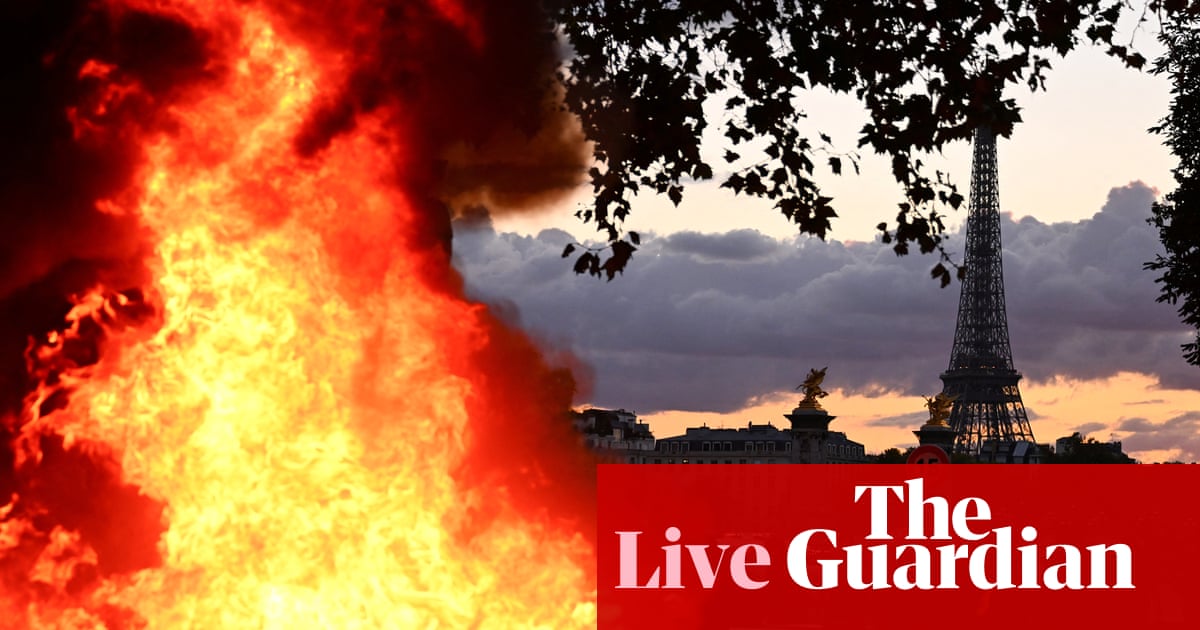
Lecornu blames 'ultra-left' and criminals for exploiting protests
French PM Lecornu says he has asked prefects to implement “a number of partial curfews” in certain “localised” urban areas to stop further disorder, which he attributes to “the extreme-left” and some criminal elements.
France’s prime minister Sébastien Lecornu looks on before an emergency meeting in Paris. Photograph: Julien de Rosa/AFP/Getty Images
We will no doubt hear more on this from local authorities, as in the example of Marseille (10:32).
He also says the government is determined to respond to the events as needed, and if declaring a state of emergency is deemed necessary, they would do so – but that’s a major decision to make and currently not being considered.
He says be believes “there is an agenda of chaos being pushed by the far-left,” with the intention of disrupting next year’s presidential election, and that’s why he urges the NR leaders to attend his briefing later today, despite their plans no to do so (12:20).
Lecornu also says that there will be a “strong” response from the country’s judiciary, cracking down on the violence and crime on the margins of the protests. Investigators are also looking through social media footage, where rioters often did not wear masks.
New measures to stop riots from reoccurring will be put in place starting tonight, but tomorrow’s football game between PSG and Barcelona is currently scheduled to still go ahead.
He also says that furlough measures for businesses affected by riots will kick in on Tuesday to ensure all jobs are saved despite any disruption to business operations in the build up to the busy Christmas period.
He says there will also be further targeted measures, but with little detail at this stage.
Separately, the government will also push to expedite various assessments required to pay out any insurance claims.
Lecornu also says that the right to legitimate protest needs to be safeguarded and considered separately from the riots and clashes with police forces.
Albania has also experienced days of disturbances, and today prime minister Edi Rama has accused protesters of crossing a “red line” after a police station was set ablaze during anti-government demonstrations.
“Protests are a right, whereas violence is a crime; this red line must be drawn clearly at this critical stage of our democratic development,” AFP reports Rama said in a Facebook post.
About 300 people have been injured in the clashes, more than half of them police, according to the authorities. Petrol bombs were thrown into a police station and the interior ministry entrance on Sunday.
Albanian riot police fire teargas toward demonstrators yesterday in central Tirana. Photograph: Vlasov Sulaj/NurPhoto/Shutterstock
The British prime minister has added his voice to the chorus of politicians condemning the violence in France.
A spokesperson for Andy Burnham in Downing Street said “Clearly, the violence we’re seeing on the streets of France is unacceptable. While the power to protest is at the heart of democracy, this can never excuse violence.”
British nationals in France were told by the UK government to “follow local advice from the authorities” if they were concerned about the situation.
German police have said that two men turned themselves in after a security fence was damaged at the airport in the city of Leipzig. The incident had sparked fears as it took place at the same airport where an attack with an explosives-laden drone happened in August, an incident German authorities attributed to Russia.
Authorities had been investigating how a gaping hole was cut into a fence around the airport. The two men say they lost control of the car and crashed through the fence, then left the scene of the accident and arranged for the car to be towed away. AP reports that German police say the car has been seized and the investigation is continuing.
Investigators inspect the site of the damaged fence. Photograph: Heiko Rebsch/DPA/AP
Swedish centrist leader Thand Ringqvist tasked with leading exploratory talks on new government
As promised, we have an update from Sweden, with the Centre party’s Elisabeth Thand Ringqvist given a chance to lead talks about the new government in the country.
Centre Party leader Elisabeth Thand Ringqvist, first right, during a televised debate before last month’s general election. Photograph: Jonathan Nackstrand/AFP/Getty Images
Thand Ringqvist welcomed the opportunity to lead the discussions and said she would look to progress the talks, but made it clear she had no intention of becoming the next prime minister.
She will try to break a deadlock among the four opposition parties that emerged with a theoretical majority in the new parliament after last month’s elections, but continue to disagree on the composition of the future government.
The Centre party has ruled out being in government with the Left, while the Left has demanded a place in government in return for its cooperation. Without an agreement, the opposition bloc would not have a majority in the new parliament.
Thand Ringqvist will have to report back on the progress of her talks by the end of the week.
The move by the parliament’s speaker Andreas Norlén comes days after the Social Democrats leader and the September election winner Magdalena Andersson failed in her efforts to unite the opposition in the first attempt.
Outgoing prime minister Ulf Kristerssontold Swedish broadcaster SVT it was the “logical” decision to give the theoretical opposition bloc another go at forming the next administration.
EU condemns 'looting' in France, says right to peaceful protest 'must be protected'
The European Commission has condemned “unacceptable” acts of “arson, looting and attacks on people or public buildings” in France over the weekend, but stressed the right to peaceful protests was “a fundamental right … and must be protected.”
Police clash with protesters during a demonstration amid a nationwide mobilisation over rising living costs, fuel prices and education funding in Paris, France. Photograph: Hesham Elsherif/Anadolu/Getty Images
EU internal affairs spokesperson Markus Lammert said:
“The right to peaceful protest is a fundamental right in all democratic countries and must be protected. Those who demonstrate peacefully must not be conflated with those who commit violence. Arson, looting and attacks on people or public buildings are unacceptable.
We support the efforts of the French authorities to protect people, property and public institutions in full respect of fundamental rights.
It is national authorities that are competent for law enforcement matters, and investigations are currently ongoing at national level.”
Lecornu blames 'ultra-left' and criminals for exploiting protests
French PM Lecornu says he has asked prefects to implement “a number of partial curfews” in certain “localised” urban areas to stop further disorder, which he attributes to “the extreme-left” and some criminal elements.
France’s prime minister Sébastien Lecornu looks on before an emergency meeting in Paris. Photograph: Julien de Rosa/AFP/Getty Images
We will no doubt hear more on this from local authorities, as in the example of Marseille (10:32).
He also says the government is determined to respond to the events as needed, and if declaring a state of emergency is deemed necessary, they would do so – but that’s a major decision to make and currently not being considered.
He says be believes “there is an agenda of chaos being pushed by the far-left,” with the intention of disrupting next year’s presidential election, and that’s why he urges the NR leaders to attend his briefing later today, despite their plans no to do so (12:20).
Lecornu also says that there will be a “strong” response from the country’s judiciary, cracking down on the violence and crime on the margins of the protests. Investigators are also looking through social media footage, where rioters often did not wear masks.
New measures to stop riots from reoccurring will be put in place starting tonight, but tomorrow’s football game between PSG and Barcelona is currently scheduled to still go ahead.
He also says that furlough measures for businesses affected by riots will kick in on Tuesday to ensure all jobs are saved despite any disruption to business operations in the build up to the busy Christmas period.
He says there will also be further targeted measures, but with little detail at this stage.
Separately, the government will also push to expedite various assessments required to pay out any insurance claims.
Lecornu also says that the right to legitimate protest needs to be safeguarded and considered separately from the riots and clashes with police forces.
We are expecting to hear from France’s prime minister Sébastien Lecornu later today, but he is currently chairing an emergency meeting on the events of the weekend.
France's interior Minister Laurent Nuñez and prime minister Sebastien Lecornu attend an interministerial crisis meeting in Paris, France. Photograph: Julien de Rosa/EPA
Party leaders will also meet with the PM to discuss the political fallout from the protests.
Curiously, the far-right National Rally party will not be represented neither by its presidential candidate, Marine Le Pen, nor its prime ministerial candidate, Jordan Bardella, but a more junior figure, media reported.
In the meantime, Paris prosecutor said at least 145 people were still in custody following “various acts of vandalism, looting and attacks on law enforcement,”as reported by Le Figaro.
A person wears a mask near burning bicycles during civil unrest, the day after a national day of demonstrations against the cost of living and rising fuel prices, in Paris, France. Photograph: Abdul Saboor/Reuters
Italy's Meloni to hold crisis talks after clashes with police in Milan, Turin, Bologna
in Rome
Italian prime minister Giorgia Meloni will hold a crisis meeting with top security officials on Monday after two days of ransacking and looting in Milan allegedly perpetrated by gangs of hooded youths.
The unrest began on Saturday on the fringes of a protest against the rising cost of living. There were also clashes between police and protesters in Turin and Bologna.
Clashes in Bologna last weekend. Photograph: Alessandro Ruggeri/LaPresse/Shutterstock
In Milan, more than 200 were detained by police, allegedly responsible for ransacking shops and smashing windows, including in the area surrounding the city’s Duomo. According to reports in the Italian press on Monday, 80% were minors, with many responding to appointments made on social media and sharing selfies as they bragged about the damage caused.
They were not believed to have been affiliated with any political party or organised groups or movements.
Meloni said on Saturday that the perpetrators were “thugs who exploit demonstrations to spread chaos, attack those who guarantee security, and hold entire cities to hostage”.
“To demonstrate is a right. To lay our cities to waste is not,” she wrote on X.
Police patrol streets after clashes with youth protesters near Piazza del Duomo in Milan, Italy. Photograph: Alessandro Bremec/NurPhoto/Shutterstock
During her more than four years in power, Meloni has enacted tough security measures, including against peaceful protesters.
In July, her cabinet approved so-called “anti-maranza” legislation in response to a rise in child gangs and youth delinquency in city centres. “Maranza” is a slang term used to describe gangs of delinquent youths, usually coming from suburban areas.
Opposition politicians often accuse the government of using security as a propaganda tool, arguing that Italy’s leaders do little to address core issues such as education, housing and living conditions in marginalised areas.
There are no signs of French protests stopping anytime soon: the yellow vest movement, de gilets jaunes, has just announced a “second act” of protests for upcoming Saturday, 24 October – and then again a week after that, too.
The idea is to “keep the momentum going” until another major demonstration planned for 5 November, a group member told AFP.
A car burns near a graffiti reading "introduction to civil war" as clashes erupted during a demonstration against the "high cost of living", in Paris last weekend. Photograph: Guillaume Saligot/AFP/Getty Images
Protesters block Louvre entrances in Paris as they back student campaign
Protesters blocked entrances to the Louvre museum in Paris in support of a nationwide high school student protest movement and to denounce “police repression”, the museum’s management and unions told AFP.
The museum could not open as scheduled because of a protest led by students from the Ecole du Louvre, management said. A leaflet displayed outside the museum read: “We are proud to announce that we are blocking the world’s largest museum.”
Protesters and students from art and culture schools block the entrance to the Louvre in Paris, France. Photograph: Abdul Saboor/Reuters
Marseille bans public gatherings, demonstrations today
Back to France, the authorities in Marseille have just issued a ban of any public gatherings and demonstrations “throughout the entire commune” from midday to 8pm.
Violent clashes and damage occurred before the start of a protest on the Canebiere and at the Old Port against the high cost of living in Marseille, France. Photograph: Alain ROBERT/SIPA/Shutterstock
Zelenskyy confirms no intelligence on overnight attacks, says US 'in denial' about Russia's position
Meanwhile, Ukraine’s Volodymyr Zelenskyy has responded to the latest wave of Russian attacks on Ukraine, confirming Ukraine had no prior warning from the US and seemingly accusing Washington of being in the state of denial about the reality of the war.
A woman stands next to a damaged beauty store near a metro station, which was hit by an overnight Russian missile strike, amid Russia's attack on Ukraine, in Kyiv, Ukraine. Photograph: Valentyn Ogirenko/Reuters
“Another Russian ballistic missile attack came in several waves overnight, and once again, there was no early warning from our partners,” he said.
“They again targeted energy facilities and infrastructure, but a medical clinic, a school, a metro station, and ordinary residential buildings were also damaged.”
Showing growing frustration with the attacks and continued criticism from US president Donald Trump, he said:
“Ukraine never wanted this war, and we have welcomed literally EVERY attempt by our partners to bring this war to a dignified end. We have responded positively to EVERY ceasefire proposal. Russia’s response, time and again, has been ballistic missiles, “shaheds,” and killings.
Putin not only doesn’t want to end this war – he doesn’t even want to take any steps toward de-escalation. EVERY ONE of our partners has experienced this firsthand when they heard Russia’s refusals.
And it is crucial to call things what they are. To call the aggressor an aggressor and help Ukraine defend lives. When deliveries of missiles for Ukraine’s air defence are blocked while Russia is granted relief or delays in sanctions, this is, unfortunately, a denial of reality on the part of our partners.
The reality is that the war continues, and it continues solely because of Russian strikes and Russia’s desire to drag this war out.”
Police clashes with protesters as protests spread to Italy, as fuel, fresh food shortages also hit south
in Palermo
Italian police also clashed with protesters who threw stones and looted shops in Milan on Sunday during demonstrations over the rising cost of living, as lorry drivers blocked roads across southern Italy in protest at soaring fuel prices linked to the war in Iran.
Demonstrators light flares during an anti-government protest organised by the Italia in Piazza movement, at Piazza Duomo in Milan. Photograph: Piero Cruciatti/AFP/Getty Images
Footage showed police in riot gear firing teargas and using water cannon after several hundred hooded protesters smashed shop windows and set bins alight in the area around Piazza del Duomo in central Milan.
Second day of the demonstration "Italia in piazza" against the high cost of living in Milan, Italy. Photograph: Nicola Marfisi/AGF/Shutterstock
Second day of the demonstration “Italia in piazza” against the high cost of living in Milan, Italy. Photograph: Alessandro Bremec/NurPhoto/Shutterstock
The clashes echoed scenes of violence in neighbouring France, where hundreds of thousands of people angered by rising living costs and declining public services took to the streets on Saturday in some of the country’s most violent protests in years.
Meanwhile, lorry drivers have caused widespread disruption across southern Italy, blocking major roads and creating huge traffic jams in Sicily, Puglia and Calabria in protest at the mounting financial pressure on the haulage industry.
A handwritten sign reading ''Tutto esaurito'' (All sold out) covers the diesel and petrol price board at a self-service petrol station in Barletta, Italy. Photograph: Matteo Della Torre/NurPhoto/Shutterstock
Hundreds of petrol stations have run out of fuel, while supermarkets are beginning to report shortages of several products, particularly fresh food. Pharmacies have also been affected, raising concerns about disruption to essential supplies.
“We are asking the government to urgently convene a meeting with industry associations. Otherwise, we will consider a nationwide strike,” said Pasquale Russo, president of Conftrasporto, an association representing Italian haulage companies.
“The situation is very concerning because the excessive price increases affecting the haulage industry have created a highly tense situation among transport companies, leading to spontaneous protests in some areas of the country,” he added.
In several parts of southern Italy, petrol stations have run out of both petrol and diesel, with motorists facing long queues at the few filling stations still operating. The road blockades have also caused extensive traffic disruption, with fears growing that prolonged protests could further disrupt supplies of food, fuel and other essential goods.
Fuel pumps are cordoned off with red and white barrier tape at a Q8 Easy self-service station in Barletta, Italy. Photograph: Matteo Della Torre/NurPhoto/Shutterstock
Morning opening: Macron declines offer of interior minister's resignation after weekend riots
French president Emmanuel Macron has declined interior minister Laurent Nuñez’s offer to resign after widespread riots over the weekend, despite “failures in anticipation and intelligence” that were deemed to worsen the crisis engulfing the country.
Macron said Nuñez should stay to ensure a chain of command is retained within the police and security forces, and has also asked Nuñez to set up as quickly as possible new approaches to deal with looters, the Élysée Palace added, quoted by Reuters.
Macron has asked the minister to “put in place new operational methods for security forces” to get a grip over the crisis.
Saturday, one of the most violent days of unrest in years, left public buildings burned, hundreds of shops destroyed and looted and at least 2,400 people arrested in cities across the country.
In a TV interview on Monday, Nuñez admitted that the police “lost control” in some cities during the protests.
Riots in central Paris over the weekend, with 2,400 people arrested nationally. Photograph: Poitout Florian/ABACA/Shutterstock
In an address to the nation last night, Macron criticised “unbridled violence”.
Emmanuel Macron condemns violence in televised address – video
“Watching these images, we have all asked ourselves how could French people do this to France?” he said.
Separately, I will also be keeping an eye on Ukraine, after another night of heavy attacks by Russia killing at least one and injuring eight people, and with conflicting reports about whether Kyiv authorities had been warned about the strikes.
A police officer inspects the site of a fitness club building hit by a Russian missile strike, amid Russia’s attack on Ukraine, in Kyiv, Ukraine. Photograph: Valentyn Ogirenko/Reuters
We should also get an update from Sweden, as the parliament’s speaker is set to decide on the next step in the government formation process there.
I will bring you all the key updates here.
It’s Monday, 19 October 2026, it’s Jakub Krupa here, and this is Europe Live.