The contribution towards the war effort made by African soldiers is often overlooked - John Rwothomack
One of my most vivid childhood memories is watching the Remembrance Day services and commemorations taking place in Sheffield each November. Even at the age of 11, the same fact always struck me.
My Ugandan grandfather, like some 600,000 other African soldiers, had stood shoulder to shoulder with British forces during World War Two. But of their efforts, I saw no representation. Not only was a legacy for the contribution of African soldiers missing, but so was that of other global majority soldiers.
During the war, the British Empire and Dominions raised millions of men for military service.
Over two and a half million men from India alone served in the British Indian Army, producing the largest volunteer army in history. Every single soldier played their part. African soldiers played an especially crucial, but long-underrecognised, role in the Allied victory in Burma.
Yet when films are made of these victories, the contribution of Commonwealth troops is underrepresented. In my school history lessons, nothing was said of the huge contribution made by so many, to fight for this nation’s future. There is still too little visible evidence of the participation of these soldiers. They are the forgotten Army.
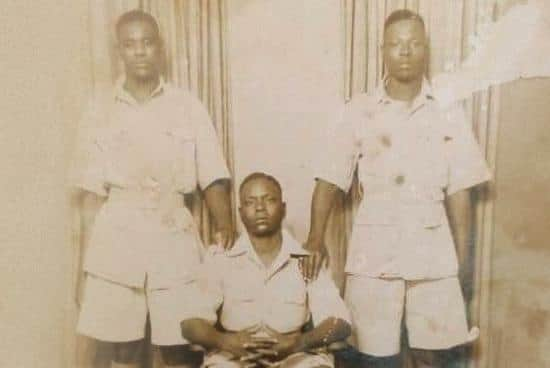
My grandfather, Rwoth John Omach Mandir II, was a signaller in Burma in 1944. Another childhood memory is repeatedly asking my father and uncle to share his stories with me. While they were proud of what he did, we collectively know almost zero details. It just was not spoken about and over time, these stories are vanishing.
The terrifying thing is that without my grandfather’s photograph, there is absolutely nothing to demonstrate his sacrifice. Many Africans don’t know the stories of their grandparents in the war. It is a huge gap in their identity and our shared history as a society.
That is a situation also faced by so many descendants of soldiers around the world. And it is the reason why I had to write a new play, Never Look Back, a historical fiction centred around the real-life 11th (East Africa) Division.
The King’s African Rifles, which supplied several of the division’s battalions, recruited African soldiers primarily from Britain’s East African territories and were led largely by British officers. The division fought in several key campaigns during the Second World War.
During a year of research carried out in both Britain and Africa, I tried so hard to find some kind of recognition for these soldiers. But it is disproportionately limited.
Next February, Sheffield Theatres will co-produce and host the world premiere at The Crucible. Finally this story will be given a new platform on the stage, more than 81 years after the end of the Second World War.
In the production directed by Daniel Bailey, we focus on the relationship between veteran Komakech Ogwang and his granddaughter Anena Gladis. She wants to know more about his service, while he is uneasy about unearthing the past. Their conversations take the audience back to Uganda in 1944. There, the daily terrors of war, personal sacrifices and racial inequality experienced by the KAR soldiers are unflinchingly retold.
As the nation marks Black History Month this month, and prepares for Remembrance Day in November, all I can hope is that this play shines a light where it is needed. I would love for the descendants of these soldiers who represented the British Empire to hopefully see and recognise what their forefathers did. Then they may also be able to speak up about it. In time, our team at Sheffield-based Roots Mbili Theatre would like to focus on the heritage behind the show. We want to capture a bit of this forgotten history.
This needs to go beyond the theatre. We must build something that has permanence in the city. In Yorkshire, and in the country. The same honour and respect that has been awarded to native British soldiers should also be afforded to every nation whose soldiers fought for this country. Monuments, museums, films and books. In all of those places or mediums, their vast contribution is still overlooked.
Yes, there was migration to Britain before World War Two. But after the war was won, with a vital role played by Commonwealth nations in securing that victory, one of the reasons some people came here was because they had contributed to the triumph. The makeup of this country right now has been shaped by that history.
I was born in Uganda, and raised in Sheffield. I am a descendant of somebody who fought in World War Two, and also my great-grandfather, who fought in World War One. At the end of the day, our mission should be very simple. By understanding history, we understand who we are today. We can understand each other better. We can be more welcoming and less discriminatory towards each other. We can use our shared history to truly unite us.
John Rwothomack is the founder of Roots Mbili Theatre.