
Wednesday's top story: Greens and SPD suddenly halt Berlin government talks with the Left
The three-way talks on the formation of a government in Berlin have stalled. The Greens and centre-left Social Democrats (SPD) surprisingly interrupted the exploratory talks on Tuesday afternoon, after a week of seemingly productive meetings.
Last week the three parties had spent days hand-wringing over a declaration, which set out how antisemitism should be defined and evaluated within the coalition.
On Thursday, the three parties, including the Left (Die Linke), had signed a "binding" charter against antisemitism and reiterated their support for "Israel's right to exist," which were preconditions for launching initial talks on forming a municipal majority.
But Die Linke reached "other arrangements within its group" on Tuesday, the Greens and SPD officials said.
"We have taken note of the fact that the Left Party has come to other agreements in its parliamentary group," said a joint press release from the SPD and the Greens. "This means that we have to interrupt the exploratory talks at this point to assess whether our agreement from last week still stands."
On Monday, German Chancellor Friedrich Merz increased pressure on his Social Democratic partners in the government, stating that an agreement with Die Linke in Berlin would be a burden for the coalition.
READ ALSO: Why is the Left Party in Berlin being accused of antisemitism?Nuremberg airport temporarily shut over hijacking scare
A flight from the Greek island Corfu to Germany accidentally sent out a hijacking alert to several European countries Tuesday, prompting fighter jets to be scrambled and a brief airport closure.
"The aircraft could no longer be reached by radio to clarify the situation," prompting warnings to be activated in several European countries, police said.
A Rafale fighter jet was scrambled from Croatia to intercept the Boeing passenger jet, operated by Corendon, while the German military also dispatched warplanes.
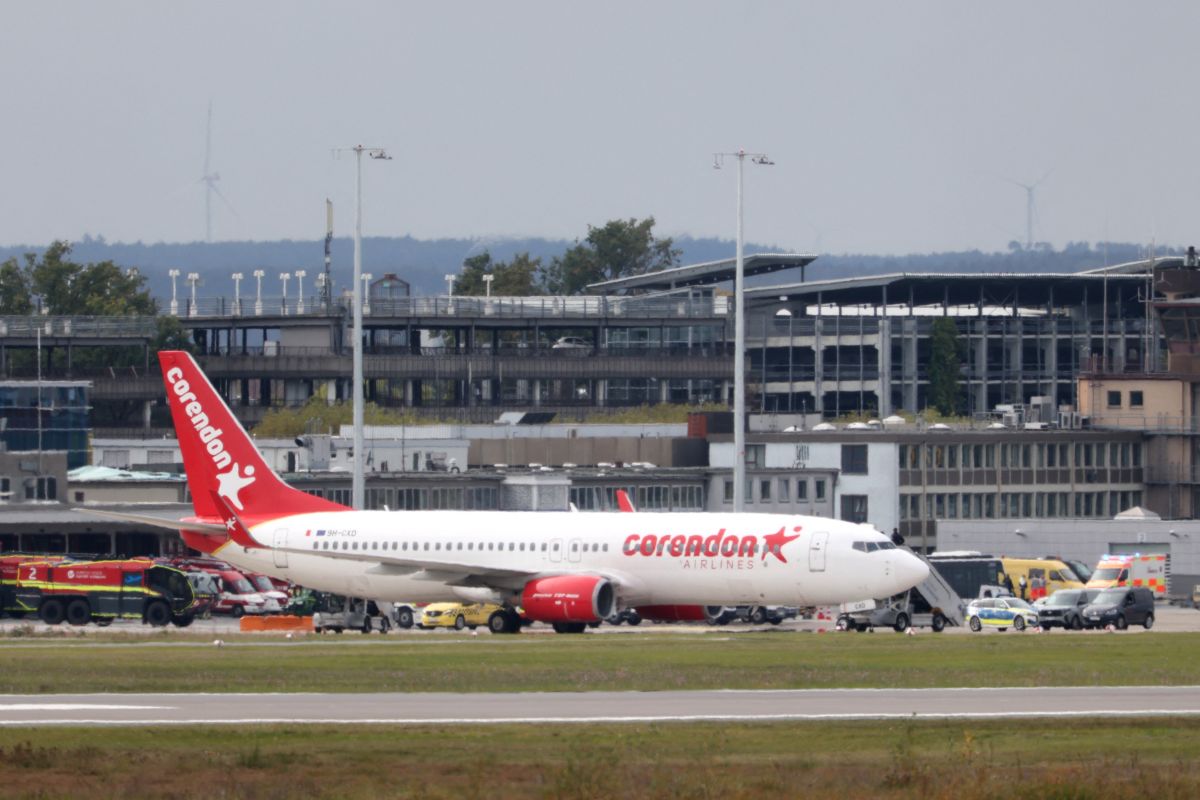
Nuremberg airport suspended operations after the alert was triggered and police were deployed to the scene. But after the German fighter jets escorted the plane to land, police inspected the aircraft and found there was no danger.
In the early hours Tuesday, flights were also briefly disrupted at the airport after pilots reported suspected drone sightings.
According to initial investigation, the flight seems to have had a broken radio.
READ ALSO: Ryanair scraps all flights from Bremen airport from spring 2027Rising fuel costs drive inflation rate above the three percent mark
Driven by high fuel and energy prices, the inflation rate in Germany has exceeded the three percent mark for the first time in almost three years.
Goods and services cost 3.3 percent more in September than a year earlier, as calculated by the Federal Statistical Office, confirming preliminary data. This is the highest inflation rate since December 2023, when it was 3.7 percent.
Ruth Brand, President of the Federal Statistical Office noted that the "inflation of mineral oil products at petrol stations and heating oil was particularly evident."
In September, consumers in Germany had to pay 14.9 percent more for fuels and household energy than a year earlier.
This means that energy inflation increased in September for the third month in a row and reached the highest increase since February 2023.
Germany has recently implemented a temporary tax cut on fuels, aimed primarily at saving drivers from price shocks at the pump.
On Monday Chancellor Friedrich Merz suggested that he'd like to try to revitalise a proposal from last year to extend tax cuts to household electricity prices as well.
READ MORE:
- How much will Germany's fuel tax cut save drivers?
- What Germany's proposed electricity tax cut could mean for your bills
While the cost of living appears to be on the rise, so is Germany's economic forecast.
The International Monetary Fund (IMF) raised its forecast for German economic growth this year to 1.3 percent, almost double the 0.7 percent it predicted in July.
It now expects Europe's largest economy to expand by 1.1 percent in 2027, an upward revision of 0.1 percentage points.
The figures match the German government's forecasts released last week. The Economic Ministry said the economy had proved more resilient than expected despite higher energy prices and uncertainty over US tariffs.
Tesla ousts the Golf as Germany’s best-selling car in September
Germany’s automotive market witnessed a symbolic changing of the guard in September, with the Tesla Model Y overtaking the Volkswagen Golf to become the country’s most-registered passenger car.
According to new registration figures from Germany’s Federal Motor Transport Authority, the Model Y recorded more than 8,000 registrations during the month, comfortably surpassing the long-dominant Golf. Tesla also secured the top position in the midsize segment with the Model 3, highlighting the growing appeal of electric vehicles among German consumers.

The shift forms part of a wider trend in which foreign manufacturers are making significant gains in Germany’s traditionally domestic-dominated market. Imported brands claimed six of the 13 vehicle categories in September, with Dacia, Peugeot and Fiat also leading individual segments.
While German manufacturers continue to dominate several categories, including luxury and sports cars, the latest figures suggest their home-market advantage is weakening.
Overall new car registrations rose by nine per cent year-on-year.
READ ALSO: Can Germany save its car industry as job cuts intensify?German wine harvest set to be one of the smallest in years
Germany’s wine industry is expecting one of its poorest harvests in more than a decade after an exceptionally dry and sunny summer reduced grape yields across many vineyards.
The German Wine Institute estimates this year’s harvest could be around 20 percent below the long-term average, potentially making it the smallest since 2010. While official forecasts differ, both industry representatives and government statisticians agree that production will fall below recent norms.
Winemakers report that prolonged drought left many grapes smaller than usual, cutting overall volumes. Producers remain optimistic about quality, however, with many expecting an excellent vintage despite the reduced harvest.
Older vines, supported by deeper root systems, generally coped better with the dry conditions, while younger vineyards and those on lighter soils suffered more heavily and often required irrigation.
READ MORE: