Special report: Search for lost WW2 soldier killed in plane crash above Holmfirth
It is hard to imagine the blinding terror that must come in the moments before impact. To see the ground coming closer and to comprehend that you’re about to die in a plane crash.
It is now 82 years since the US aircraft known as Sack Time hit a hill above Holmfirth in the Second World War, killing all but one of the 10 men on board.
The body of Cpl Clarence Watson, as the last missing crew member, has never been found. The flames were too fierce, it seems, the strike too tall, and with a barrage of hell fire that came after to ravage it all.
An old wreckage of the twisted fuselage has been, until now, all that remains. It has lain for decades, scraps of this old aeroplane, ragged on the blackened peat of Twizle Head Moss. Scattered and bleak, a scar torn through the lonely moor.
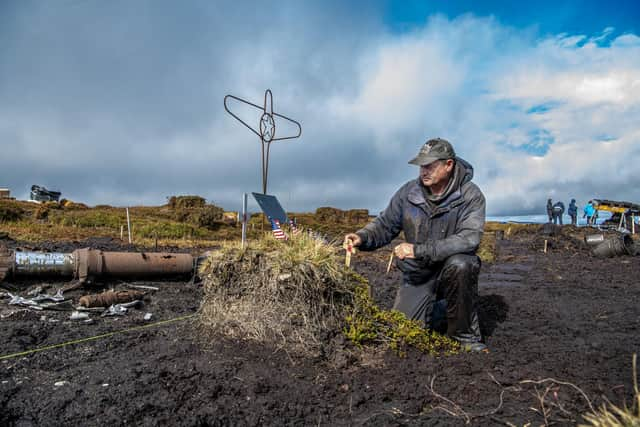
Now, finally, decades on, there is a sliver of hope to find some answers. To find, with his family’s blessing, evidence of Cpl Watson’s remains.
For some months, archaeologists have been sifting the soil, quietly excavating these jagged moorlands.
It may be years before any findings can be confirmed, scientifically or through DNA.
But there could be signs. ID tags, a broken watch, pieces from the parachute. The peat bog here, wet and acidic, acts as a natural preservative.
It may be that clues lie frozen, untouched by the passing of time.
Following breadcrumbs
Tim Fletcher is the lead archaeologist on the project.
“We are here to try and find evidence,” he said. “To really confirm that Clarence was actually killed here.
“We are essentially following breadcrumbs,” he added.
“But the guy who survived, who died later that night, he died on his 21st birthday. Clarence, he was just 21, he was going to be 22 in a few weeks’ time.
“They were just regular guys. They came over here all the way from the States, doing their bit. To me, it’s so important not to forget the sacrifices that they made.”
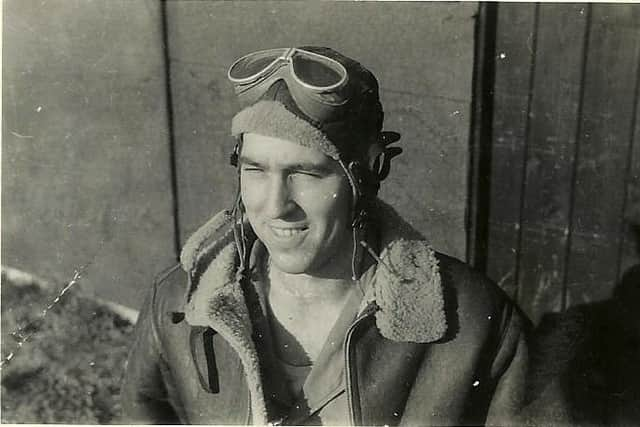
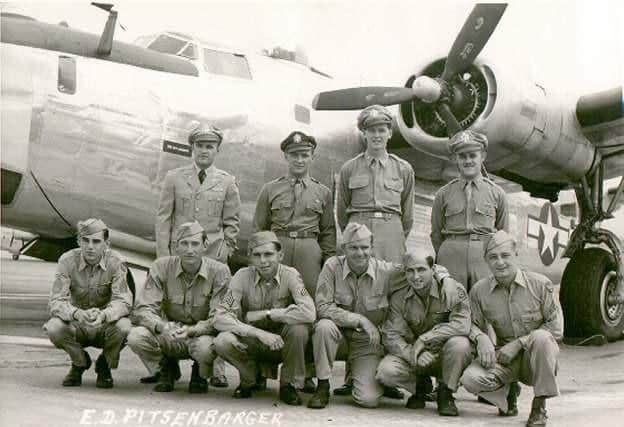
Cpl Watson was a US serviceman from California, and one of 10 men on board the B-24H Liberator when it crashed into the hillside on October 9, 1944.
He wasn’t a pilot, but had begged his childhood friend to take him for a spin. He had hitched a ride that day.
Seven men were killed outright. The eighth died later that night. Cpl Watson remains Missing in Action (MIA).
Only one man survived, Staff Sgt Curtis Anderson. He later left an account.
The crew had been up near the cockpit, near the radio room, outlined Mr Fletcher. Clarence, best friends with the radio operator Joseph Zwinge, was there.
Sgt Anderson had asked for permission to return to his station.
“He looks out of the window,” recounts Mr Fletcher. “He sees cloud - they are in cloud. He plugs his intercom in, looks out the window again and he sees grass.
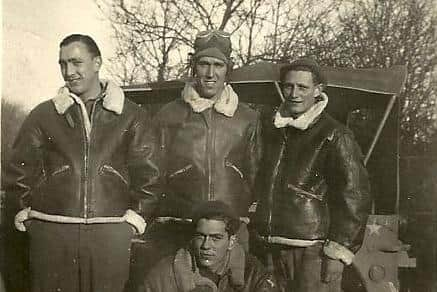
“Then it all just goes black. He says he wakes up and he’s in a deep gulley, he sees a scene from hell. That’s the words he uses. He sees rivers of fire, he’s on fire himself.
“And he starts to grab wet peat to put on himself and to put the fire out.”
An easy mission
The plane had been on a training mission, navigating by landmarks. Up to Sheffield. Left towards Huddersfield. Another left, up the Holme Valley above Holmfirth.
An easy mission. Crews hadn’t anticipated the sudden steep elevation change, with the hilltop hidden in mist. Until it was upon them. Until it was too late.
An off-duty soldier was close by, on leave from war. He saw the plane come in. His first thought was that it couldn’t possibly make it. Then he heard the crash.
It was to be hours before he could find Sgt Anderson as the sole survivor, guided by the sound of explosions from the wreckage.
The scene here is still pockmarked by scars. There is a triangle of raw earth, where the tail hit. A bigger rift, gouged into the ground, for the fuselage.
Charred landscapes, blackened by jet fuel and flames. No new growth has ever recovered.
Now today, in the mist and the fog, the rain is so biting it seems to fall sideways. The wind, so wild it snatches any scraps of words away.
We shout instead; Fletcher gesturing over his dig site. He is possessive of this patch of land, and honouring it the right way.
It takes a certain kind of person, perhaps, to search for a lost soul in this torrid fog.
Teams have been camping, in teepees nearby, for weeks on end. They climb this hill every day. And they dig and sift, and sift again, to find evidence of a man they have never met. To bring answers to his family.
Repatriation
Driving rain, wild and untethered, pelts those working the dig site. Heads buried in Gore-tex, they squint from its shrapnel lash.
It is relentless. My boots are devoured in seconds into the squelch of seared peat bog. Then gloomed grey-green moorland, tufted and wiry, as a wintry sun creaks out.
The land here, Twizle Head at Lightens Moss, is owned by Yorkshire Water.
It is America that wants its son back. Forensic archaeologists, at Geoscope Services Ltd, have been appointed to investigate. Behind it all is the US Defence, under its Prisoner of War and Missing in Action Accounting Agency, (DPAA).
The operation is to uncover evidence from the crash site. If possible, it is also to repatriate Cpl Watson’s remains to the United States.
It began with extensive geophysical surveys. Advances in technology mean teams can map how the aircraft came to crash - and where it came to land.
Then they can pinpoint where to look. Some 300sqm has been excavated.
“We know this is where the aircraft first impacted the ground,” said Mr Fletcher.
“The obvious evidence for proving that Clarence was killed here would be physical remains. Or it could be personal items. Jewellery, rings, watches.”
Clarence’s parents held out hope, for so many years, that he was one day to walk through the door.
That he hadn’t died that day on a Yorkshire moor, but was living somewhere with amnesia.
His niece, Vicky Weatherby, has shared a remarkable glimpse into the life and legacy he left behind, after visiting the crash site this September.
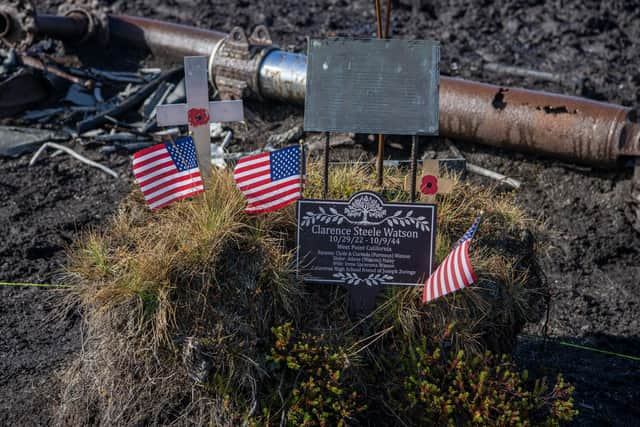
She was able to lay a memorial plaque, bearing his name. A California state quarter. And beside it, a toy marble found at the site of his childhood home.
With her sister Cindy, they had been raised on stories of Uncle Clarence, she said in a letter.
Her mother, Ailene, kept a picture of her beloved brother next to her bed. She died in 2015, never having had any answers.
Instead, shortly afterwards, Army reports confirmed details of the crash that the family had never known.
That the military, removing the fuselage, had found pieces of Sgt Watson’s parachute. The back of a watch, a hip bone.
“The bones were sent to the hospital and then to the morgue,” she said. “They somehow fell off the face of the earth and were lost.”
Her wish, she added, was that her mother and grandparents had been told.
“Maybe they would have come to terms with his death and not always waited for a letter, or the door to open with Uncle Clarence walking in.”
Reunion
Clarence Watson’s middle name was Steele, after his great-grandmother. He was born on the Mayflower Ranch in West Point, to Clarence William and Clarinda.
He was a big brother to Ailene. And he married Irene Garavanta in 1942, just shy of her 18th birthday.
These details have never fully been shared with the public before. Ms Weatherby, in a letter to teams excavating the site, has been able to tell his story for the first time.
She also revealed that Clarence’s parents, some time after the crash, had received a knock on the door.
It was Sgt Anderson, the sole survivor, after recovering in hospital for three years from the terrible burns he endured.
He had been able to tell them of Clarence’s last movements, of where he had been sitting when the plane crashed down.
Her uncle had gone to Calaveras High School, where he had met and became friends with the crewman Joseph Zwinge.
The records show he had always wanted to go on a flight, and had always bothered his friend to help him.
“We know that friend would have been Joe Zwinge,” said Ms Weatherby, of how Cpl Watson came to be on the plane that day.
“Two friends from small Calaveras County, meet again in England, and pass away together on the beautiful mountain.”
It is a “miracle”, she said now, that teams have brought Clarence’s story together.
Years ago, she had come across the website of a man by the name of Ian Burgess, an aviation historian who has logged countless crash sites.
He offered to take her to Holme Moor. Plans were set for September 3.
Then came a message from DPAA that Geoscope was to explore. She replied, asking for more details, but Mr Burgess was already preparing for the trek.
Checking the path, he came across the excavation site.
“That’s when the miracles began to happen,” she said.
Ms Weatherby had been standing outside the Tower of London when she took the call, tears streaming, to be told teams were in place searching for her lost uncle.
The following week, she was able to join them on site, with her son and daughter-in-law. It was a rainy, windy day, she recalled.
Teams had been worried, she said in the letter, that she may struggle to hear the news in this way.
There was nothing, she added, that could be further from the truth. They were searching for Clarence – hopefully finding something that could be brought home.
Something that might finally, after 82 years, fill his empty grave.
“We appreciate all you are doing to find something of Uncle Clarence,” she told the team. “But if nothing is found, it’s ok. We are at peace and can’t thank you enough.
“We want to say a huge thank you for bringing Uncle Clarence’s story to life.”
The hills in Holmfirth, on a softer morning, are said to echo to the haunting call of a curlew, or the thumping ruff of the red grouse that thrives on these moors.
This has been the resting place of Cpl Watson, it may be, for so many years. A rarity, as a high war grave. With no memorial, until now to bear his name. With no body.
Instead, a small American flag flutters wildly, in a blur of wind-whipped stars and stripes. He has family yet, to remember his name.
It is a privilege, said Fletcher, to search for him.
“This is a mystery that no one has had an answer for,” he said. “I can only tell you what I believe. I’m a retired military man myself. This is a rewarding thing to do.
“To work on these sites, and to bring the names of these guys back out from the archives again, is to make them real people and to understand them.”
Re-wilding and repair
A war grave will still be honoured on this site, landowners have said, with work now to begin to restore and rewild its protected moorland.
The crash site, atop Holme Moss, has since lain as an open scar on the peatland for 82 years.
Legally protected as a war grave, it has remained untouched until archaeological excavations began.
Now, with digs completed, work can finally begin to return it to a more stable condition.
The Moors for the Future project, set up in 2003 to protect damaged blanket bog habitats, is working to restore and repair the peatland.
It will see re-wilding, re-wetting, and re-vegetation, said the project’s Tom Harrison, working to undo the damage with the planting of sphagnum moss.
The site, with work underway, he added, is to remain incredibly fragile for some time and there is a plea to walkers and tourists to give it a chance to recover.
“This is stabilising it,” he said. “So that it can do all the wonderful things that peat does - providing drinking water, holding carbon and run-off so that surrounding areas don’t flood.”
Yorkshire Water, as landowner, has secured the permits for work to press ahead.
It’s better for the environment, said countryside lead Alastair Harvey, but also for water quality and in delivering better protection against wildfires.
“This excavation has got to be done to try and repatriate this poor air crewman,” he said. “To provide a resolution for the families and relatives. And to finally bring to a conclusion the uncertainty of not knowing what actually happened here.
“It doesn’t change it, but hopefully they can remember it in a better way.
“Hopefully it brings some peace to the relatives, the family and friends.”
The land here has been protected for so long, and it is illegal to scavenge the site or carry out metal detecting here. That will remain in place, he added.
What is critical now is in protecting these landscapes and building its recovery.
“There will still be a war grave here,” he said. “There is still a memorial.”
Recovery
This is a triple-protected landscape, as an SSSI within a Special Area of Conservation (SAC) and granted Special Protection Area (SPA).
The site is in a popular area for walkers and is well known among aviation enthusiasts, but there are pleas to people to pay heed.
This is a military aircraft crash site - legally protected by the Protection of Military Remains Act (1986).
People are asked not to enter the excavation area or disturb the ground. Doing so without a license, they warn, may be a criminal offense.
And there is a plea to the public to avoid the vulnerable area as restoration works take place, to allow this precious landscape to fully recover.