The murky RAF Fairford incident may have just taken a headache away for Andy Burnham - Patrick Mercer
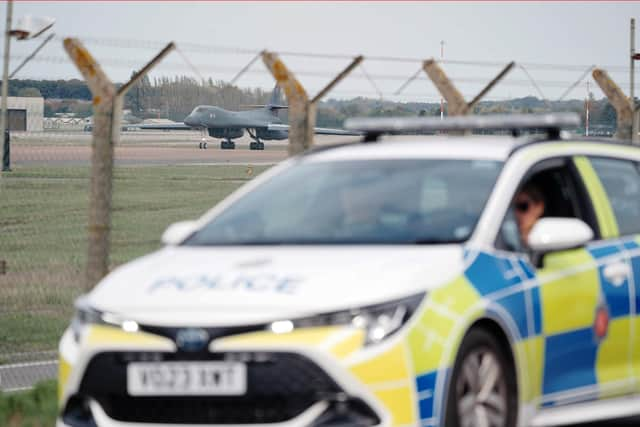
The wires are still buzzing with rumour and counter rumour about the ‘incident’ at RAF Fairford in Gloucestershire a few days ago. Fairford and a handful of other airfields have always been high on the target list of any of Britain’s enemies because they play host to nuclear tipped US aircraft and it’s a fair bet that when tensions are high security will be even tighter around these sites than normal.
But, if they’re high on target lists, they’re top of the pops when it comes to political controversy. Ever since they were established as nuclear armed bases there have been intermittent protests about them. Similarly, in the last few months the Labour government has been deeply inconsistent about whether the UK would allow US planes to fly from British soil to bomb Iranian and other Middle Eastern targets.
Since last weekend, though, there have been several young men arrested with suggestions that there’s an Iranian link to probable terrorist attacks - pretty serious stuff, Yet, all those who had their collar felt have been released on bail and it’s even said that one of the suspects rang the police to say that he’d seen something fishy going on.
The whole thing made little sense and was beginning to die down until last Tuesday when Donald Trump gave the order for all his bombers in the UK to fly back to the US. Such was the urgency that the crews didn’t know where they were going to rendezvous with mid air refuelling tankers until they were about 90 minutes into their journeys - that suggests a real crisis.
Then a whisper started that an Operation Spiders’ Web look alike had been planned. Remember, in June 2025 a series of trucks concealing Ukrainian drones were driven towards Russian airfields and parked nearby. Then, remotely, the devices were activated and destroyed several strategic bombers.
It’s now suggested that Iranian agents intended to copy this highly successful Ukrainian attack, but on British soil and against US aircraft. Whether that’s correct or not, whether the CIA got wind of something else we will probably never know, but it was enough to galvanise the Pentagon who shifted their aircraft in a real hurry.
Now, it’s rumoured that the original Operation Spiders’ Web was planned by British Intelligence: true or not, that attack is a by-word in covert operations and I have no doubt that the very mention of a repeat would make Washington sweat.
Obviously, US Intelligence has now decided that the threat to all long range bombers is too serious and, at a stroke, one of Mr Burnham’s greatest problems has been solved. Our new PM and all of us watched the unedifying sight of Sir Keir Starmer turning somersaults earlier this year. Sir Keir was hoping to please Mr Trump whilst simultaneously trying to appease many of his own MP’s who were deeply unhappy about British support for Israel’s President Netanyahu.
As the Whitehouse decided to withdraw its own bombers rather than being told by Downing Street that they wouldn’t be allowed to attack from British soil, a future row with Mr Trump has been averted. Similarly, a damaging bust up within the Labour Party has been dodged. All you need is a credible threat but with no explosives, no drones and no copper bottomed arrests, a carefully built rumour of Spiders’ Web II might work instead.
Too cynical, too conspiracist? Probably, but I wonder what President Zelensky would say about one of his most successful operations having its name taken in vain?
Frankly, I suspect he’s got more immediate problems.
Ever since the start of the Ukrainian war we’ve been told that Russia isn’t fighting as hard as she might, but that once ‘the gloves come off’ things will be much more ruthless. That’s hard to quantify, but strategic targets - which would certainly be struck in ‘total war’ - have so far been spared. The most obvious examples are the sweeping bridges over the Dneiper across which all warlike materiel and reinforcements have got to pass.
Classically, some bridges are often left intact in war because both sides may want to manoeuvre over them sometime in the future. But, up until recently the Kremlin’s not touched Ukraine’s very arteries: now all bets are off.
The three, most significant bridges in Kiev have already been made unsafe by drone and missile strikes. Endless traffic jams have formed, supermarkets are at breaking point whilst thousands of people are sleeping in the city’s metro system to protect themselves from the Russian blitz.
Then there’s another factor. When VIP’s were visiting Kiev or Moscow both sides informed each other and held their fire. Now Russia ended that arrangement when the visit of Germany’s Chancellor - Herr Merz - was greeted by Moscow’s redoubled onslaught on Kiev. This is the equivalent of ‘severing diplomatic relations’.
Combine all this with the slow garroting of Kiev’s exports from the blockaded port of Odessa and a dismal, intimidating picture emerges.