Energy and enthusiasm at the Labour Party conference was palpable - David Blunkett
So, the party conferences are over. As I've noted on previous occasions, these gatherings may have made no impression whatsoever on the general readership – who, whilst having a passing interest in current affairs, might not be tuned into the internal rallying cries of these annual get-togethers.
The governing party, understandably, gets the bulk of the traditional coverage. They have something to announce, and their words matter, because they are in a position to implement ideas.
But they always have (and this year is no exception) specific features. Motivating the audience and, therefore, the rank-and-file who do the bulk of the work campaigning and the weekly grind trying to win people over - whether on social media or on the doorstep.
They have to say something to the country, but these days also to the international markets and to those whose power and influence is way out of the hands of any of us.
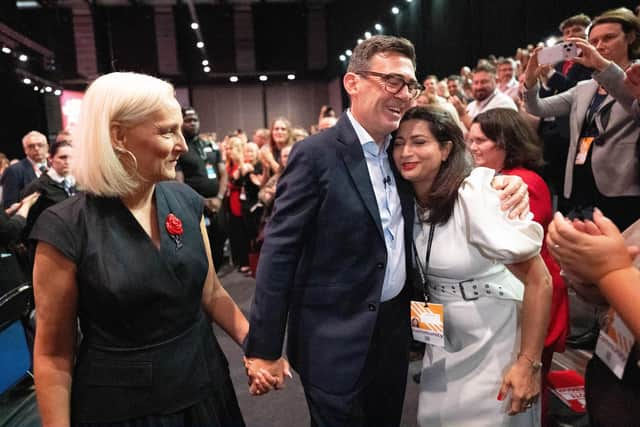
Yet there was something different about the Labour Party conference this year. I only attended briefly but the energy and enthusiasm were palpable.
This matters, because a party that preaches hope must also demonstrate that message in practice - which hasn't been easy over recent times (to say the least), despite the fact that Labour won a landslide back in July 2024.
Sitting through Andy Burnham's first speech as Prime Minister to Labour Conference and having the privilege of being one of the first to give him a hug (as well as to give a bunch of tissues to his wife, Marie-France) I was proud of how he reached out to offer a sense of purpose and optimism to a country that desperately needs it.
One thing that has gone without much commentary is his genuine desire to lift politics to a level focused on debating the future of the country, the values we hold and the identity that we rejoice in. That is why I was so pleased that at no point (and uniquely in my experience at these events) did he attack Kemi Badenoch, Ed Davey, nor Zack Polanski or even Nigel Farage.
That wasn't to say that he did not have some robust things to say about what they stand for, or the ideas that they promote, but it was genuinely refreshing to hear an argument laid out, vision articulated and an appeal to the best in us.
This doesn't mean that I agree with everything he said. Tongue-in-cheek, I told a radio station that I would be very happy to serve on his proposed Commission on Electoral Reform.
I'm highly sceptical. Our voting system is imperfect, but for Westminster at least, it provides us with Members of Parliament who are rooted (if they want to be re-elected) in the geographic constituency they speak for, and where the electorate can genuinely hold them to account.
We are able to put together a government which, under our system, can easily be removed, but that under other electoral systems would be subject to behind-the-scenes negotiation after an election has taken place.
True that, in 2010, there was a moment where, because the Conservatives didn't have an overall majority, negotiations with the Liberal Democrats led to a coalition.
This was an abnormality, and not normal practice in the UK. It also resulted in the Conservatives being able to manoeuvre to ditch their junior partner at the following general election.
The other issue given a substantial push by the Prime Minister in his speech was our relationship with Europe.
There is no doubt in my mind that we need to take every step possible to improve our relations with the European Union, given its size and its influence over our economy; and to join them on common cause - including supporting the Ukrainians against Russia and having the capacity to provide a more robust response to any aberrations that might come out of Washington.
But the enthusiasm of what I call the ‘metropolitan elite’ (which, I’m afraid, includes many presenters and commentators on the BBC) is not reflective of where the British people find themselves.
Yes, they might respond to opinion pollsters in the affirmative about the undoubted (in my view) mistake we made 10 years ago in leaving the EU.
That is very different to any idea, any time soon, of re-joining - even if we were wanted and could afford it.
I'm all in favour of the conversation, but in our febrile social media echo chambers, a whisper can so often be interpreted as a shout, and a shout misinterpreted as a call to action by those who resent politicians appearing to dismiss their fears (and sometimes their prejudices) out of hand.
With the budget two and a half weeks away and a promised 10-year forward look to be published in November, getting the mood music right will be absolutely crucial.
Andy Burnham is a politician prepared and capable of squaring the circle, but it will require nuance, which those around him need to interpret carefully if a new direction for the United Kingdom is not to be derailed before the journey starts.
We all know that there is little room for manoeuvre for John Healey, the Yorkshire based soft-spoken Chancellor of the Exchequer. That doesn’t stop every Tom, Dick or Harry wanting him to conjure up funds to resolve the numerous challenges our country faces. Without, of course, raising taxes.