I visited the world's tallest student tower in Leeds that costs £410 per week for top floor views
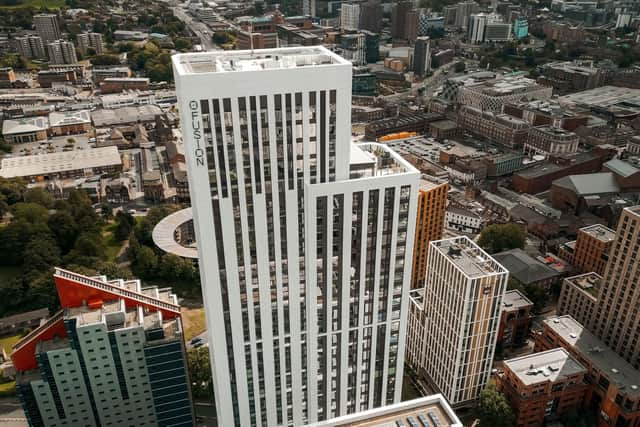
It takes less than a minute to travel from the ground floor to the top of Yorkshire’s newest skyscraper – a 45-storey student accommodation tower near the arena in Leeds.
When the lift doors open on the 45th floor, and your ears have stopped popping, the city looks tiny below and the view stretches out for miles.
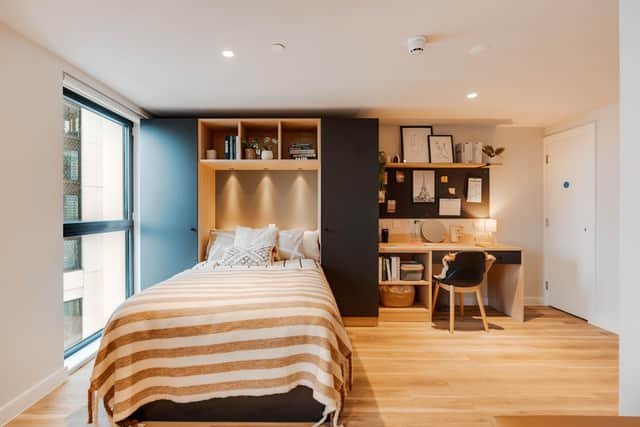
Created by Fusion Students, the tower provides 633 student beds with a mix of ensuite rooms and studio apartments. Prices start from £195 per week for a basic ensuite room, rising to an eye-watering £410 for a penthouse studio on the top floor.
It claims the title of the world’s tallest student tower and Yorkshire’s tallest building, overtaking its 38-storey neighbour, Altus House.
But a visit to the site suggests its ambitions extend beyond the novelty of being the highest. General manager Lindsay Hamilton is focused on making this huge building feel like a community.
Students from across the UK and overseas began moving in at the end of August, with a mix of people studying at the University of Leeds, Leeds Beckett, Leeds Conservatoire and Leeds Arts University.
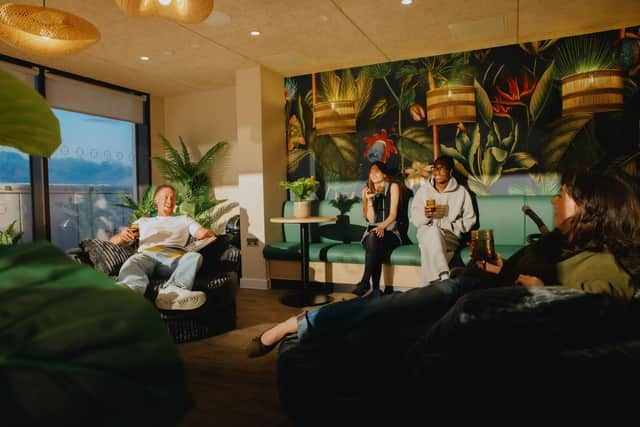
There is plenty to do on site, including a gym, a yoga and pilates studio, photography and recording facilities, a podcast studio, gaming suite, study areas and a 39th-floor social space capable of holding around 200 people.
There is also a private dining room plus a TV lounge, pool table, table football, electronic darts and retro arcade games.
Events are held throughout the week, including yoga, cookery sessions, movie nights and cultural celebrations, with students able to book spaces through the Fusion app. “They’re all very interactive with each other,” says Lindsay. “Before they even moved in they created group chats on the Fusion app so they could interact and get to know each other.
"We can see who is attending events and reach out to those that aren’t.”
Lindsay, who says approximately 150 parcels arrive each day for residents, says one of her biggest challenges is remembering everyone’s names. “I’m a perfectionist, and I also like to make sure that I know everyone’s faces,” she adds.
The team carries out hourly checks around the building, giving staff the opportunity to speak to students and check that they are safe and well.
The 39th floor has emerged as one of the most popular areas, and Lindsay says she particularly likes the TV lounge and fine dining room. “It means students get to bring their family and friends into the building too,” she says.
The practical side of student life has also been considered. Free tea, coffee and cereal are available to all, while pasta, noodles and rice can be taken from a free food store for those who need it. Laundry and bike hire are included in the rent.
A building of this height was incredibly challenging for the people who designed it. Architect Rob Cunniff, director of Leeds-based Cunniff Design, took over the project in 2022, after planning consent had already been granted.
One of the biggest changes to the design followed a detailed fire-safety review. The original design had a single staircase, but with the Building Safety Act coming into force, the decision was taken to introduce a second.
That meant reducing the number of bedrooms from 705 to 633 and changing the balance of accommodation, with the final scheme split roughly 50/50 between bedrooms and studios.
It also allowed the architects to rethink the amenity spaces. Rather than being divided between the 38th and 39th floors, the top amenity level was concentrated on the 39th floor, with further space on the first and second floors.
The extreme height and relatively small footprint also affected some of the less visible architectural decisions. The windows had to be designed so glazing could be fitted from inside the building. “We wouldn’t want to be dangling huge pieces of glass down the side of the building,” Rob says.
Most building maintenance above the lower floors will have to be carried out by abseilers.
The choice of cladding was another significant decision. Rather than the heavier concrete panels used on nearby Altus House, Fusion has aluminium cladding on a lightweight steel framing system.
Rob describes the finished building as “very crisp”, adding: “It’s just a very simple building, which I think sometimes is the best way.”
Earlier in his career, Rob worked on Sky Plaza, which became the world’s tallest student accommodation building when it opened in Leeds in 2009. He sees Fusion as part of the evolution of the city’s high-rise landscape in that part of the city, alongside Altus House and the 25-storey Opal 3 Tower. “I think those three buildings work really well together,” he says. “They give a reference point for miles around.”
But as the city’s buildings reach higher, Rob points out there are practical limits to the race upwards. Construction costs rise sharply once buildings pass 20, 30 and 40 storeys, while lifts, concrete and other structural requirements become increasingly expensive.
“You need very big pockets to build 50 and 60-storey buildings,” he says. “It happens in London but I don’t know if that’s the future for Leeds.”