"I use an iPad to create my paintings like the great David Hockney"
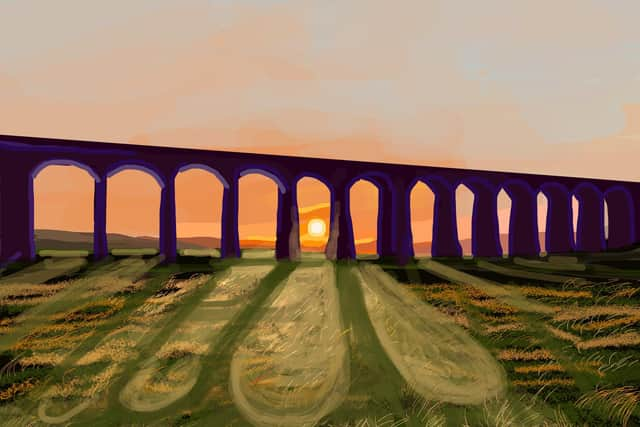
There is something familiarly striking about Samuel Sharp’s artwork. The fine lines, the bold colours, and the sheer vibrancy of the landscapes around his home county of Yorkshire exude a similarity to David Hockney, who was born and grew up in Bradford – the city where Sharp himself resides.
In a coincidental twist of fate, Samuel’s artwork is featured on cards within the 1853 Gallery in Salts Mill.
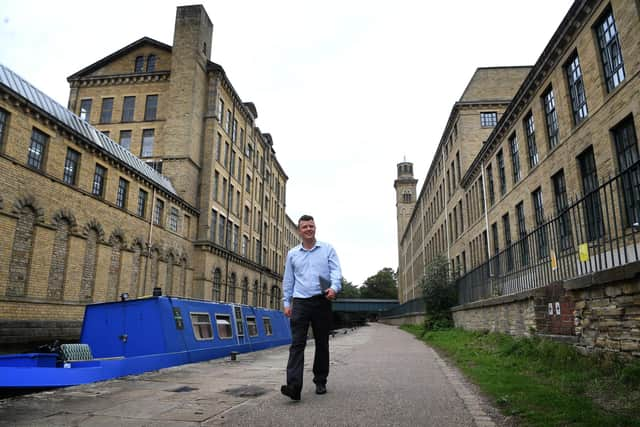
The industrial landmark, in Sir Titus Salt’s purpose-built model village in Saltaire – which this year celebrates the 25th anniversary of its designation as a UNESCO World Heritage Site – is home to many of the late Hockney’s art collections.
Hockney’s connection to this location came through his friendship with Jonathan Silver, the entrepreneur who transformed Salts Mill into the cultural retail destination it is today.
Chatting in the kitchen of the 19th-century Wilsden home that Samuel shares with his wife, Alicia, their two-and-a-half-year-old daughter, Rosie, and four-month-old son, Alfie, he recalls how his own association with the mill began.
“My brother and I were cricketers, and we used to play in Roberts Park in Saltaire. We would walk around the mill, and I remember looking at David Hockney’s work on the wall. That is where I feel I learned how to colour and craft an image and make a picture.”
Back then the opportunities to see the work of great artists beyond the prestigious London galleries would have been few and far between, but Bradford was a place Hockney had once called home, and his influence continues to inspire generations of artists, like Samuel, to adopt their own style and develop their technique.
“Luckily, at Salts Mill, we have David Hockney’s work on our doorstep. Going to primary school in Bradford, I remember art classes were all about Hockney because he was an icon across the world,” says Sharp.
Although art has been an integral part of the 33-year-old’s life, it was financial stability that persuaded him to follow his mum into pharmacy.
“I did A’ levels in biology, chemistry and maths, and I got full marks in A’ level art, but my mum was a pharmacist, so I made what I thought was a sensible decision and picked something I thought would give me a financially secure future. I went to Manchester to study pharmacy at university, and I probably didn’t paint for ten years – I just did little bits here and there,” explains Sharp.
“I qualified to be a pharmacist in 2016, but it was in lockdown that I decided to paint again because we were all trapped in.”
The pressure placed on the health service was unprecedented during that time, and being a community pharmacist, Sharp found picking up his paintbrush and capturing local landscapes in acrylics and oils on canvas gave him solace away from his demanding role.
“It was horrendously busy, but in that time a lot of people also rediscovered passions, and it was in lockdown when I started to paint again. I found it very mindful because, when you look back, it all feels like a bad dream.
“We were going to work in masks, visors and gloves. Everybody else was working from home; you couldn’t see family and friends, so painting was a complete distraction, and I think that is the essence of what I want my painting to be now. I don’t paint to create an ultra-realistic, lifelike still of what is in front of me; it is more about capturing how the landscape makes me feel. I phrase that as emotional realism.”
Landscapes and country lanes remain the focus for his work. It is his choice of medium that has changed, as he explains. “In the past, if you wanted to document something quickly, you would use watercolours to do it because it dries fast and you can go over it, but with an iPad it is even faster.”
Sharp’s recent iPad painting – the top of Otley Chevin – is all the more dramatic for the vibrancy of the colour palette available to the digital artist, yet the addition of some dainty white flowers brings the colourful landscape naturally into perspective.
“It is putting in enough detail so it makes sense. What I learned from Hockney is not to overwork the landscape. Some overwork it too far, and they lose the vibrancy and energy.”
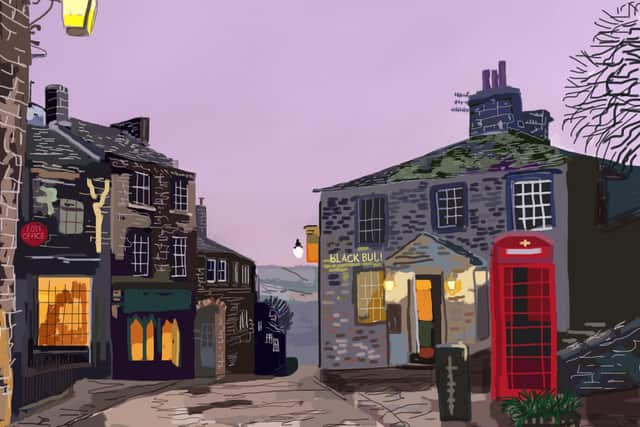
In contrast, the lilac-hued backdrop framing the Black Bull pub at the top of Haworth’s cobbled Main Street evokes an eeriness usually reserved for the blackness of night.
“All of my Yorkshire collection I have done en plein air. I love country lanes, and I have so much inspiration from Hockney’s work in Woldgate Woods. He did a series of 11 tree tunnels, and, for me, they are his best series of work.”
Sharp’s own interpretation is a tree tunnel close to his home that he continues to capture throughout the seasons. The Wilsden tree tunnel is one of many works Sharp has created through the digital medium he tapped into two years ago when he learned the basics of iPad painting during a lesson at Salts Mill.
“I use an app called Brushes. It is the same as what David Hockney used, and it is really instinctive. There is nothing overfancy, and that is why I like it, but it relies on your artistic ability to create the image.”
Sharp says there is still an element of surprise for viewers that his paintings are digitally produced, but, unlike AI, Samuel says it is obvious his work is physically produced by hand. The speed at which he can produce his artwork also prompted the switch from paintbrush to iPad. The prints of the acrylics he was selling took longer to produce, while the digital format is file-ready. “They can also go bigger with perfect clarity.”
Launching his Etsy shop established his customer base. He is also grateful to his workplace, Wilsden Pharmacy, for enabling him to showcase his prints there.
Reaching out to retailers led to his artwork being reproduced onto cards currently being sold throughout 30 shops in Yorkshire and the North East.
Sharp credits his commercial success to Sally Corry at Woodbank Garden Centre, in Bingley, who, as well as stocking his cards, introduced him to card rep John Murphy, who is helping to expand his retail network. Displaying his work in The Bronte Birthplace, in Thornton, where he was artist in residence; York River Art Market; and this year’s Bradford Literature Festival has helped to widen his audience and retail reach.
“During the Festival my work was noticed by a buyer at Waterstones Bradford, and now I have cards stocked in there too. I also did a commission piece they sell as a card and print.”
In February Sharp began working with Wayne Mann, Yorkshire and North East rep for Star Editions, after signing a national licensing agreement with the company for his designs to be adapted into a giftware collection including bags, calendars, coasters, magnets and mugs.
“I was over the moon, and it is because they have such a big distribution network, giving me the logistics to get my artwork across the entire UK.”
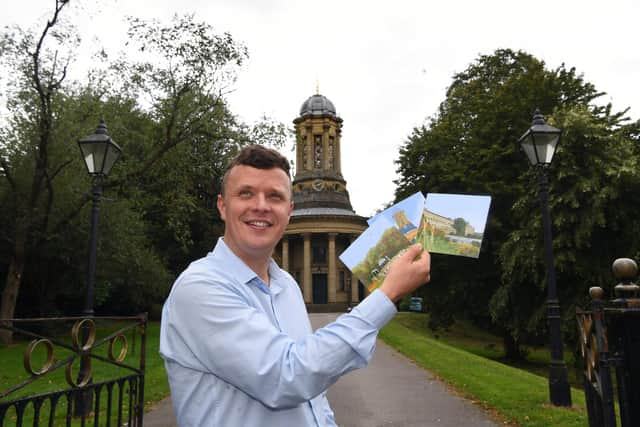
Sharp’s greatest coup was seeing 28 designs of his cards – among them Roberts Park, where he played cricket with his brother – in Salts Mill, where he browsed Hockney’s paintings as a young boy.
“I said to the manager, ‘If you get reports of a man loitering around the card stands for a long time, it will be me because I am so proud.’ It really is a dream account, and they are displayed in the 1853 Gallery surrounded by Hockney’s originals – that is a huge milestone.”