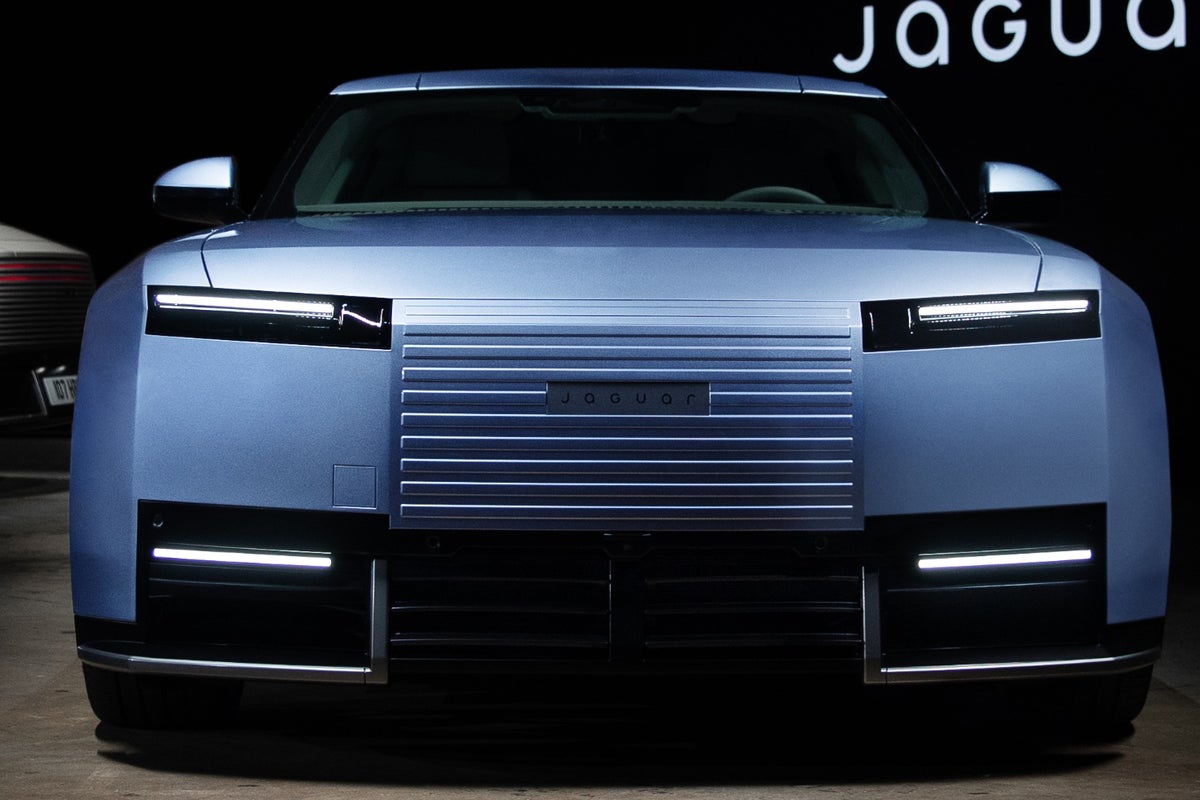
Jaguar says it won’t rush to launch its next new models after the Type 01 was revealed this week to huge fanfare.
Managing director Rawdon Glover has admitted that introducing several cars in quick succession has gone wrong for the company before.
The first job, he says, is to get the new electric GT properly established – and that means finding its customers, getting production up and running and delivering the right experience through its dealers.
When asked whether the Type 01 was still one of three new Jaguars, Glover said: “We’re taking it step by step.”
Further models are coming – a crossover and an SUV are rumoured, likely to be badged Type 02 and Type 03 – but Glover didn’t give a date for the next launch.
“As soon as Type 01 is established, then the next vehicle will come and not before. I’ve experienced this in the past when we launched multiple Jaguars in a really short space of time – it didn’t work. You need to allow them to have room to breathe and to really establish themselves.”
The Type 01 isn’t intended to be Jaguar’s biggest seller, and Glover acknowledged that other models will need to bring in more customers. “Not too long,” was his answer when asked how soon it would be before we’d see those cars, although establishing the first model is clearly taking priority.
That’s something he’s also had to explain to Jaguar’s dealers, whose patience he was keen to acknowledge. Their commitment needs to be repaid, he said, and he shares their urgency: “They’re not going to have to wait too long because I need it too, right?”
Glover said deposits for the Type 01 would open immediately, followed by the full order system early in 2027 and the first deliveries around the middle of that year. But success won’t simply be measured by how many cars Jaguar can get out of the factory. He wants demand to stay ahead of supply.
“So it’s not about chasing volume, this is about making sure we’ve got a profitable business,” he said. “And part of that means we need to make sure that there’s an element of scarcity.”
There’s also the task of persuading buyers that a Jaguar is worth more than twice the brand’s previous average price. Glover accepts that the badge alone won’t do that job: the car needs the substance to justify the price, while the brand must establish itself at a higher level.
“That’s really the key job that we need to do in the next 12 months,” he said.
He’s encouraged by the reaction from potential customers, including a group of wealthy clients who, he said, “wanted to buy all of them” when shown examples of a limited run of Chromatic Moments cars during a preview.
Glover didn’t disclose confirmed order numbers but described the potential early buyers as people with several cars already, rather than someone looking for a replacement for the only car on their driveway.

“They’re interested in cars. They’ve got a whole collection of interesting auto exotica and they see this as nothing else like it,” he said. For Jaguar, the common factor is less about where those customers live than their desire to have something different: “The person that’s going to be attracted to this car is somebody that wants to stand out, somebody that wants something different.”
Finding those buyers also means moving the conversation on from the advertising that accompanied Jaguar’s reinvention in late 2024. Asked whether that campaign had done the job he wanted and what he would have done differently. His answer wasn’t an unqualified defence.
“I guess yes and no,” he said. The campaign’s job was to attract attention, which it had achieved, but not all of the resulting discussion was welcome.
“Did we want to be involved in a political social debate about gender and all sorts of other things? Of course not. So, I think that’s definitely a learning.”

The distinction now, he explained, is that Jaguar has a production car to sell rather than a concept to introduce. He wants the car itself, and the work behind it, to lead the story.
He was rather more direct when I asked about the reaction in Britain. “It’s very British, isn’t it? It’s very British to knock your British brands,” he said, pointing to Jaguar’s investment in British design, engineering and manufacturing. “Why wouldn’t you want to get behind this?”
Glover also acknowledged that Jaguar’s early message had focused on change, with the link to its history harder to communicate, particularly on social media. That doesn’t mean he wants to recreate an old car, though: “Jaguar is a brand with history, but it’s not a historical brand. If it’s a historical brand, it can’t look forward.”
Nor is there any sign of him backing away from electric power. Asked whether Jaguar has to be an EV-only brand, he said: “It is an EV only brand, yes.” For Glover, that choice is tied to the proportions, power, refinement and luxury he wants the cars to deliver. “I couldn’t do any of that with a combustion engine, not at that price,” he said.
He was equally unconvinced by the idea of using hybrid range-extender technology, describing it as “almost the answer to the question that nobody’s asked”. His argument is that adding range wouldn’t change the objection of someone who had rejected the Type 01 because it was electric. Reaching 400 miles of range had been one of the project’s requirements precisely to address concerns about usability, he explained.
That still leaves the bigger question of what happens if the new direction doesn’t work. When I asked whether there was a plan B, or whether this was Jaguar’s last chance, Glover didn’t set out an alternative strategy. He said deciding whether it was the brand’s last chance wasn’t his call. “That would be a question for others,” he said. Instead, he stressed the support of Jaguar’s shareholders and his team’s job of making the best Jaguar it could.
“They’ve been extremely supportive in everything so far. We’ve got no reason to believe they wouldn’t be supportive moving forward.”