Mathematician Rachel Riley: '3,000 people applied for Countdown and with no TV experience, I never expected to get it'
Countdown number expert Rachel Riley speaks to Laura Reid about the importance of maths, how it connects to the real world and its surprising applications.
Fresh out of university as a maths graduate, Rachel Riley spent her daily commute in and out of London with her nose in a Countdown puzzle book. Like several thousand other people, she’d applied to take over the baton of the show’s mathematician from long-standing number expert Carol Vorderman.
With no TV experience, she hadn’t expected to hear back but found herself among 100 selected for interview. “Doing this puzzle book, I started to see the patterns in how to solve the problems,” she says. “I’d always watched the show and when it came on I’d do the numbers round for a bit of fun. But once I started looking at how it works, it’s all about pattern spotting and deciphering, the kind of thing that’s a mathematician’s jam.”
Needless to say, she got the job, and has spent nearly 18 years now with the Channel 4 show. Last week, she was back in Leeds, the city where she passed the final screen test, hoping to inspire more budding mathematicians. Rachel was the host of the Leeds International Festival of Ideas event Is maths the root of everything?, joined on stage at Leeds Playhouse by a panel of people who together explored how maths is all around us and the opportunities it can present when it comes to the world of work.
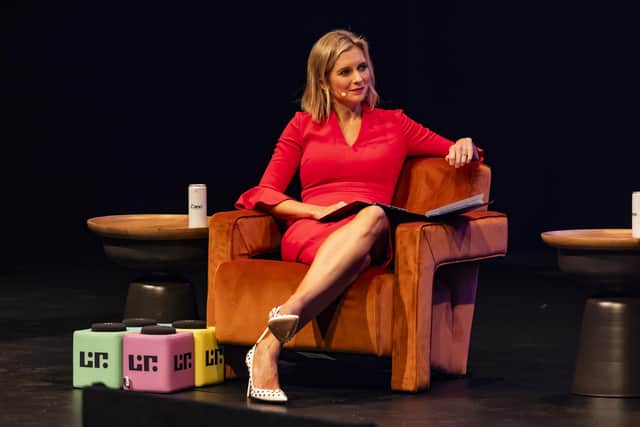
"The festival pulled together a really interesting group of people who use maths in ways that your average (person) might not know,” reflects 40-year-old Rachel. “I think people traditionally hear maths and just think numbers…People don’t necessarily know what mathematicians are doing so this was a great opportunity to discuss the wider topics from education, to applications in the real world, and just fun questions for the sake of it. It was a great maths positive event.”
The panellists offered insight into how they use maths in their working lives. Dr Ollie Halliday, for example, a Senior Manager in Weather and Catastrophe Modelling at Lloyds Banking Group highlighted the maths behind extreme weather and climate change considerations and how that is embedded into the financial services industry to help it better understand and manage risk.
Professor Ben Gaunt, an award-winning musician and lecturer at Leeds Conservatoire, shared how pattern-based maths plays a role in musical composition, whilst chartered engineer Professor Cath Noakes explained how mathematical modelling and research into building ventilation, air quality, and infectious disease transmission have shaped the design of indoor environments as well as public health policy, including the response to the COVID-19 pandemic.
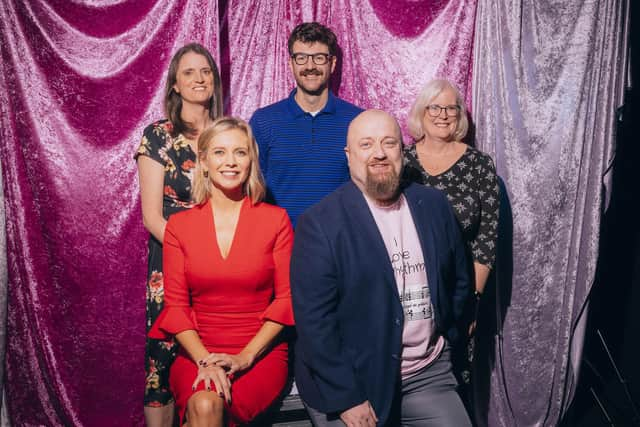
Also on the panel was Dr Katie Chicot, the CEO of MathsWorldUK and European Mathematical Society outreach committee chair. She works to make maths more accessible and engaging, including offering people the chance to ‘play’ with the subject in the hands-on non-formal setting of MathsCity in Leeds. Informal STEM (Science, Technology, Engineering and Maths) experiences are among the most powerful drivers of a person’s decision to pursue a career in a STEM field, supporting confidence and curiosity and allowing people to explore maths in real-world contexts.
This knowledge is behind Leeds’s two-year City of Maths celebration, which through a range of activities is helping to boost engagement, confidence and enjoyment with mathematical thinking, whilst highlighting the importance of maths in how it connects and contributes to real life, careers, creativity, and communities.
“It’s crucial to show that maths exists outside the classroom and isn’t just about number crunching and exams,” says Katie, one of the team behind the programme. “We want everyone to see that there’s a type of maths that’s for them, and that a stronger relationship with maths will make a difference to their life.”
For Rachel, throughout her degree, there was a desire to use maths within the real world, but she admits she wasn’t sure about what path she wanted to take. “I was at Oxford and the people coming to recruit us really were management consultancies, finance and the legal firms,” she says. “I quickly realised that wasn’t for me.”
Her family and friends encouraged her to apply for the Countdown role. “I was applying for loads of different grad jobs and most of them were like write a tome on when you’ve worked in a team and this, that and the other. Countdown wanted 50 words and a photo. It was something I’d always watched after school as a kid, I loved puzzles and I loved the game.
"I never expected to hear back. The story goes they had about 3,000 applications and they interviewed 100 of us. Two producers were sitting there asking maths questions and staring at me whilst the Countdown music was going. Six of us got taken for a screen test in Leeds and the rest is history.”
There’s a big gap in understanding of where maths can take people when it comes to careers, she says, and “if you can’t see someone that you relate to doing those jobs, you might not necessarily see yourself doing them either”.
Key is supporting children to grasp the building blocks of maths and then putting more examples of people in different industries, from different backgrounds, in front of them, she says “so they can see the opportunities out there and what maths and STEM can offer”.
"I get to meet so many different people working in various sectors of STEM,” she continues. “And I try and share some of those stories to younger people, to show where maths can take them. Not necessarily on telly, but there are so many opportunities. Basically it can take you any route you choose.”