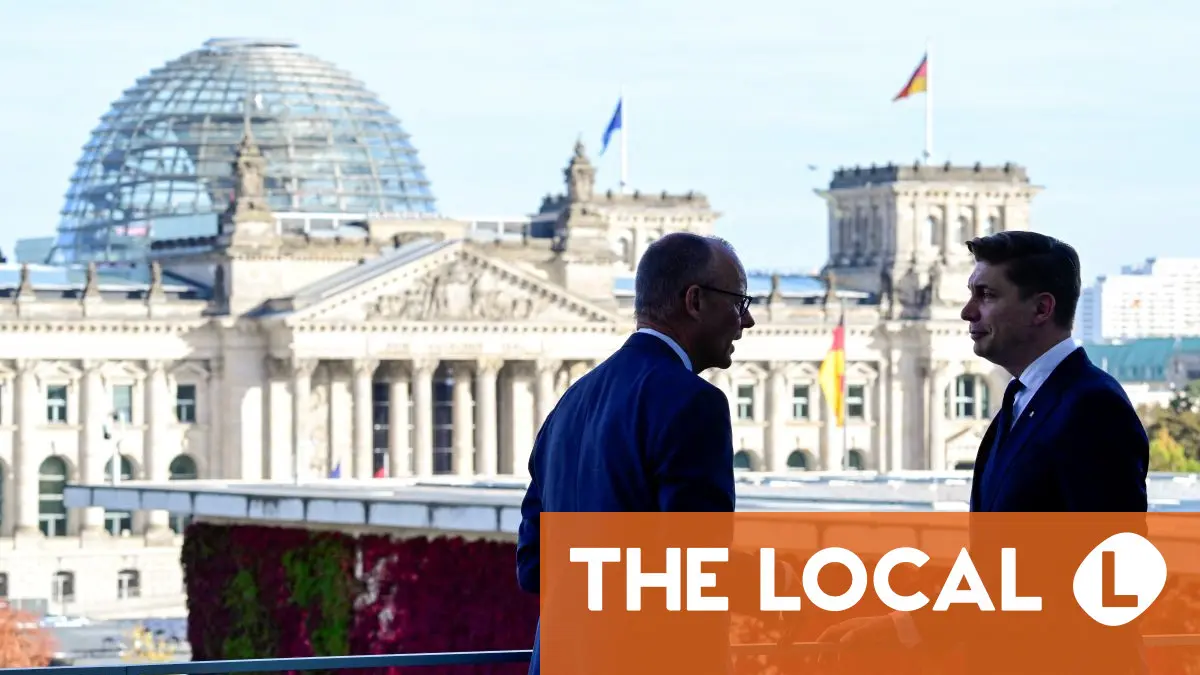
Tuesday's top story: Baltic defence is Germany’s defence, says Merz
German Chancellor Friedrich Merz has declared that the security of the Baltic states is inseparable from Germany’s own security, as he welcomed Lithuanian Prime Minister Mindaugas Sinkevicius to Berlin.
Speaking at a joint press conference, Merz stressed that Germany remained firmly committed to NATO’s eastern flank and confirmed that the German brigade stationed in Lithuania would be fully operational by the end of 2027.
The deployment, he said, demonstrated Berlin’s determination to deter Russia and uphold its alliance obligations.
Merz warned that Russia was intensifying hybrid attacks against both Germany and Lithuania in an effort to undermine support for Ukraine and create divisions within NATO. He insisted that such efforts would fail and reiterated Germany’s commitment to backing Kyiv for as long as necessary.
Sinkevicius thanked Germany for its support and highlighted Lithuania’s own defence investments. He noted that the country had allocated a record €4.8 billion defence budget this year, equivalent to more than five per cent of GDP.
NATO has strengthened its eastern defences since Russia’s invasion of Ukraine, with Germany’s permanent brigade in Lithuania expected to comprise 4,800 troops and 200 civilian staff by 2027.
READ ALSO: Will Saxony-Anhalt's parliament elect a far-right president?German researchers win Nobel prize in medicine
A Berliner and a Würzburger, as well as an American, received the Nobel Prize in Medicine this year.
Peter Hegemann, Georg Nagel and Karl Deisseroth share the award for their work which shows how nerve cells in the brain shape memories, feelings and behaviors.
Hegemann conducts research at the Humboldt University of Berlin, Nagel at the University of Würzburg. The researchers will each receive a third of the prize money of the equivalent of around one million euros.
The three researchers have developed a tool for researching communication between nerve cells in the brain. They found a way to switch certain nerve cells in the brain on or off with light, and can then observe whether this creates a memory or a feeling, for example. The method is called optogenetics.

"The importance of optogenetics extends far beyond the understanding of the healthy brain," explained Abdel El-Manira of the Karolinska Institutet. It can reveal when certain brain circuits are disturbed, which can lead to diseases such as blindness, depression, addiction or dementia.
"This method is now used in laboratories around the world to unlock the secrets of the brain," the Nobel Committee wrote on X.
Flight prices from Germany have doubled since 2010
Flights to and from Germany have become considerably more expensive in recent years. This is the result of a joint report by the Federal Association of the German Aviation Industry (BDL) and the German Aerospace Center (DLR).
According to the study, the average ticket price developed from just under €150 to around €300 between 2010 and 2024 - so it roughly doubled.
LISTED: The new direct flights from Germany in Autumn 2026
The report cited increased government taxes such as aviation tax, aviation security levies and air traffic control fees as reasons, but also higher personnel and operating costs at the site.
At the same time, international air traffic from Germany is increasingly going through hubs outside Europe -- especially via the Gulf region and Turkey, the report suggests.
‘Die Lücken’ wins German Book Prize
Author Shida Bazyar has won the 2026 German Book Prize for Die Lücken (The Gaps), a novel examining Jewish life, Germany’s Nazi past and the experiences of migrants in a small Hunsrück town.
Awarding the prestigious literary prize in Frankfurt, the jury described the book as a “novel against indifference” and praised its exploration of nearly a century of German history through the lives of individual characters.

READ ALSO: The six novels battling to win the German Book Prize 2026
In her acceptance speech, Bazyar warned of growing political radicalisation in Germany, pointing to rising levels of antisemitic and racist crime. The writer, whose parents arrived in Germany as Iranian refugees, urged the public to resist extremist narratives and expressed concern over calls for the “remigration” of immigrants.
German Publishers and Booksellers Association president Sebastian Guggolz echoed the jury’s praise, noting the novel’s focus on the role ordinary people play in shaping community and belonging.
The €25,000 prize was awarded on the eve of the Frankfurt Book Fair, which opens officially this week.
German intelligence warns of risks from Chinese tech
German intelligence services warned Monday that Chinese high-tech goods could pose security risks due to the potential for data to be collected and passed on to "state agencies".
Concerns are mounting in Germany about the threat from an overreliance on Chinese technology as sales grow of equipment ranging from electric vehicles to robot vacuum cleaners.
Sinan Selen, the head of Germany's BfV domestic intelligence agency, said he viewed the issue "with great concern".
"I already see substantial shortcomings that create potential for abuse," he told a hearing of parliament's intelligence oversight committee in Berlin.
Germany and China, the world's third- and second-biggest economies respectively, have long had deep ties, especially in the field of commerce.
But relations have become more strained as Berlin increasingly worries about an economic overreliance on China, and as Chinese firms increasingly compete directly with German manufacturers.
Berlin previously announced the phase-out of components from Chinese telecom giants in its 5G networks due to security concerns, and has also blocked or watered down attempted Chinese investments in strategic sectors like chipmaking.
READ ALSO: Germany urges EU action against China to defend carmakers
With reporting by AFP and Paul Krantz.