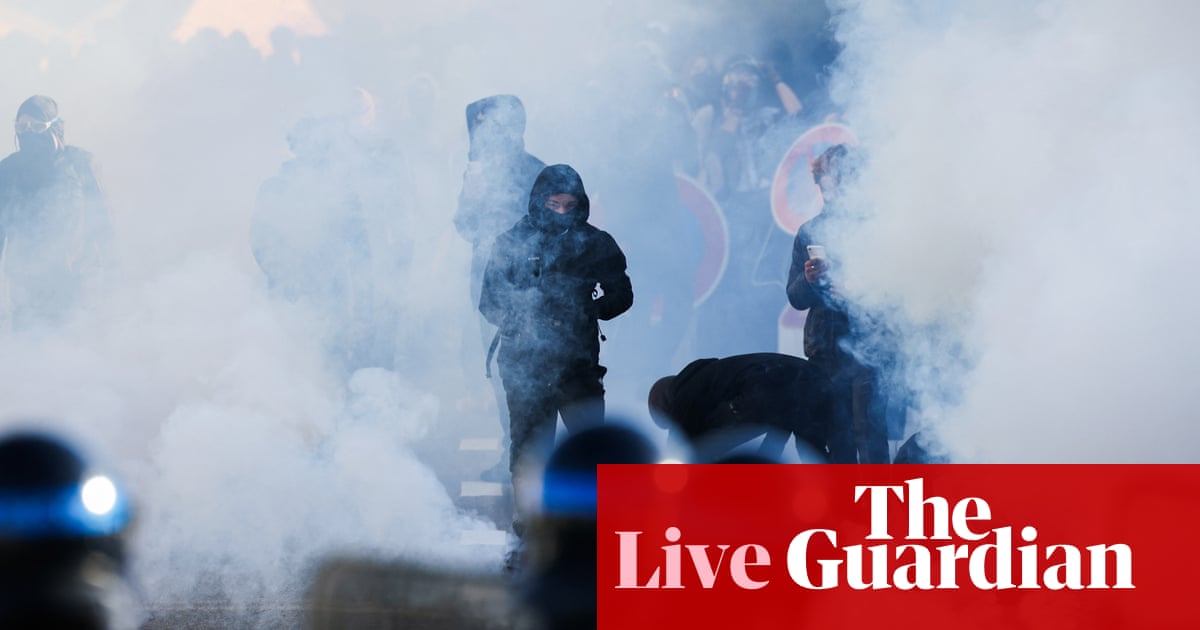
Police officers stand in front of protestors amid tear gas as protesting students carry out blockading action Photograph: Fred Tanneau/AFP/Getty Images
Police officers stand in front of protestors amid tear gas as protesting students carry out blockading action Photograph: Fred Tanneau/AFP/Getty Images
Clashes between protesters and law enforcement during a student demonstration near Place de la Bastille in Paris. Photograph: Raphaël Lafargue/ABACA/Shutterstock
High school students in front of Lycee Sophie Germain continue to block the entrances to schools in Paris. Photograph: Nik Erik Neubauer/ZUMA Press Wire/Shutterstock
A 15-year-old student reportedly had his hand blown off on Monday during a protest in Lens, as reported by AFP.
A police union source said the student in the northern town of Lens appeared to have picked up a teargas grenade fired by riot police, hoping to fling it back, but the device exploded in his hand.
Elsewhere, a 17-year-old was arrested after allegedly throwing a piece of stone at police officers, striking a passerby in the face and making him lose sight in one eye, Le Figaro reported.
A protester is detained by riot police officers during clashes near the Place de la Bastille in Paris. Photograph: Lou Benoist/AFP/Getty Images
Romania's Dan hopes to name another PM candidate today
In other news from Romania, we are waiting for an update from the country’s prime minister Nicușor Dan who is expected to name his latest preferred prime ministerial candidate later today.
Alexandru Rogobete, deputy for the Social Democratic party, attends the consultations with Romanian president Nicușor Dan at Cotroceni palace. Photograph: Lucian Alecu/Shutterstock
His last candidate, Siegfried Mureșan, lost a key parliamentary vote last week, forcing the president to have another go at finding a new person for the top job.
Two dead after fire on ship outside Romania's territorial waters, which Ukraine says Russia is responsible for
Separately, Romanian authorities said that two people died and others were rescued after a fire on a ship in the Black Sea outside Romania’s territorial waters, as Ukraine blamed Russian drones for the incident.
A rescue operation following a fire on a vessel outside Romania's territorial waters, in which two people died and others were rescued. Photograph: Romanian Interior Ministry/Reuters
Romania’s interior ministry said 11 crew members of the ship which sank had been rescued. The country’s Naval Authority said the incident involved a fire on the ship Royad Mammadov, Reuters reported.
Romania did not comment on the cause of the fire but Ukrainian president Volodymyr Zelenskyy said it had been caused by Russian drones. He confirmed the death of one person in the incident but said a second person had yet to be accounted for.
Russian authorities had no immediate comment. An earlier daily bulletin from the Russian defence ministry said Russia had struck two cargo vessels.
'We will yield neither to intimidation nor to Russia’s escalation,' Macron says
In other news, French president Emmanuel Macron Monday condemned Russia ramping up strikes on Ukrainian civilian infrastructure, calling it “irresponsible” after speaking with Ukraine’s Volodymyr Zelenskyy on ways to bolster support for Kyiv, AFP reported.
A Ukrainian expert inspects the site of a Russian drone strike on a bridge across the Dnipro River in Kyiv, Ukraine. Photograph: EPA
Russia “has made the irresponsible choice to intensify its strikes on civilian infrastructure and targets”, Macron said on X.
He said Zelenskyy and he reviewed “the concrete support we can provide” to help Ukraine intercept drones and defend itself against Russia’s attacks.
“We will yield neither to intimidation nor to Russia’s escalation,” Macron said, accusing Moscow of “stubbornly refusing all calls for a ceasefire.”
EU’s chief diplomat Kaja Kallas also warned Russia is putting lives at risk with its growing carelessness when it comes to hybrid attacks in Europe.
“Europe has seen a spike in the Russian hybrid attacks and sabotage attempts and airspace violations in recent weeks. Russian missiles and drones violated Moldovan airspace again over the weekend. And this is completely unacceptable,” she told reporters in Brussels, as reported by Reuters.
Over the weekend, embattled German chancellor Friedrich Merz also visited Zelenskyy in Kyiv, as the city continued to face attacks from Russia.
Germany's chancellor Friedrich Merz and Ukraine's president Volodymyr Zelenskyy attend the site of a Russian strike on the building of the National Academy of Sciences in Kyiv, Ukraine. Photograph: Maxym Marusenko/EPA
Russian drone hits key bridge in Kyiv on German chancellor's visit – video
Two German scientists and an American peer have been awarded the Nobel prize in medicinefor their workinvestigating the mysteries of the brain. Peter Hegemann of the Humboldt University of Berlin, Georg Nagel of the University of Würzburg and Karl Deisseroth of the Howard Hughes Medical Institute and Stanford University were recognised for “their discoveries concerning light-gated ion channels and optogenetics”.
In a nutshell – their research led to the development of a light-sensitive switch that can be used to control nerve cells in the living brain, switching them on or off.
This is the week of the Nobel Prize announcements – with the Nobel assembly at the Karolinska Institute in Stockholm, Sweden, announcing the winners of the first award today.
You can read more about the scientists’ breakthrough below:
The euro has fallen to its lowest level against the US dollar since May 2025 amid concerns over France’s burgeoning public debt and an aggressive sell-off in government bonds.
Monday’s trade saw the euro drop as much as 0.9%, after four straight weeks of falls against the dollar. 1 euro is currently worth US$1.12.
The yield on France’s 10-year government bonds – the benchmark used to price fixed-rate mortgages, credit cards and other consumer loans- is now also nearing 5%, meaning the government is having to pay a significantly higher interest rate to borrow money. That multi-decade high will also affect consumer loans.
Spain’s snap election called this morning too is also adding to some of the Eurozone uncertainty and volatility.
The euro has also dropped further against the pound. It’s now worth 85p.
The French education minister said yesterday that 78 teachers and other education staff had been injured in the student protests so far, while in some cases, members of the public have also been caught in the fray.
But students have also accused police of brutality and using excessive, disproportionate force against them. Rights groups have also raised concerns over violent arrests.
Amnesty International said last week: “Images of high school students being subjected to violence by law enforcement are extremely concerning. Many of them are minors, children. They must be protected, not beaten with batons,” the human rights group wrote on X.
Along with this incident we’re hearing of in Lens this morning where a boy reportedly had their hand blown off by a police grenade, Amnesty last week reported that a 14-year-old had been hit by a grenade to the jaw where he lost several teeth, while other students had been arrested under chokehold techniques by police.
The French Human Rights League (LDH) on Monday also raised the alarm.
“We can see that in the instructions given to the police, there is no directive to show restraint, even though they are dealing with children,” LDH president Nathalie Tehio said.
A reminder that students are protesting en masse against the state of their schools – the overcrowded classes, run-down school buildings and shortage of teachers. The protests began on September 17 in the Parisian suburb of Creteil when students there joined their teachers who were striking over the lack of resources and staff.
French education minister condemns 'acts of extreme violence,' but defends democratic right to protest
Today’s violent clashes raise concern about tomorrow’s big “day of protests” in France, as several groups mobilise to show their discontent with the state of the education system.
Clashes between protesters and law enforcement during a student demonstration near Place de la Bastille in Paris, France. Photograph: Raphaël Lafargue/ABACA/Shutterstock
But education minister Édouard Geffray insisted that the protests represent “a freedom that must be respected and protected,” Le Figaro reported.
But he strongly criticised “acts of extreme violence” including, in some cases, direct attacks on schools principals.
Clashes between protesters and law enforcement during a student demonstration near Place de la Bastille in Paris. Photograph: Raphaël Lafargue/ABACA/Shutterstock
High school students in front of Lycee Sophie Germain continue to block the entrances to schools in Paris. Photograph: Nik Erik Neubauer/ZUMA Press Wire/Shutterstock
A 15-year-old student reportedly had his hand blown off on Monday during a protest in Lens, as reported by AFP.
A police union source said the student in the northern town of Lens appeared to have picked up a teargas grenade fired by riot police, hoping to fling it back, but the device exploded in his hand.
Elsewhere, a 17-year-old was arrested after allegedly throwing a piece of stone at police officers, striking a passerby in the face and making him lose sight in one eye, Le Figaro reported.
A protester is detained by riot police officers during clashes near the Place de la Bastille in Paris. Photograph: Lou Benoist/AFP/Getty Images
Germany at risk of conflict with Russia as it steps up its 'shadow war' activities, intelligence chief warns
In other news, Germany is at risk of entering a violent conflict as Moscow steps up an increasingly aggressive “shadow war” against European democracies, its head of foreign intelligence warned, as reported by Reuters.
Martin Jäger, President of the BND, attends a meeting at the Bundestag. Photograph: Action Press/Shutterstock
“The confrontation we are facing with Russia has taken on a new, more dangerous dimension,”Martin Jäger, head of the Bundesnachrichtendienst (BND), told the annual public hearing of intelligence chiefs in parliament.
“Germany is in danger of becoming embroiled in a violent conflict with Russia – the attempted attack in Leipzig is just one example,” he said, describing Russia as “waging a shadow war” with the threat of attacks against targets in Germany remaining “real and imminent“.
German authorities have warned repeatedly that Russia is conducting a hybrid campaign of drone and cyber-attacks, and have blamed it for an attempted drone attack on Leipzig airport in August.
Jäger, however, said Moscow was prepared to use force to achieve its goals, and that Russian intelligence services’ operations in and against Germany were “increasingly aggressive“.
“Russia is putting us to the test and closely watching how we handle this situation. From the perspective of the Kremlin leadership, any sign of wavering invites them to further increase the pressure on Germany.“
Jäger said there was no indication of an imminent large-scale Russian attack on Nato territory.
“However, Russia could engage in low-intensity military activities, particularly in the Baltic states.“
Germany must prepare for more meddling and attempts at intimidation, including threats of nuclear attack, he said.
“Moscow is betting on our weakness”, he added. “We have to stand up to that.“
Jäger said Moscow was trying to compel Germany, Ukraine’s largest donor, to drop its support.
“Russia is determined to bring Ukraine to its knees this coming winter,” he said. “We must expect Russian attacks of a severity and brutality that we have not yet seen.“
President Pedro Sánchez greets the supporters of the left-wing PSOE party celebrating after the results of the 23 July elections in 2023. Photograph: Diego Radames/SOPA Images/Shutterstock
Sánchez’s minority coalition government with the smaller, leftwing Sumar alliance, has struggled to get legislation through a fraught congress and has not passed a budget since 2023. Junts, which offered him its conditional support three years ago, has attempted to extract maximum benefits from the government, only to abandon it when it feels so inclined, as it did with the emergency housing measures.
Dozens of young migrants walk escorted by riot police officers during the eviction of the makeshift camp on El Trampolin beach in Ceuta. Photograph: Fabian Suspensivo/ZUMA Press Wire/Shutterstock
Faced with all that, it’s not hard to see why the prime minister may have decided that an early election was preferable to several more months of legislative deadlock, mud-slinging and uncomfortable headlines.
Prime minister Pedro Sánchez attends the extraordinary plenary session of parliament last week. Photograph: David Canales/SOPA Images/Shutterstock
Sánchez, a politician with an almost feline allocation of lives, will be hoping that his efforts to tackle the housing crisis will contrast sharply with those of his rightwing opponents and thereby mobilise disenchanted voters.
Perhaps unsurprisingly given what’s at stake, the prime minister is once again pushing to characterise this latest election as a simple choice between progressive and reactionary politics.
“You, the men and women of Spain, must decide whether you want to join the far-right wave that drives regression wherever it governs, or to ensure that Spain remains a bastion of openness, social justice, and environmental responsibility.”
His opponents, meanwhile, will be hoping that, after eight long years, the public has grown tired and disillusioned, and that the great survivor of Spanish politics has finally lost his lustre.