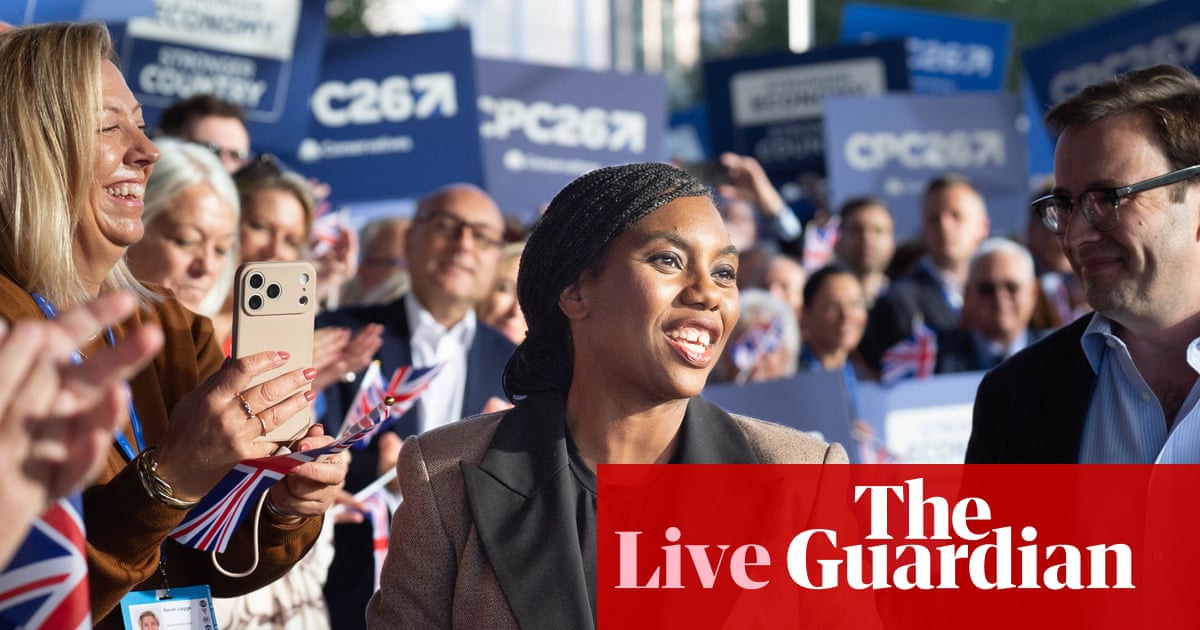
Conservative party leader Kemi Badenoch, with her husband Hamish, arriving at the party’s conference in Birmingham on Saturday ahead of it kicking off today. Photograph: Stefan Rousseau/PA
Conservative party leader Kemi Badenoch, with her husband Hamish, arriving at the party’s conference in Birmingham on Saturday ahead of it kicking off today. Photograph: Stefan Rousseau/PA
Badenoch says Tories want to have policies 'for everybody' as she defends plan to let people earning £1m to get free childcare
Kemi Badenoch recorded her interview with Laura Kuenssberg yesterday. It is playing out on the programme now.
In it, Badenoch defended her plan to extend free childcare to high earners. (See 9.08am.)
She said:
What we want to see is that people who work harder don’t get punished for doing so. If you earn £100 a pound over £100,000, you could lose £10,000, £20,000 worth of childcare. And we don’t want people to stop working because of that.
Asked if she would be happy for someone earning £1m to be able to get free childcare, Badenoch said it did not matter what people were earning.
But she said the policy was aimed at people caught by the cliff edge.
The kind of people that we’re really targeting [might be] a deputy headteacher who wants to become a head teacher. She goes from £85,000 to £110,000. She’s got three kids. All of a sudden she’s losing tens of thousands of pounds.
Asked why the Tories were not proposing a means test, so the very rich would not qualify, Badenoch said:
I believe that the number of people who have very small children who are earning tens of millions of pounds is negligible.
But she also said she wanted the Tory conference to show that the party had “policies for everybody, whether you don’t earn, whether you earn a little, whether you’re an a bit, whether you earn a lot”.
She went on:
We want everyone in this country to know that if you are out there working, the Conservative party has got a plan for you.
Greens express concern that, despite Labour's U-turn, some suspects will still lose right to jury trial
The Greens have also described the Labour U-turn on limiting access to jury trials as a victory for their campaigning. (See 8.22am.) But they are concerned that, even under the new proposals announced today, some suspects who can currently opt for a jury trial will lose that right.
Siân Berry, the Green party’s home affairs spokesperson, said:
This is a victory for justice and fairness, and is yet another concession from the prime minister to Green pressure - as Zack said at conference: ‘vote Green and watch Labour move.’
Greens in parliament argued so hard for these clauses to be removed from the courts and tribunals bill, and my proposals to preserve jury trials and the freedom of juries to acquit, were voted down time and time again in the public bill committee I sat on. Finally, Labour has seen sense.
However we need urgent clarification from the Government on the crucial issue of precisely which cases may still have the right to jury trial removed by a judge who is given what the government calls ‘a final say’. If the reference to ‘relatively minor cases’ means all either-way offences, this still potentially removes the right to trial by jury from all protest cases and all cases of alleged theft. This would remain a major erosion of the right to jury trial through the back door.
In interviews this morning, Alex Norris, the justice secretary, has said he will give full details of the changes he is making to the bill when the Commons returns after the conference recess.
Badenoch publishes The Right Way, 100-page guide to her political philosophy
Kemi Badenoch has published a 100-page guide to her political philosophy. It is called The Right Way, and it is in part modelled on a pamphlet published by the Tories soon after Margaret Thatcher became leader in the 1970s. That one was called The Right Approach and drafted by Keith Joseph.
In her foreword, Badenoch says that the 30,000-word booklet is not a policy document; it is a statement of principle.
She explains.
In February 2026, the former head of MI6, Sir Alex Younger, addressed the Conservative parliamentary party. When I interviewed him on stage, he started with a warning: once you are in government, there is no time to construct first principles. If you have not worked out how you think before the crises arrive, you end up reacting to them one by one.
This is where the last Conservative governments went wrong, before they went wrong about anything else. We do not intend to make this mistake again. The Right Way is our answer to the challenge the now late Sir Alex Younger posed.
Good government enters office knowing how it thinks. A manifesto full of suggested policies for current, visible problems is not enough. Many problems a government ends up dealing with are not known at the time of the election. What is essential for success is a settled way of approaching the problems nobody predicted, how to recognise trade-offs, what government should do itself, what it should leave alone, and how to decide when circumstances, and indeed the world, change.
In her interview with the Times yesterday, Kemi Badenoch said she regarded Nigel Farage, the Reform UK leader, as a “grumpy grandpa”.
Asked what equivalent label she would apply to Andy Burnham and to herself, Badenoch told Laura Kuenssberg:
Andy Burnham is the cheesy uncle. I think he’s the cheesy uncle who does all the dad jokes. And what am I? Someone else has to do that. It’s very difficult.
Pressed to give an answer, she replied:
They probably see me, you know, as the no-nonsense mum. No nonsense, [that’s] probably me.
Badenoch defends arguing cheating significant problem in benefits system
Kemi Badenoch repeatedly claims the benefits system is being abused. But, when Laura Kuensseberg asked her how many people she thought were cheating the system, she did not give a figure.
Badenoch replied:
I don’t have exact figures for you, but what we have seen is an explosion in the number of people who are claiming for low-level, conditions … ADHD, anxiety. These are conditions that work would actually help them with. We are seeing because of the stopping of face-to-face assessments during Covid for understandable reasons.
People have worked out how to game the system. I don’t believe that that’s right.
When Kuenssberg pressed her again for an estimate, Badenoch could not give one. But she said her team would supply Kuenssberg with a figure later.
Kuenssberg said that, if Badenoch was talking about benefit claims being bogus, people were entitled to know if she was talking about a tiny number, or 20/30%.
Badenoch replied:
I’ll give you I’ll give you one statistic, which I saw the other day; that the increase in disability claimants has been higher in the UK than it has been in Ukraine where they’re actually at war. That cannot be possible.
We have now one in four people in our population self-reporting as disabled. That cannot be right. Something is going wrong.
Later, in the live section of the programme after the pre-recorded interview, Kuenssberg said the Tories had not given her a figure for the number of people supposedly cheating the benefits system. But she said they said almost £10bn is lost through fraud or error, and that nearly 7% of universal credit (UC) claims are fraudulent.
That is a reference to these figures from the Department for Work and Pensions. They show that fraud in the UC system was actually higher under the last government – but that can be traced back to a high spike during Covid.
Badenoch says current triple lock 'right policy' - but declines to say Tories will always keep it
In her BBC interview, Kemi Badenoch was asked if she could say she would never change the pensions triple lock. Laura Kuenssberg asked her if she could say she would never touch it.
Badenoch did not quite give that assurance. Instead, she replied:
The triple lock is our policy. We believe that this is the right policy for pensioners. That is what we have planned, that is what we have promised.
There is nothing that has happened that has made me change my mind. That is our policy.
Given that Andy Burnham has said that he wants to legislate to end the pensions triple lock before the next election, it is possible that the choice for Badenoch when that election happens won’t be whether or not to keep the triple lock, but whether or not to restore it to the more generous version it was before Burnham amended it.
In her interview, Badenoch also suggested that more has to be done to protect politicians. Asked about the man accused of murdering Ann Widdecombe being charged with planning a terror act against Nigel Farage, Badenoch said:
I just think that whether it’s Nigel Farage or even Keir Starmer who had his home firebombed, that there is a threat to politicians that is increasing and we just need to crack down on this.
Let’s build the prison spaces so that we can put people who are making these threats and threatening politicians. But what I want the public to know is that my priority really is their safety.
In her BBC interview, Badenoch rejected suggestions that the Tories were regaining their “nasty party” reputation under her leadership.
She said:
It’s the common sense party. That’s what we’re doing.
And, quite frankly, if we were doing so well the old way, then why did we have such a terrible issue in 2024?
I am a classic old-school Conservative. I believe in common sense: people working hard and being rewarded for that effort.
We look after those who can’t look after themselves. Welfare should be a safety net, not a lifestyle. But this is an amazing country and I want us to look to the future and see what we can do, not just hark back to the past.
Badenoch also said her values were timeless.
Personal responsibility is not a 1980s idea. These are the things that keep us going and we need that, the principles are timeless.
Badenoch claims pensions triple lock should stay because pensioners 'have contributed'
On Friday the Times revealed that Katie Lam, the communities secretary, told a meeting in private earlier this year that the state pension system needs a fundamental overhaul.
Speaking in June, when she was a frontbencher but not yet in the shadow cabinet, Lam was asked at a meeting with activists if she thought the pensions triple lock was sustainable. She replied:
Ultimately I think what we will need in the end is an entirely new pension system.
I mean, a baby that is born today has a 20% chance of living to be 100 and I don’t think we can fund one in five people half of their lives, you know, for the first 20 and the last 30 years. But obviously if you are 90 you probably can’t go out and get a job right, so I think you have to be realistic about how you would taper that and bring that in across the population.
I just think the whole system as it stands can’t stand for very much longer.
Asked about Lam’s comments, Badenoch said her shadow minister was right to say what mattered was growth. She went on:
The fact is, the triple lock and pensions are things that people have contributed to.
Conservatives believe that if you have contributed, then you deserve to get your state pension.
What we don’t want to see is people going after the elderly, chasing after vulnerable and disabled people, and then the extremely large cohort of people who can work, who are not working, [being] left alone [ie, not having their benefits cut].
Badenoch claims rising costs of pensions triple lock would not be problem if economy growing more quickly
Badenoch gave a similar answer when Kuenssberg asked her to defend her support for the pensions triple lock.
She said she accepted there were “good people” on both sides of the argument about keeping or changing the triple lock. But she said, as party leader, she had decided the Tories would stick with it. She went on:
The reason why is because what is going wrong in our economy is not lots of elderly people earning £10,000, £12,000 a year on the state pension. It is the huge number of people who can work, who don’t work.
Kuenssberg said 55% of welfare spending is now going on pensions, and that in 2017, when Badenoch was first elected, the Tories were promising to change the triple lock.
Badenoch replied:
We’ve had different policies at different times. We go with what the leader does. I am the leader now and what I am saying is that our economy is not growing. Changing and moving around the triple lock does not create growth.
In fact, if we were growing at 2 or 3%, nobody would be talking about the triple lock.
Kemi Badenoch being interviewed by on the BBC's Sunday with Laura Kuenssberg Photograph: BBC
When Laura Kuenssberg asked Badenoch whether it was a good use of public money to spend it on subsidising childcare for “incredibly wealthy” people, Badenoch switched the subject to the amount spent on benefits for people not working She replied:
This policy is about people at that cliff edge. What is not a good use of taxpayers money is paying thousands and thousands of people who can work, not to work.
Badenoch says Tories want to have policies 'for everybody' as she defends plan to let people earning £1m to get free childcare
Kemi Badenoch recorded her interview with Laura Kuenssberg yesterday. It is playing out on the programme now.
In it, Badenoch defended her plan to extend free childcare to high earners. (See 9.08am.)
She said:
What we want to see is that people who work harder don’t get punished for doing so. If you earn £100 a pound over £100,000, you could lose £10,000, £20,000 worth of childcare. And we don’t want people to stop working because of that.
Asked if she would be happy for someone earning £1m to be able to get free childcare, Badenoch said it did not matter what people were earning.
But she said the policy was aimed at people caught by the cliff edge.
The kind of people that we’re really targeting [might be] a deputy headteacher who wants to become a head teacher. She goes from £85,000 to £110,000. She’s got three kids. All of a sudden she’s losing tens of thousands of pounds.
Asked why the Tories were not proposing a means test, so the very rich would not qualify, Badenoch said:
I believe that the number of people who have very small children who are earning tens of millions of pounds is negligible.
But she also said she wanted the Tory conference to show that the party had “policies for everybody, whether you don’t earn, whether you earn a little, whether you’re an a bit, whether you earn a lot”.
She went on:
We want everyone in this country to know that if you are out there working, the Conservative party has got a plan for you.
Tories propose allowing parents with earnings above £100,000 being able to still access free childcare
Overnight the Conservatives have also announced a proposal to end a childcare “cliff edge”, which currently means parents earning more than £100,000 do not qualify for the entitlement, the Press Association reports. PA says:
All parents working 16 or more hours a week would be eligible to get 30 hours of free care a week under the Tories’ proposals.
The policy is estimated to cost £700m a year, which party officials say could be funded by cutting the number of public servants at arms-length bodies.
Suella Braverman accuses Tories of 'tacky immitation' after they back her call for student loan system to exclude foreigners
Overnight the Conservative party announced that they would save £900m a year by stopping people getting student loans if they are not UK nationals.
In a news release explaining this, the party said:
Around 20% of student loans now go to non-UK nationals, up from about 10% in 2015. We will end this access for non-EU nationals. While those with EU settled status (EUSS) have protected rights, we will end new claims for this status, which is being abused. There is no good reason why the Home Office are continuing to wave through new applications, and yet in the past 12 months alone, around 66,000 completely new applicants gained residency via this scheme, five years after the deadline.
So we will stop new EUSS claims and tighten access to student loans as part of our wider tightening of student loan access. Expected losses on student loans score as public spending, and repayment rates for non-UK borrowers are lower than for UK nationals. We estimate that by cutting student loans for non-EU nationals we will save around £900m.
This is more or less exactly the same as the policy announced by Suella Braverman, the Reform UK education spokesperson, in April.
Last night she posted this on social media.
It does make me smile when I see Kemi and the Tories copy Reform’s policies…
But cheap and tacky imitations always let you down.
Former Green co-leader Carla Denyer urges activists to reject 'Zionism is racism' motion, saying it would alienate many Jews
Carla Denyer, the former Green party co-leader, has urged activists to reject the ‘Zionism is racism’ motion due to be debated by the party this morning. She issued a long statement last night. She says:
If this motion passes as written, I am concerned that elected Greens will be forced to spend our time and energy debating and defending definitions, at the expense of focussing on the essential actions that only we can take to make things materially better for people in Palestine.
I also worry that the current wording risks alienating a significant proportion of Jewish people, including those who vehemently disagree with the Israeli government; support boycott, divestment and sanctions; and are strong advocates for Palestinian rights.
Denyer’s statement Photograph: Carla Denyer
Peter Beaumont has a good explainer here looking at the issues behind this debate.
And here is Jonathan Freedland’s column from yesterday explaining why he thinks the motion shows “a deep ignorance of what the word Zionism means and the sheer range of people who identify with it”.
Conservatives claim ‘major victory’ as Tory conference begins after Labour scraps plans to curb jury trials
Good morning. Anthony Seldon recently published the latest in his long and invaluable series of inside stories of premierships, Sunak at 10, and he gave it the subtitle “The last Conservative prime minister?” When the book was being planned in the early days of Kemi Badenoch’s leadership of the Conservative party, it did look as though the Tories might be finished as a party of government. But now Seldon, and his co-author Tom Egerton, aren’t so sure. Their book concludes: “At the time of writing in July 2026 … the Tory party still needs to engage in a process of deep self-reflection to understand why it failed in government, and tore itself so destructively apart, if it is ever to regain power. But at this point in time we believe it is unlikely that Sunak will have been the last Tory prime minister.”
That is a victory, of sorts, for Badenoch. For most of last year there were doubts that she would still be leader by the time of the next election. But she gave a successful party conference speech, her response to the budget was much admired, and her personal approval ratings with Tory members and right-leaning voters shot up. After two years as opposition leader, Iain Duncan Smith was booted out. Two years in, Badenoch’s position as leader is safe and it is even conceivable that she could stay on if the Conservatives were to lose the next election (in part because any Tories who favour a radically different policy approach are being purged from the candidates list).
But that does not mean Badenoch’s leadership is going well. At the last election the Conservatives won 24.4% of the GB vote. According to the Politico poll of polls, they have been consistently polling below that since the end of 2024 and they are currently on 19%.
The Conservative conference starts today and, explaining her strategy in an interview in the Times, Badenoch said: “Last year was about telling the party who I was. Now the party is going to be showing the country who we are: a strong team of people who actually like each other.” The Tories have already announced quite a lot of conference-related policy.
But she has not got the news space all to herself. It is the final day of the Green party’s conference in Brighton and this morning activists are expected to debate their ‘Zionism is racism’ motion. The proposal has split the party, and critics claim that it is antisemitic. Whatever happens, it will affect how the Green party is seen.
And this morning Labour has announced a major U-turn – abandoning most of the Keir Starmer/David Lammy plans to restrict access to jury trials. Haroon Siddique has the story here.
In the past, there was an unofficial ‘gentleman’s agreement’ that the government did not make big news announcements during the opposition party’s conference. But that era (like two-party politics) is over, and Alex Norris, the justice secretary, has successfully kept Badenoch off the top of this morning’s news cycle.
Still, the Tories can claim this as a victory. This is from Nick Timothy, the shadow justice secretary.
This is a major victory for everyone who fought to defend trial by jury, and Conservatives led that fight from day one. Labour has been forced to abandon its central attack on jury trials in the crown court.
But Timothy also claimed the U-turn did not go far enough.
Labour are restricting juries by the back door, scrapping the right to elect one and dumping those cases on magistrates whose backlog is at a record high.
Nearly 81,000 cases are stuck in the crown court, yet there is no commitment to get courts sitting more often, but Labour did find the time to write into law a review of how its reforms treat people of different backgrounds.
Here is the agenda for the day.
8.30am: Alex Norris, the justice secretary, is interviewed on Sky’s Sunday with Helen Lewis.
9am:Kemi Badenoch is interviewed on the BBC’s Sunday with Laura Kuenssberg. (The interview has been pre-recorded.) Norris is being interviewed too.
Morning: The Green party debates the controversial ‘Zionism is racism’ motion on the final day of its conference this morning.
2pm: John Belsley, president of the National Conservative Convention, opens the proceedings at the Tory conference in Birmingham. The session is on the theme of “resisting separatism” and the speakers include Alex Burghart, the deputy leader and shadow Northern Ireland secretary; Mims Davies, shadow Welsh secretary; Harriet Cross, shadow Scottish secretary; Darren Millar, leader of the Welsh Conservatives in the Senedd; and Russell Findlay, the Scottish leader.
Mid afternoon: Badenoch delivers her opening speech to the conference.
4pm:James Cleverly, who wants to be the Tory candidate for London mayor in 2028, is speaking at a fringe event.