Today's top story: AfD in bid for state premier spot in Saxony-Anhalt
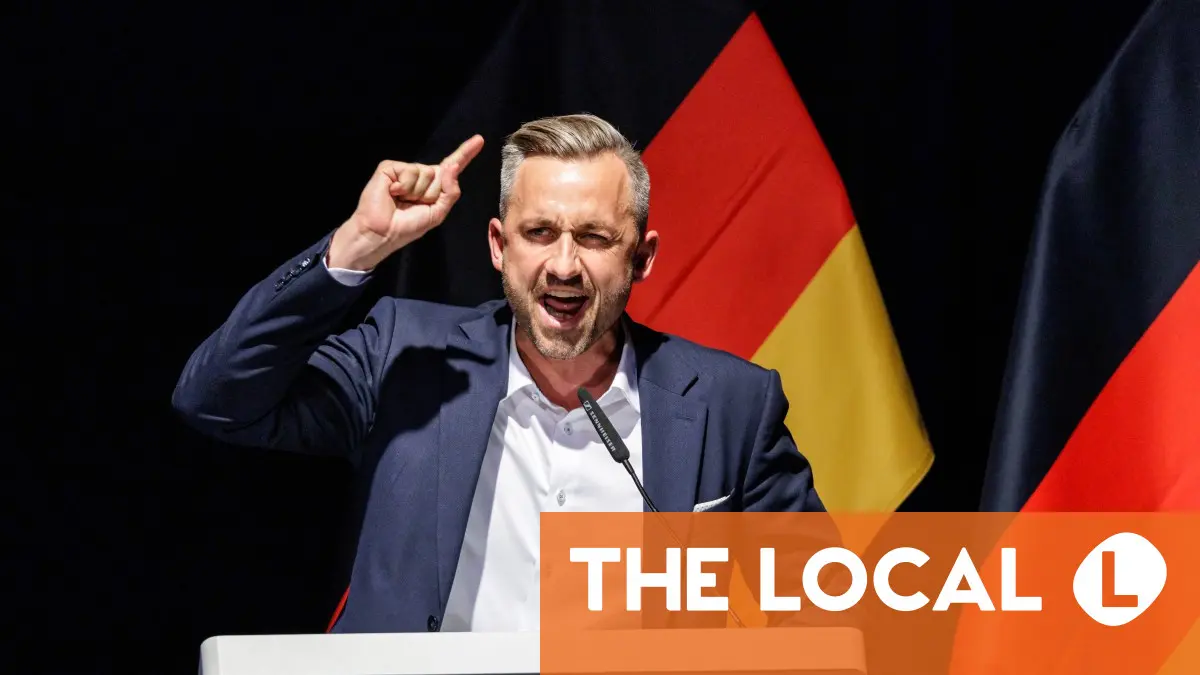
The leader of the far-right Alternative for Germany (AfD) in the eastern German state of Saxony-Anhalt said Tuesday he hopes to become state premier in December after the party's crushing election victory earlier this month.
If Ulrich Siegmund does succeed in becoming the state's leader, it would be a first for the AfD and the first time any far-right party has held such a position in post-war German history.
READ ALSO: What happens next after the AfD's win in Saxony-Anhalt?
Siegmund told Welt television station that "we will stick to this timetable" of December after discussions within the party and with other state lawmakers who will choose the next head of the state's government.
The parliamentary vote to elect a state premier is held by secret ballot and can include up to three rounds of voting.
The AfD emerged as the strongest party in the September 6th state election, winning 43.8 percent of the vote and 39 seats – falling just three seats short of an outright majority and well ahead of the CDU on 17.2 percent.
Most German political parties have maintained a "firewall" against the AfD, refusing to enter coalitions with it.
However, the small left-wing, pro-Russia BSW party, which has five state MPs, has agreed to discuss some form of co-operation with the AfD in Saxony-Anhalt.
The parties are currently holding exploratory talks about policies that could be implemented by an AfD-led minority government.
READ ALSO: 'Why is the AfD so popular?' - Your questions answered on the far right threat in Germany
The SPD, Greens, The Left and BSW have also held initial talks about possible alternatives, including a non-partisan state premier, and plan to continue discussions after the state parliament's first session on October 6th.
The CDU has said it sees itself in opposition and previously rejected an invitation from the SPD.
However, the first test of cooperation between the AfD and BSW is on the horizon, when AfD politician Tobias Rausch is due to stand for election as state parliament president. The BSW previously signalled it would support the AfD in this role.
READ ALSO: 'I feel unsafe': Foreigners in Germany react to AfD win in Saxony-AnhaltMinisters' meeting showed Russia 'not interested' in serious talks, says Merz
German Chancellor Friedrich Merz said this week that Russia's reaction to the recent meeting of the two countries' foreign ministers showed Moscow was not ready for meaningful negotiations to end the war in Ukraine.
"Russia's subsequent assessment of this conversation has shown that Russia is obviously not interested in serious talks at all at this point in time," Merz told a Berlin press conference.
On Saturday Russian Foreign Minister Sergei Lavrov spoke to his German counterpart Johann Wadephul at the United Nations in New York, the first such meeting since Russia's full-scale invasion of Ukraine began in February 2022.
German diplomats said that Wadephul used the conversation to call on Russia to "abandon its dangerous path of escalation vis-a-vis Germany, Europe and NATO" and made clear "Germany's resolve to support Ukraine".
Lavrov later used a speech to the UN General Assembly to accuse Europe of blocking efforts to resolve the conflict and insisted the "aims of the special military operation will be achieved", using Moscow's terminology for the conflict.

Berlin's Philharmonie due for €800 million upgrade
Berlin's Philharmonie concert hall could be in line for a major renovation in the coming years.
A feasibility study commissioned by the Berliner Philharmoniker found that the building needs extensive upgrades to its fire safety systems, climate technology, cabling and plumbing.
The concert hall, which was designed by architect Hans Scharoun and opened in 1963, has never undergone a large refurbishment.
The renovation could keep the Philharmonie closed from 2032 until 2040, meaning the orchestra would need a temporary home for several years.

The study estimates that the former Tempelhof Airport could serve as an alternative venue, at an additional cost of around €350 million, bringing the total estimated cost of the project to €1.15 billion.
Other options, including the former ICC congress centre and a newly constructed venue, are also being considered.
However, funding for the renovation has not yet been fully secured. The federal government has pledged up to €225 million through its capital city financing agreement, while €350 million has been included in Berlin's investment budget.
Philharmonie director Andrea Zietzschmann has called for a decision within the next six months to prevent further delays.
Amazon to hire 13,000 seasonal workers in Germany
Online retailer Amazon is set to hire 13,000 seasonal workers in Germany to work in the last three months of the year.
Amazon wants to ensure that customers "receive their Christmas orders quickly and reliably," the company said on Tuesday. In 2025, the firm took on 12,000 seasonal workers.
The firm has been preparing for the holiday season since July. Deliveries are organised across nearly 24 logistics centres, nine sorting locations, and more than 70 distribution centres.
According to Amazon, seasonal workers earn at least €16.22 per hour. At the logistics sites, the average wage is €16.66 per hour. The company also offers workers bonuses, employees discounts and subsidised meal options.
However, Amazon has come under fire in the past over its treatment of workers, including in Germany.
Trade union Verdi has repeatedly called for collective bargaining agreements to be introduced – a step that the company has not agreed to.
World's tallest wind turbine in Germany reaches full height
A wind turbine being built in eastern Germany reached its full height of 365 metres (1,197 feet) Tuesday, making it the world's tallest, according to the company that built it.
The developer Gicon, which plans to put the turbine into operation in November, said that the height was achieved with the "extension of the turbine's inner tower" using a special cable lifting system.
It means the turbine in Schipkau, Brandenburg state, now with its rotor blades attached, is the second-highest structure in Germany, just three metres shorter than Berlin's TV Tower.
The turbine is designed to harness stronger and more consistent high-altitude winds to generate twice as much energy as a conventional wind turbine, according to Gicon.
Built among around fifty similar turbines on the Schipkau wind farm, established in 2000, the giant turbine is expected to supply electricity to 7,500 households, a manager told AFP during a site visit earlier this year.
With reporting by AFP