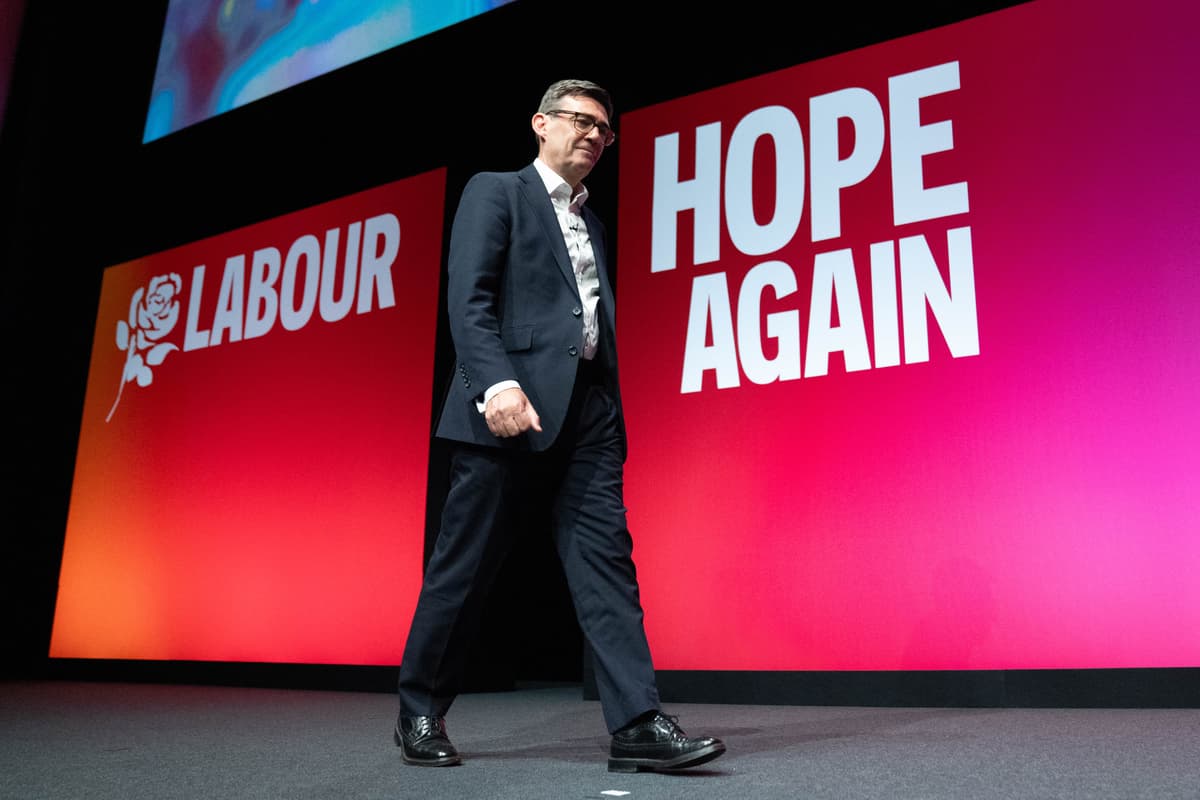
Andy Burnham expected to tackle pensions triple lock in first Labour conference speech as Prime Minister
Andy Burnham will pledge to tackle the issues politicians “usually avoid” in his first leader’s speech at the Labour Party conference amid mounting speculation the pensions triple lock could be reformed to fund social care.
The Prime Minister is expected to use his address to set out a new course for a “Britain where people feel the country has their back again”.
He will flesh out his plans for free social care in England, promise measures on youth unemployment and public control of utilities – with a pledge to hold an “honest conversation” about tough issues.
Echoing the Liverpool conference’s slogan of “Hope again”, Mr Burnham will tell party members that “hope comes from honesty and from saying the things politicians usually avoid”.
He will also announce a new publicly-owned “Great British Grid” in a bid to bring UK energy costs down in line with European nations within a decade.
Social care is likely to feature prominently in the speech, with the Prime Minister suggesting on Monday he would set out more detail of his plans to fund reform of the system.
Mr Burnham has previously said he intends to spend what “political capital” he has on reforming social care, an issue he tried to address as health secretary under Gordon Brown.

Those proposals, which would have seen care funded by a levy on estates, was condemned by opponents as a “death tax” and foundered after Labour’s defeat in the 2010 election.
But change will not come before the next election, with Baroness Louise Casey still to publish the findings of her review of social care and Mr Burnham suggesting he would put his proposals to the public in Labour’s next manifesto.
Ministers have refused to confirm Labour’s commitment to the triple lock – which guarantees that pensions will rise in line with inflation, 2.5 per cent or average earnings, whichever is the largest increase – will be in that manifesto.
That has fuelled speculation that a change in the way pensions are increased to a less generous system could be used to partly fund the cost of free social care for adults in England.
Chancellor John Healey told the BBC: “The manifesto will be the manifesto at the time, I’m not going to do that now, but I think what people will see from the Prime Minister is not just a vision for the future, but an argument about why we must act.”
Speaking on BBC Newsnight, Business Secretary Jonathan Reynolds said: “We have a commitment in our manifesto, we’re sticking to that commitment, we’ve stuck to it to date, that is the right thing to do.
“It’s… right to give pensioners that reassurance that that pledge remains but of course we also have a Prime Minister who again is going to talk about a range of things tomorrow.
“We’re all very much waiting to hear that but if anyone thinks this is a Prime Minister not willing to tackle big issues they’d be wrong in that.”
Housing Secretary Angela Rayner praised Mr Burnham for being willing to stake his political reputation on fixing a social care system in England which leaves people facing a “lottery” at the end of their lives.
She said families faced a lottery over “which way to die is the better way” and Mr Burnham was right to stake his political future on addressing it.
“He’s saying that this lottery at the moment of ‘which way would you like to die’ is not OK.
“He’s making it really clear that people are paying at the moment, and it is a system that we’ve got to ask ourselves: Is this what we want for our loved ones? And is this value for money, is this fair on individuals? Is it fair on the taxpayers?”
She told a live recording of Sky’s Electoral Dysfunction podcast that Mr Burnham was aware of the criticism he would face – his previous attempt to reform the system during Gordon Brown’s premiership led to claims he was planning a “death tax”.
Ms Rayner said: “We’ve got a prime minister who said ‘I am okay with burning through all my political capital to the point where it might finish me off on the basis that my legacy will be something better and different’.”
Changing the triple lock has long been seen as off-limits for politicians because of the risk of losing the votes of pensioners, despite warnings from economists that it is unsustainable with an ageing population.
But Ms Rayner suggested pensioners could be sympathetic if they knew where the money was going instead.
“The high principle on this is that people have paid in all their lives. They are willing, I think, to look at that.
“But what they don’t want is what they consider to be, quite frankly, incompetent politicians that are going to take something from us to fill a black hole.
“If they can see that this is going to improve and and move it into a way that delivers, so you’ve got a retail offer of ‘that’s no longer fit for purpose, but we can either do something for the younger generation because of the intergenerational disparities, or something on social care or whatever’, I think they would they would be willing to have a conversation.”