Tuesday's top story:Left Party accuses Government of smear campaign
Germany’s Left Party has launched legal action against a second federal minister, escalating a bitter political row over allegations of antisemitism following the party’s recent election victory in Berlin.
Party co-chair Ines Schwerdtner accused members of Chancellor Friedrich Merz’s government of conducting a “campaign by any means necessary” against the Berlin branch of the Left Party.
The party had already filed a complaint against Interior Minister Alexander Dobrindt after he appeared to endorse a television host’s mistaken description of Berlin Left leader Elif Eralp as an antisemite during a live broadcast.
The party is now also pursuing legal action against Economy Minister Katherina Reiche over comments in a video shared through her ministry’s social media channels. Reiche criticised a Berlin political movement she said tolerated antisemitism and supported housing expropriation, remarks Die Linke believes were directed at the party.
The dispute comes amid heightened scrutiny of the Left Party after its strong showing in Berlin’s state election and efforts to form a coalition government. Schwerdtner argued that unfounded accusations risk undermining the fight against genuine antisemitism.
READ ALSO: What does Die Linke's election win mean for foreigners in Berlin?German wholesale retailer Metro’s Russian operations seized by authorities
Russian authorities have placed the Russian business of German wholesale retailer Metro under state-appointed management, marking the latest move against foreign-owned companies from countries supporting Ukraine.
A decree signed by President Vladimir Putin transferred the management of Metro Cash & Carry’s Russian operations to a company known as UK Torg RUS. The decision follows similar action taken earlier this month against the Russian assets of Swiss food giant Nestlé and French retailer Auchan.
Metro said it formally remains the owner of its Russian subsidiary but no longer has operational control over the business and is assessing the implications of the move. The company reported Russian sales of €2.6 billion in its 2024-25 financial year, highlighting the market’s continued importance to the group.

The seizure forms part of a broader trend since Russia’s invasion of Ukraine, with Moscow increasingly restricting the ability of Western firms to exit the country and, in some cases, taking control of their assets outright.
Many international companies withdrew from Russia after the war began, while others maintained limited operations, citing concerns for employees and customers. Moscow’s latest action is likely to deepen uncertainty for foreign businesses still operating in the country.
READ ALSO: Moscow seizes Russian assets of German food retailer MetroWomen retreat from online life as fears over digital abuse grow
A growing number of women in Germany are changing their online behaviour due to concerns about digital violence, according to a new survey that highlights increasing fears over image-based abuse, deepfakes and online harassment.
The representative study, commissioned by the German Women’s Council, found that 67 percent of women avoid sharing photos, videos or personal information on social media to reduce the risk of misuse.
Nearly two-thirds said they deliberately limit certain online activities, with the figure rising to 76 percent among women aged 18 to 39.
READ ALSO: Oktoberfest ride linked to thousands of suspected illegal ‘upskirting’ videos
The research suggests concerns are being driven by widespread experiences of digital sexual violence. Fourteen percent of respondents reported that intimate images of them had been distributed without consent, while 13 percent said they had encountered sexually explicit deepfakes or AI-generated images.
Among younger women, the proportion reporting deepfake-related experiences rose to 21 percent.
Nine in ten women surveyed called for stronger legal protections against image-based sexual abuse and more effective action against anonymous offenders.
Care sector demands rethink of Germany’s reform plans
Germany’s nursing sector has called for major changes to the government’s proposed long-term care reforms, warning that planned spending cuts could undermine support for vulnerable people and worsen staff shortages.
The German Nursing Council has criticised proposals from Health Minister Carsten Linnemann aimed at stabilising the finances of the country’s long-term care insurance system.
Council president Christine Vogler said higher barriers to accessing care services and plans to abolish relief payments for those with the lowest level of care needs would place additional burdens on patients and families.
The organisation also warned that proposals affecting pay and working conditions could deter staff from remaining in the profession. Vogler argued that limiting future wage increases and suspending collective bargaining arrangements would threaten the stability of care provision at a time when the sector is already struggling to recruit and retain workers.
READ ALSO: Long-term care reform plans spark widespread backlash in Germany
The intervention comes amid an escalating dispute within Germany’s governing coalition. While the CDU supports reforms designed to curb costs, the SPD has vowed to resist what it describes as a purely austerity-driven approach.
The Nursing Council is also calling for greater public funding of training and family caregiver support, arguing that long-term care should be treated as a responsibility shared by society as a whole.
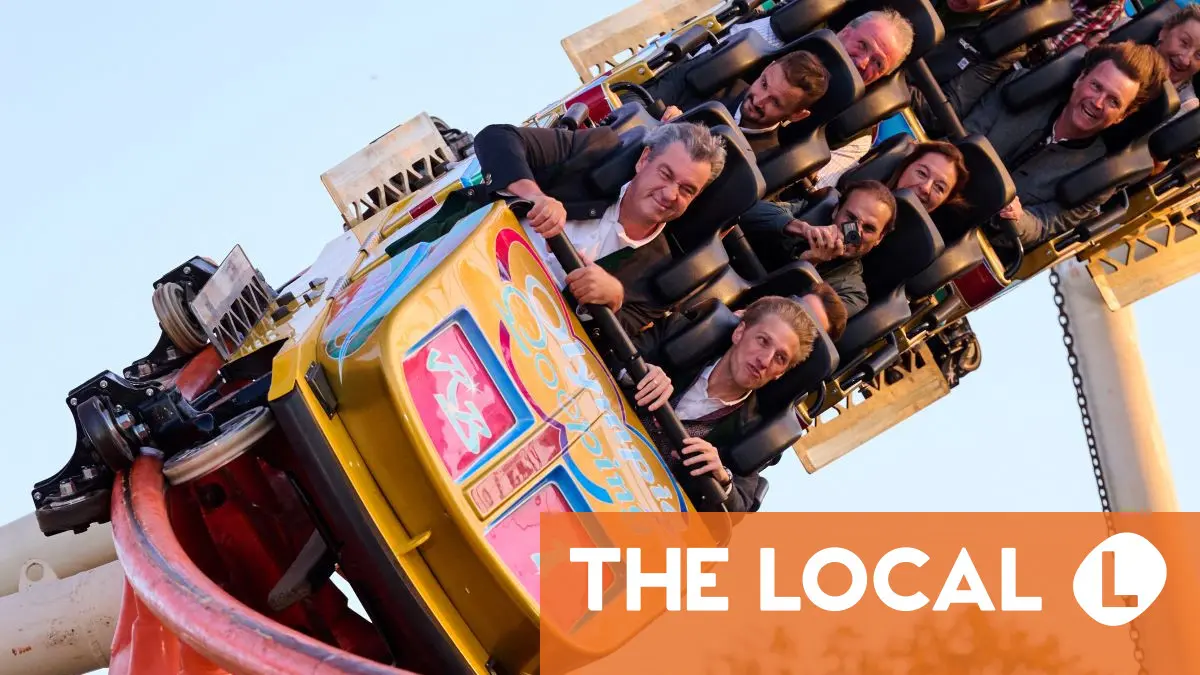
Söder and Munich mayor celebrate Olympic bid victory with roller coaster bet
Bavarian Premier Markus Söder and Munich Mayor Dominik Krause honoured a political wager by taking a ride on the famous “Olympia Looping” roller coaster at Oktoberfest after Munich was selected as Germany’s candidate for a future Olympic Games.
The pair had promised to brave the high-speed attraction if Munich won the national selection process. Their bet came due after the German Olympic Sports Confederation (DOSB) chose Munich over the Cologne/Rhine-Ruhr region to represent Germany in the race to host the 2036, 2040 or 2044 Summer Olympics.
Under the gaze of cameras and festival-goers, the CSU leader and Green Party mayor boarded the roller coaster, which features five loops, reaches speeds of more than 90 kilometres per hour and rises over 30 metres above the Oktoberfest grounds.
Both emerged smiling from the ride, with Söder giving a thumbs-up and joking that “once is enough”. However, he hinted there could be further celebrations if Munich ultimately secures the Olympic Games.
The stunt highlighted a rare moment of cross-party unity as Munich begins its international campaign. The city now enters discussions with the International Olympic Committee as Germany seeks to bring the Summer Olympics back for the first time since the 1972 Munich Games.