Nepal floods remind us of the need to recognise the reality of other people’s lives - Dr Nazanin Shiraj
Just one month ago, Nepal’s devastating floods dominated news bulletins and social media feeds around the world. Now, mostly, those reports have been overtaken by other events. When the flash floods struck on August 26, many of us witnessed the destruction and disaster unfold in real time, something that would once have been impossible.
But however close the disaster may have felt, for most of us it was still taking place on the other side of a screen.
Disasters no longer seem quite so distant in an age of social media and live streaming. Social media has become a kind of portal through which we can witness tragedy unfolding across the world. And this creates a paradox.
Because we can see what is happening, we assume that we understand it. Yet there remains an important distance between witnessing a disaster and living through one.
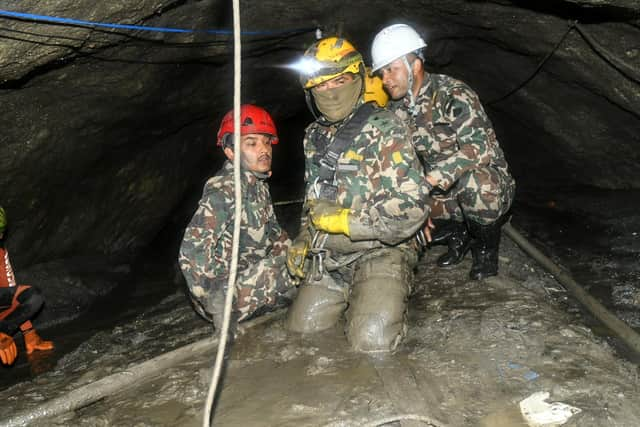
One of the difficulties in understanding disasters such as the flash floods in Nepal is that we often underestimate the invisible infrastructure that supports our everyday life. Those of us living in relatively secure societies exist within layers of infrastructure that we rarely have reason to notice.
There is physical infrastructure: clean water, clothing, shelter and sanitation. There is social infrastructure: functioning institutions, public services, family networks and systems of support.
And there is what we might think of as psychological infrastructure: the expectation that tomorrow will bear some resemblance to today; that we will not go hungry; that our home will still be there; and that the people we love will still be with us.
These forms of security are often invisible precisely because they are ordinary. Disaster makes them visible by taking them away.
We have seen footage and accounts of Nepal survivors saying that they wish they had died because continuing to live with such misery, loss and financial debt feels even more intolerable than death. Some have even spoken of envying the dead. From the affluent side of the world, we might think that we understand their suffering.
Perhaps the recent discussions around women’s sanitary products in Nepal offers a small window into just how psychologically distant we may still be. From the outside, providing sanitary products to women affected by disaster seems an obvious and helpful intervention.
But how often do we stop to consider the conditions that must already exist for those products to be usable? That is why it can be so startling to hear a female survivor ask, “how can I use sanitary products when I don’t have undergarments?”
A sanitary product does not exist in isolation. Its usefulness depends upon other things: underwear, access to clean water, privacy and some means of safe disposal. In more affluent societies, these conditions are so ordinary that we barely notice them. We see the sanitary product but not the infrastructure that makes its use possible.
This is where the psychological distance between the two sides of the portal becomes visible. We see someone receiving sanitary products and can immediately construct a reassuring humanitarian narrative: a need has been identified and something has been provided to address it.
Now that social media has brought Nepal’s disaster into our living rooms, perhaps the challenge is not simply learning to care about people on the other side of the portal. It is recognising how much of their reality remains invisible to us from the other side of the portal.