Firbeck, South Yorkshire: Classic case of a village with history
Named after a woodland stream, the village of Firbeck ranks among South Yorkshire’s most rural and remote villages, with the former mining town of Maltby three-odd miles to the north-west being its nearest urban centre.
Nevertheless, the village boasts impressive road connections to its north, east and west with the A1, M1 and M18 all passing within five miles.
However, it is Firbeck’s Classic horseracing connections, due to its most famous resident, Anthony St Leger, has meant for most of the past 250 years it has most closely been associated with Doncaster, 12 miles to its north.
The anniversary of the St Leger race this month has thrust the peaceful village into the spotlight and to mark the occassion Country Post revisited Firbeck.
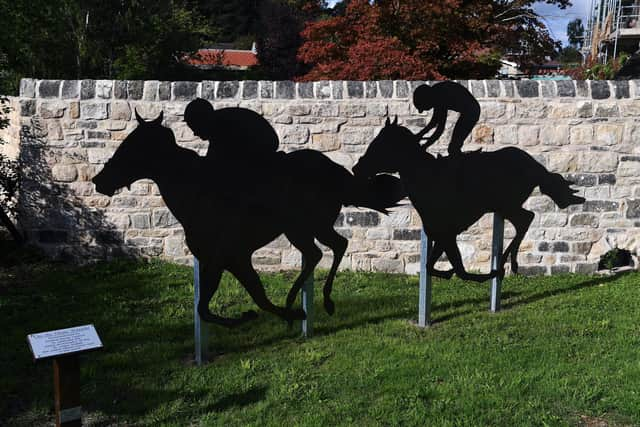
Firbeck Parish Council has realised a long-held ambition among villagers to underline its links with the oldest Classic race by commissioning a bronze horse sculpture On The Home Straight.
The artwork, depicting jockeys aboard horses galloping past a stone wall towards a field known locally as Long Close, has ben unveiled on a grass verge off Kid Lane, at the one-time entrance to the 18th century Irish-born lieutenant-colonel’s home, Park Hill House.
While it is understood St Leger created a racecourse in an oval-shaped field just outside the village, little, if any, physical evidence of the track for the horses he bred at his stud on the estate, south of Firbeck, remains.
Although some have suggested St Leger staged the first editions of the world's first horseracing Classic in the village, turf historians have concluded rather than hosting it the innovator helped stage the two-mile race for three-year-olds on Cantley Common in 1776, before it moved to its present location on Town Moor, Doncaster, two years later.
A blue plaque commemorating the founder of the St Leger Stakes, an Eton-educated army officer who went on to be governor of St Lucia and MP for Grimsby, was unveiled by five-time winner of the race Frankie Dettori at Firbeck’s village hall in 2012, two years after the community hub was renovated using grants secured from the Big Lottery Fund.
The array of activities and groups, ranging from table tennis and bowls to the Yorkshire Countrywomen’s Association, the hall hosts underlines the close-knit nature of the community as do the regular events it hosts, such as the popular bi-annual Scarecrow Festival.
The village hall also boasts another blue plaque, honouring botanist Hewett Cottrell Watson, who was born on the Park Hill Estate in 1804.
Watson, who sketched out the locations of some 1,400 species of plants, exchanged ideas with Charles Darwin and is said to have contributed to the Theory of Evolution.
Although St Leger’s home, Park Hill House, an Elizabethan farmhouse featuring two Georgian wings, was demolished in 1935, the 1740-built Park Hill Cottage, which sits behind a tree-lined drive off Park Hill Drive, formed part of his family residence.
The surrounding fields have long since reverted to farmland, but horses are still kept nearby and the sound of hooves at the heart of the village, where its main thoroughfare, New Road, meets Kid Lane and Park Hill Drive, is not uncommon.
It is here that St Leger, who is also credited coming up with the idea of using bone residue as fertiliser to enhance soil quality, is further celebrated with a beautiful village sign. Hand-painted by villagers it features a depiction of an early edition of the race and on the other side a ploughman and RAF Firbeck.
The village’s agricultural heritage is marked by the striking building late 16th century Manor Farmhouse in the centre of the village, just to the north stands the impressive Firbeck Hall, which dates to 1594.
The hall was extensively remodelled in the mid-18th century and substantial additions in the 19th century gave the building an Elizabethan appearance with the addition of Ogee Gables to the roof.
The mansion house, built by Rotherham-based lawyer William West, has been given an £11m revamp and converted into flats, marking the latest chapter for the building which was altered in the 19th century by another Eton alumni, writer Henry Gally Knight, who drew praise from Lord Byron for some of his verses.
Regarded as a kind landlord, in 1841 Knight was presented by his tenants with his portrait, painted at a cost of 250 guineas, which is the equivalent to about £13,000 in today’s money.
He was buried in the St Martin’s Church in the village, outside which stands a monumental gravestone to his family, one of just five that lived there before Firbeck Hall was gutted by a fire in 1924.
A church has existed on the site since at least the 15th century, when it was one of a number of churches placed under the ecclesiastical authority of York by Archbishop Thomas Rotherham, but the current structure dates to the 1820s.
It features several fine stained glass windows and interesting hatchments and monuments, including some to the St Leger family.
A decade after the devastating fire Firbeck Hall was transformed into one of Europe’s most exclusive country clubs, whose visitors included the future King Edward VIII, by Sheffield stockbroker Cyril Nicholson.
There was also an 18-hole golf course, championship-standard squash courts, a restaurant and a riding school where several first-class hunters and hacks were stabled, a cocktail bar and even an aerodrome, used by the likes of Amy Johnson, behind where the Black Lion pub and a row of 1960s houses now stand.
The pantile-roofed pub on a crook in New Road continues to serve as an important community venue, hosting events such as quizzes in its bar with a log fire, and has been named among the finest of gastropubs.