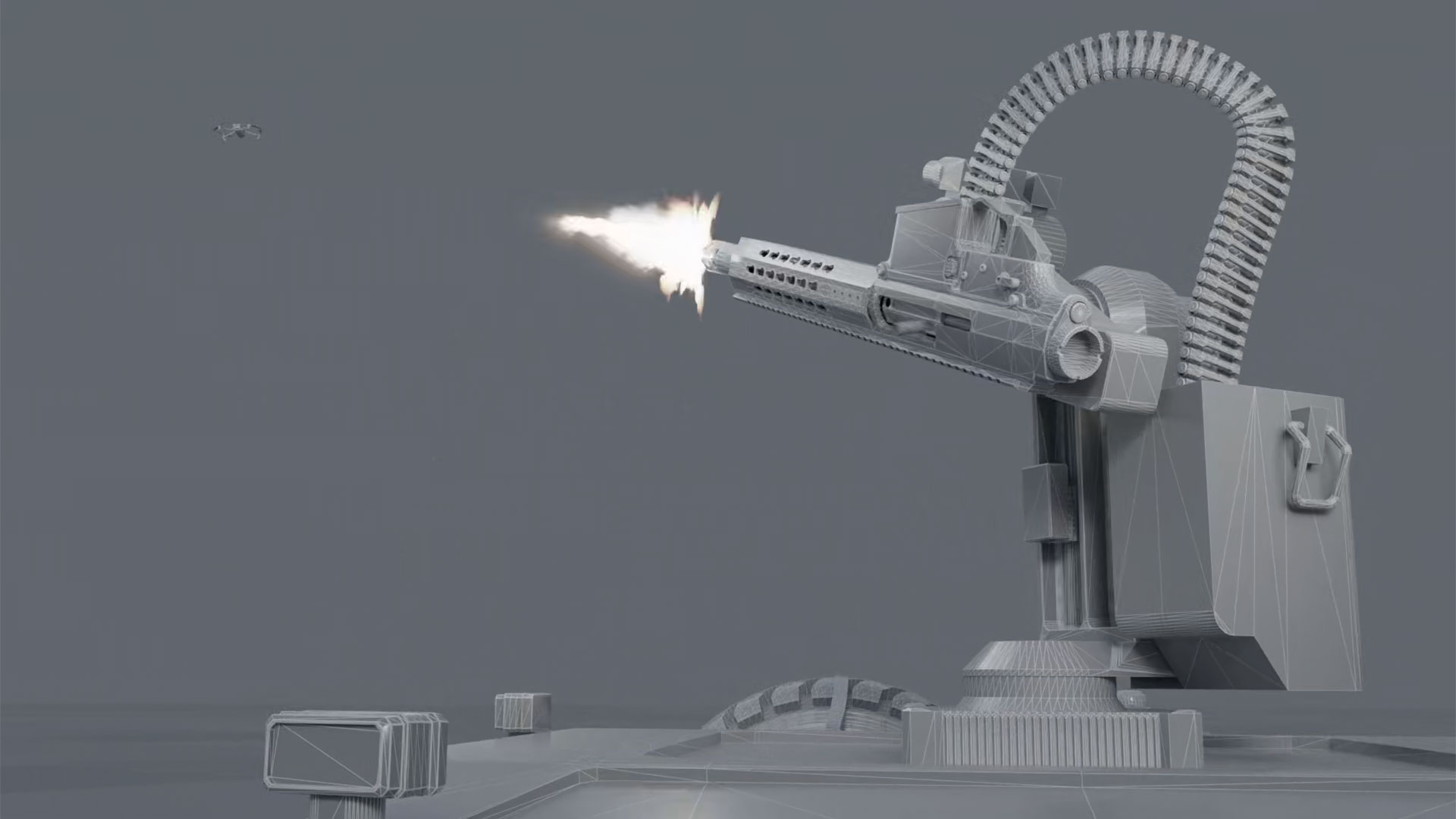
The U.S. Army tested an autonomous breaching vehicle with an onboard counter-UAS (C-UAS) turret during a live-fire exercise at Fort Bragg on August 18. As part of Project Sandhills 2.0, self-driving Ford F-250 trucks were put through their paces, some armed with computer-controlled drone-killing shotgun turrets.
Sandhills 2.0 builds on the original Sandhills project which spawned the Lancer UGV, built on the Polaris Ranger 1500 utility vehicle, which ended up being gifted to Ukraine. However, this new breaching solution adds C-UAS abilities to bolster their abilities to clear the way for human soldiers to advance. Breaching operations can be seriously compromised by a determined enemy using increasingly common FPV drone technology and this fact inspired the changes delivered in Sandhills 2.0.

The vehicle chosen for Sandhills 2.0 was a self‑driving Ford F‑250 truck, equipped with Forterra’s AutoDrive system. Ford’s readily available spares should make the F-250-based system easier to maintain and repair, reckons Forterra’s VP of defense. That is another important factor the designers weighed, for this latest iteration of a viable U.S. Army autonomous breaching vehicle.
Meanwhile, the Edda counter-unmanned aircraft system turret (built by Austin-based 9 Mothers) takes care of fast-moving drone threats of 7-inch diameter or larger, at ranges between 10 to 100m (33 to 328 feet). The source report notes that the turret weighs around 23kg (50 pounds).
Interestingly, the turret first detects incoming drones acoustically before an onboard visual tracking system locks on. This methodology prevents the F-250-based system from being easily detectable by advanced enemy drone sensors, suggests the source report. Finally the shotgun-armed Edda engages the enemy drone. According to 9 Mothers published data the Edda turret is an “ultra-fast, ultra-light, ultra-accurate motion platform — 5° in under 15 ms at 1.5 arcminute precision.” We would welcome some test data, though – like what percent of drones get destroyed in one shot, the maximum speed of drones that Edda can engage, or how many drones it can handle per minute.
FollowTom's Hardware on Google News, or* add us as a preferred source**, to get our latest news, analysis, & reviews in your feeds.*
Get Tom's Hardware's best news and in-depth reviews, straight to your inbox.

Mark Tyson is a news editor at Tom's Hardware. He enjoys covering the full breadth of PC tech; from business and semiconductor design to products approaching the edge of reason.
so who wants to tell em?Reply blasting drones willynilly isnt always gonna be a good thing when they start making drones carry toxic stuff that is then scattered on the public populace when exploded?
Reply We could tell them, but would they listen? I doubt they even care about that specific concern due to what their actions tell us.hotaru251 said:so who wants to tell em? blasting drones willynilly isnt always gonna be a good thing when they start making drones carry toxic stuff that is then scattered on the public populace when exploded?
Reply Chemical weapons.hotaru251 said:so who wants to tell em? blasting drones willynilly isnt always gonna be a good thing when they start making drones carry toxic stuff that is then scattered on the public populace when exploded? That has been a possibility for 100+ years.
People and armies generally don't do that for 'reasons'.
Reply The 1925 Geneva Protocol and 1993 Chemical Weapons Convention both made the use of chemical and biological weapons a war-crime.USAFRet said:Chemical weapons. That has been a possibility for 100+ years.
People and armies generally don't do that for 'reasons'. Seeing as how the US likes to invade when WMD are involved, most countries don't use them.