York and North Yorkshire look set to be almost cloud-free for tonight’s solar eclipse (Wednesday).
The Met Office is forecasting some cloud cover north of Middlesbrough, with the rest of the county enjoying clear skies.
It’s technically a partial solar eclipse that the UK will enjoy, but the Moon will obscure more than 90% of the Sun.
It will happen between 6.17pm and 8.06pm, and is the fullest above UK skies since the total eclipse in 1999.
Full details of how to watch safely are below.
Remember to never directly look at the sun, even wearing sunglasses.
The sun will be quite low in the sky. So for a good view you’re best to be in a vantage spot with a clear view to the west, unimpeded by trees, buildings or other obstacles.
There are some organised viewings in the area.
The York Astronomical Society is hosting an observing event at its observatory at Beetle Bank Farm, Moor Lane, Murton, York.
Now sold out, the viewing event at the Ron Cooke Hub, University of York starts at 6.15pm and features a talk by astrophysicist Dr Emily Brunsden.
Scarborough & Ryedale Astronomical Society is setting up specially filtered solar telescopes at Oliver’s Mount, Scarborough.
How to watch safely
Can I use sunglasses to watch the eclipse?
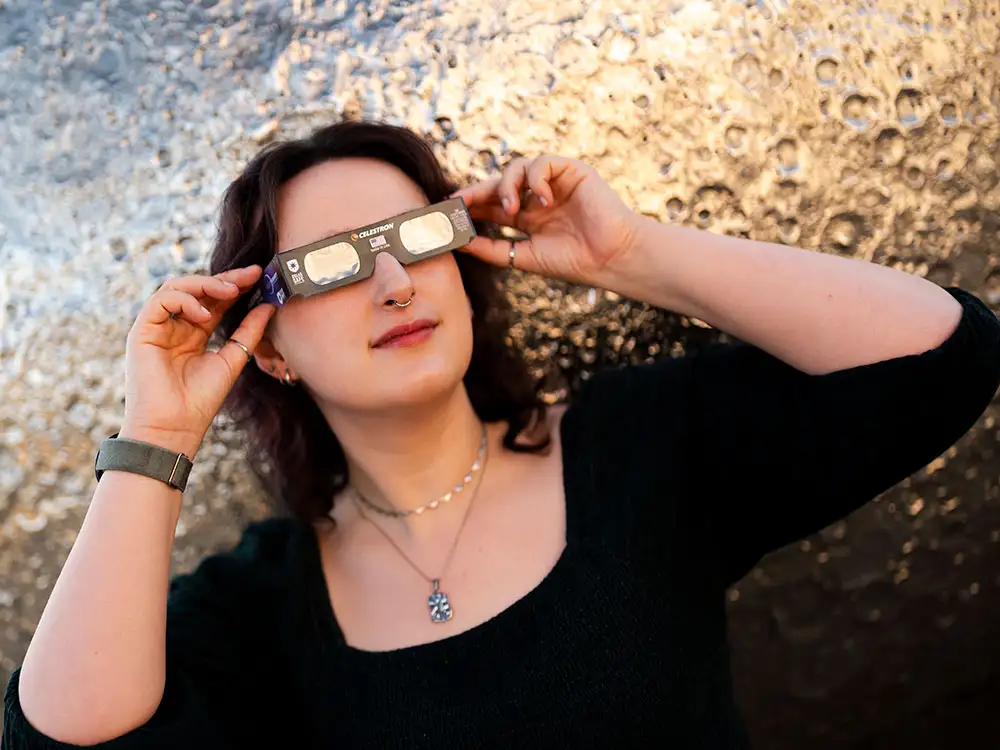
No, it is not safe to watch the eclipse using regular sunglasses. Only specialised eclipse glasses are safe to use.
According to the National Aeronautics and Space Administration (Nasa), eclipse glasses are several thousand times darker than sunglasses, meaning they are safe for viewing the Sun.
If you have a pair of eclipse glasses, Nasa recommends inspecting them for damage before using and discarding the goggles if torn or scratched.
The organisation also says you should not use eclipse glasses while looking through binoculars, camera lenses, or any other optical device, as the concentrated solar rays will burn through the glasses’ filter and could cause eye injuries.
What do I do if I cannot find eclipse glasses?
With so many looking to view the eclipse, glasses are in short supply.
If eclipse glasses are not available, Nasa suggests using indirect viewing methods. These do not involve looking directly at the Sun, but instead project the eclipse onto a nearby surface.
For example, a pinhole projector can be made using a box, aluminium foil and a white sheet of paper. By taping foil and paper to both ends of the box, then punching a hole in the foil, you can indirectly view the Sun shining through the hole onto the paper.
During the different phases of the eclipse, you will be able to see the shadow from the Moon block out the light projected onto the piece of paper.
If you do not have time to make a pinhole projector, Nasa suggests a good alternative is using a colander. By watching the shadow that the colander projects onto the ground, you can safely view the phases of the eclipse.
Can I use my phone’s camera to view the eclipse?
While using your phone’s front-facing camera to view the eclipse will not damage your eyes, it could destroy your device.
In a post on X, Nasa said that pointing your phone’s camera directly at the Sun could damage its image sensor.
The organisation added that using magnifying lenses attached to the phone camera would increase the risk of damage.
Nasa suggested using a solar filter or holding a pair of eclipse glasses in front of your phone’s lens to protect the sensor from damage.
Why is it dangerous to look at the Sun during an eclipse?
Normally when we glance at the Sun, the brightness prevents us from looking too long and damaging our eyes with solar radiation.
However, while eclipses might appear less bright, the UK Health Security Agency explains that solar radiation is just as dangerous as during any other day.
This leads to people being mistaken that it is safe to look at the Sun during an eclipse.
Mohamed Elalfy, president of the Royal College of Ophthalmologists, said: “Looking directly at the Sun during a solar eclipse can cause damage to the retina, potentially damaging the cells responsible for sharp central vision.
“Crucially, the retina has no pain receptors, so people will not feel the damage as it happens.”