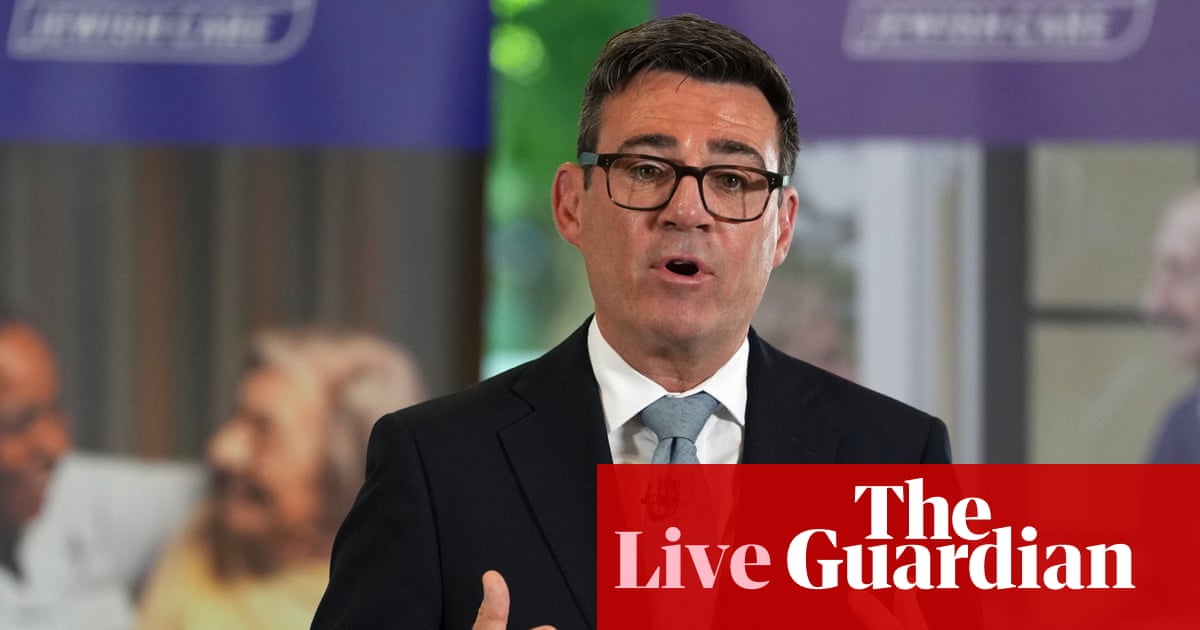
Burnham says it’s ’shameful’ politicians have failed to fix social care, as he fast-tracks Louise Casey’s review – UK politics live
‘There’s only one group really to blame, and that’s my generation of politicians,’ the prime minister says, as he reveals final recommendations will be out by summer 2027
Burnham urges media to avoid scaremongering in debate on case for NHS-type reform to protect families from huge costs
Q: [From Millie Cooke from the Independent] Do you think people should not have to sell their homes to pay for care?
Burnham said:
In an ideal world I wouldn’t want anybody, to have to sell their their home to pay for care. I think it’s a really awful process for those who live through it … I think the whole thing is horrendous for those who live through it. They see everything that their parents have worked for just whittled away in front of them, paying for care that often isn’t good enough.
So I think the system, isn’t right. And in an ideal world, no, I, I wouldn’t want to see that.
Burnham said the proposals he put forward in 2010 (see 11.23am) were designed to address that.
He went on:
If everybody, on the NHS principle, contributed a little, it would mean everyone could protect the majority of what they’d worked for.
Now I know the Mail and probably in the Telegraph doesn’t support that.
But I don’t know – do people support that?
And this is the point. What I got wrong, as I said before (see 10.51am), was going to close to a general election when there just wasn’t time for those issues to breathe.
And I do ask colleagues in the media again, can we not let the country look at this in a quite clear-eyed way without all of the the hype and the overwriting of some of these issues?
On this issue, please can we have a factual debate. Can we allow people to weigh up the different options that Louise might put forward, and then just come to a considered view based on those facts.
Is that too much to ask? I don’t think it should be too much to ask, because I think the public will give us their view. They’ll make it really clear what they feel they can accept and what they can’t.
We won’t get to that point if there’s all of this stuff swirling around, and everyone frightened about everything. That just won’t get us there.
Burnham did not rule out tax rises, but he said it was very important to him to stick to Labour’s manifesto (which did rule out raising income tax, national insurance or VAT).
Burnham says life has 'moved on' from when he proposed care levy in 2010, and 'more voluntary approach' may be better now
Q: [From Daniel Martin from the Telegraph] In 2010 you were in favour of compulsory insurance. Are you still in favour of that?
Burnham replied:
I have views that are on on the record, but life has moved on from when I was first looking at social care in 2010.
We are in a difficult world from a financial point of view.
And I would come back to what I said a moment ago. I can feel whatever I want to feel, but if I want to persuade others and get a cross-party consensus, you don’t just go in and say, ‘It’s got to be my way, and that’s it.’
Because how do you persuade people?
I think there are ways of looking at this that could include a more voluntary approach initially, or could include a roadmap to a reformed social care system.
In 2010 Burnham proposed three options for funding better social care, including a 10% levy on inheritances.
A new social care system, [Burnham] said, could be financed in one of three ways.
One, people could decide to defer retirement to 68 and use their pension contributions for three years to pay for a care fund. Two, people could pay in instalments in the run-up to retiring at 65. Three, an estate levy could be deducted from the property of older people when they die.
Health department officials said that they were looking at a levy rate of 10%. “This is not a flat fee and would enable people to protect 90% of their homes and savings,” Burnham told the conference. He said the levy would be “progressive” as the millionaire would pay more than the ordinary pensioner.
Burnham says social care in England 'as unfair as American healthcare'
Q: [From Sky’s Sam Coates] People can only get funded care if their assets are worth less than £23,250? Do you think that figure is too low?
Burnham says under the current system people can end up paying hundreds of thousands of pounds because they have to spend it on care. It is like a “roulette table”.
I think social care in England is as unfair as American healthcare. The vulnerable pay with everything and it can completely leave them with nothing.
And that floor has been in place for a long, long time.
Burnham says the Dilnot report 15 years ago looked at a solution to this.
He goes on:
But it’s not the case that the funding and the paying for social care is the only issue.
As I’ve said before, [there is] a whole other set of issues here that have to be that have to be considered.
Burnham also says:
We do have to be sure that there isn’t profiteering in the system. I think that is where we absolutely draw draw the line.
There are good organisations in all sectors, but what we cannot accept is money being taken out.
And we actually do see that happening, not just in adult social care, we see it in children’s social care too.
Burnham does not rule out tax rises for social care reform, but says current inefficiencies should be tackled first
Q: [From ITV’s Rebecca Barry] Can the government realistically reform social care without raising taxes?
Burnham says existing resources can be used more effectively.
I think more is possible from within existing resources. And the things that I’ve talked about today, particularly around the workforce, will be fully funded.
I think it is possible from existing budgets to do much more.
I mentioned that whole thing of people coming into hospital unnecessarily from social care settings, then having a long stay in hospital as a result of that unnecessary admission, and then a long period where they’re medically fit to leave, but can’t, because the care is not available. Now, that very last bit has been [estimated to cost the NHS] £2.5bn a year.
If you add all of it up, you are talking several billion pounds a year is lost from the lack of a preventative front-end social care service that’s well supported.
Burnham says government needs to address these problems “before we talk about tax rises”.
But Burnham goes on to say:
I think Louise [Casey – see 10.18am] indicated some of what we would want to in the fullest sense will require difficult decisions.
He goes on:
But we will be honest with people about those. We will put them before the country at the right time, and we will hopefully proceed with people’s consent.
Burnham says he's doing social care reform now because he does not want to leave it until close to election
Burnham is now taking questions.
Q: [From Alison Holt from the BBC] We have had cross-party talks before. What will be different this time? Are today’s talks just a show? And can you get change before the election?
Burnham says his experience as health secretary in the 2005-10 parliament convinced him they left reform too late in that parliament.
He thinks it is better to do it sooner.
He goes on:
That answers another story from the media, doesn’t it? That there’s no election on the horizon.
I think it’s best to deal with it, early and to listen.
As for the talks today, he says he is holding them because Kemi Badenoch and Ed Davey wrote to him asking if he would engage.
Burnham says he would 'never forgive myself' if he let 'screaming headlines' put him off trying social care reform
Burnham ends by saying he won’t be put off by negative headlines.
I’m not going to be deflected by the point scoring or the screaming headlines that comes out of that point scoring. That is what has set back social care.
And I come back to this point about the political culture of this country and the media culture of this country.
If we’re trying to shut down the fact that you have a serious debate about an issue like this, if that’s what that is trying to do, well, it’s shame on all of us if we say, ‘Well, I’m not brave enough then to go into that.’
Well, I’m just not going to do that in my time in office … I would never forgive myself.
Who knows how long I will be in this position, but as long as I am, I will do my best to find a solution.
Burnham says he agreed with what Ed Davey said in his Today interview this morning about the pressures carers are under.
We see people struggling in in their homes looking after a partner or a relative.
It can break people if they’re kind of left without that support that they need.
In fact, it does break people, and that needs to be recognised.
It needs to be recognised that people can see everything they’ve worked for wiped out by the costs of care. Hundreds of thousands of pounds can just disappear paying for care.
Adults with disabilities will say that they face very unfair care charges just to live, just to live their life. That needs to be recognised.
Burnham calls for media to be responsible in way social media crisis is reported
Burnham says this is a challenge for politicians and the media.
There is something here that is a test for the political and the media culture in this country when it comes to this issue, how it’s spoken about, how it’s reported.
It’s for everybody. Everybody needs to take on board, what is being launched today with this Big Conversation, because I think everybody needs to engage in it responsibly, needs to remember who they are talking about, what they are talking about, the people who work within it, and to do it respectfully and to do it accurately.